Sajdak Benjamin, Sulai Yusufu N, Langlo Christopher S, Luna Gabriel, Fisher Steven K, Merriman Dana K, Dubra Alfredo
Department of Cell Biology, Neurobiology, & Anatomy,Medical College of Wisconsin,Milwaukee,Wisconsin.
Department of Ophthalmology,Medical College of Wisconsin,Milwaukee,Wisconsin.
Vis Neurosci. 2016;33:e003. doi: 10.1017/S0952523815000346.
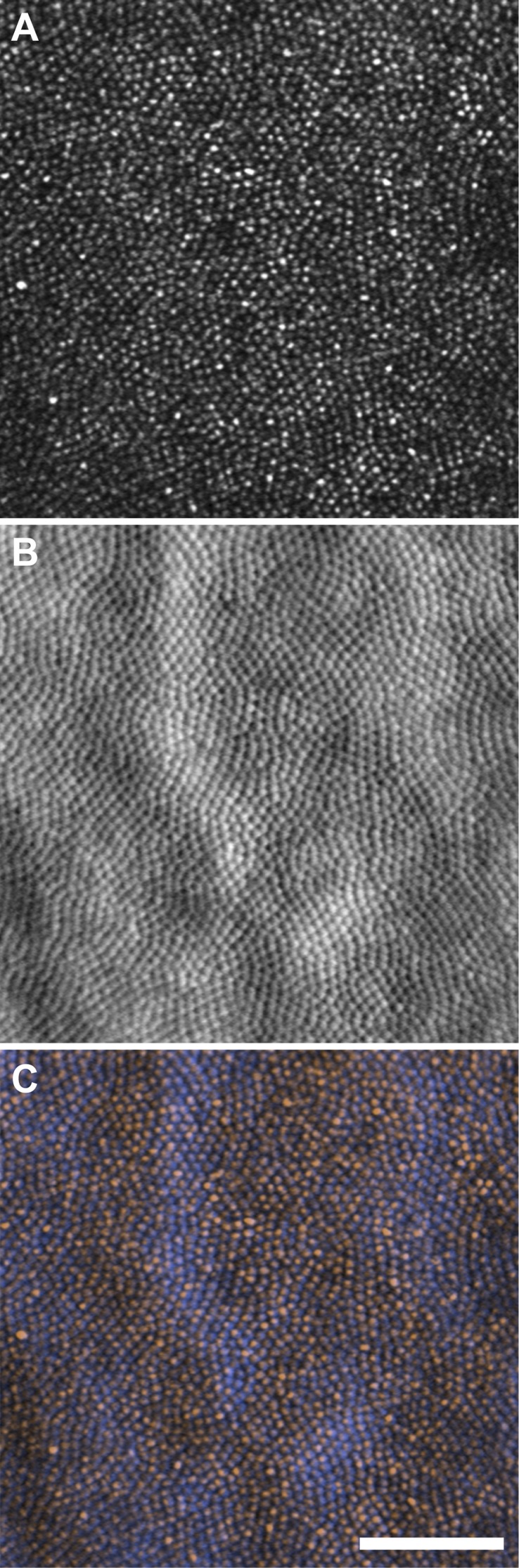
Ground squirrels are an increasingly important model for studying visual processing, retinal circuitry, and cone photoreceptor function. Here, we demonstrate that the photoreceptor mosaic can be longitudinally imaged noninvasively in the 13-lined ground squirrel (Ictidomys tridecemlineatus) using confocal and nonconfocal split-detection adaptive optics scanning ophthalmoscopy using 790 nm light. Photoreceptor density, spacing, and Voronoi analysis are consistent with that of the human cone mosaic. The high imaging success rate and consistent image quality in this study reinforce the ground squirrel as a practical model to aid drug discovery and testing through longitudinal imaging on the cellular scale.
地松鼠正日益成为研究视觉处理、视网膜回路和视锥光感受器功能的重要模型。在此,我们证明,使用790 nm光的共聚焦和非共聚焦分光检测自适应光学扫描检眼镜,可以在地松鼠(Ictidomys tridecemlineatus)中对光感受器镶嵌进行纵向无创成像。光感受器密度、间距和Voronoi分析与人类视锥镶嵌一致。本研究中的高成像成功率和一致的图像质量,强化了地松鼠作为一个实用模型的地位,有助于通过细胞水平的纵向成像来辅助药物发现和测试。