Krishnamoorthy Vidhyasankar, Cherukuri Pitchaiah, Poria Deepak, Goel Manvi, Dagar Sushma, Dhingra Narender K
Department of Ophthalmology, University Medical Center Göttingen Göttingen, Germany.
Developmental Neurobiology Laboratory, European Neuroscience Institute Göttingen Göttingen, Germany.
Front Cell Neurosci. 2016 Feb 17;10:38. doi: 10.3389/fncel.2016.00038. eCollection 2016.
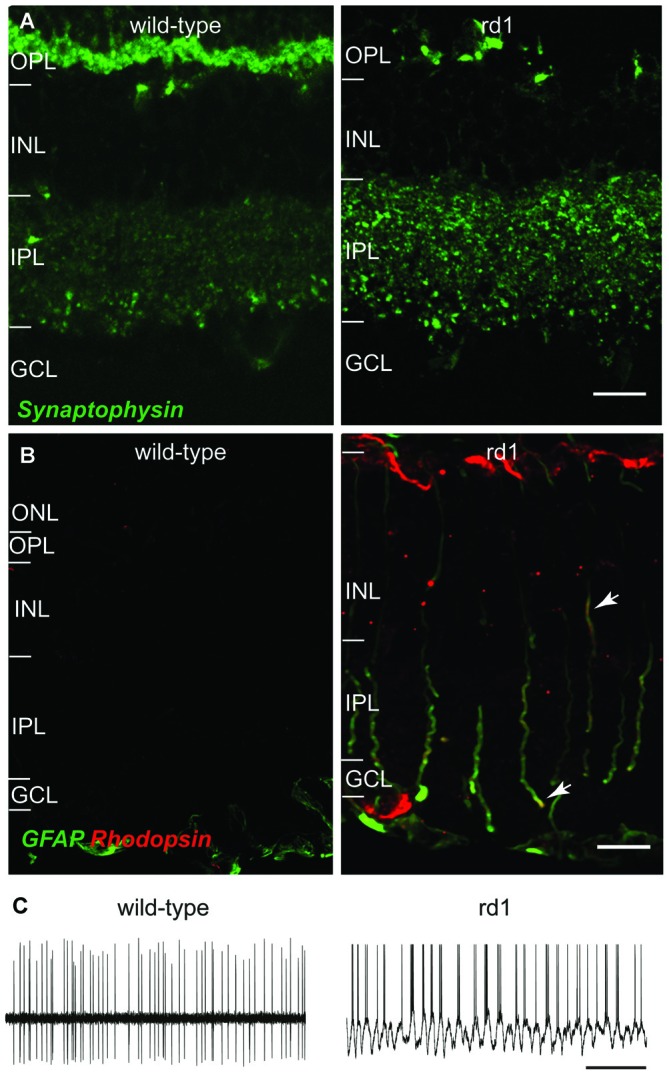
Deafferentation results not only in sensory loss, but also in a variety of alterations in the postsynaptic circuitry. These alterations may have detrimental impact on potential treatment strategies. Progressive loss of photoreceptors in retinal degenerative diseases, such as retinitis pigmentosa and age-related macular degeneration, leads to several changes in the remnant retinal circuitry. Müller glial cells undergo hypertrophy and form a glial seal. The second- and third-order retinal neurons undergo morphological, biochemical and physiological alterations. A result of these alterations is that retinal ganglion cells (RGCs), the output neurons of the retina, become hyperactive and exhibit spontaneous, oscillatory bursts of spikes. This aberrant electrical activity degrades the signal-to-noise ratio in RGC responses, and thus the quality of information they transmit to the brain. These changes in the remnant retina, collectively termed "retinal remodeling", pose challenges for genetic, cellular and bionic approaches to restore vision. It is therefore crucial to understand the nature of retinal remodeling, how it affects the ability of remnant retina to respond to novel therapeutic strategies, and how to ameliorate its effects. In this article, we discuss these topics, and suggest that the pathological state of the retinal output following photoreceptor loss is reversible, and therefore, amenable to restorative strategies.
去传入不仅会导致感觉丧失,还会引起突触后回路的多种改变。这些改变可能对潜在的治疗策略产生不利影响。视网膜退行性疾病(如视网膜色素变性和年龄相关性黄斑变性)中光感受器的逐渐丧失,会导致残余视网膜回路发生多种变化。穆勒胶质细胞会肥大并形成胶质封闭。视网膜的第二级和第三级神经元会发生形态、生化和生理改变。这些改变的一个结果是,视网膜神经节细胞(RGCs),即视网膜的输出神经元,变得过度活跃,并表现出自发性、振荡性的尖峰爆发。这种异常的电活动会降低RGC反应中的信噪比,从而降低它们向大脑传递信息的质量。残余视网膜中的这些变化,统称为“视网膜重塑”,对恢复视力的基因、细胞和仿生方法构成了挑战。因此,了解视网膜重塑的本质、它如何影响残余视网膜对新治疗策略的反应能力,以及如何减轻其影响至关重要。在本文中,我们将讨论这些话题,并指出光感受器丧失后视网膜输出的病理状态是可逆的,因此适合采用恢复性策略。