Tiadi Aimé, Gérard Christophe-Loïc, Peyre Hugo, Bui-Quoc Emmanuel, Bucci Maria Pia
UMR 1141, Institut National de la Santé et de la Recherche Médicale - Université Paris Diderot - Paris 7, Robert Debré Hospital Paris, France.
Child and Adolescent Psychiatry Department, Robert Debré Hospital Paris, France.
Front Hum Neurosci. 2016 Feb 17;10:58. doi: 10.3389/fnhum.2016.00058. eCollection 2016.
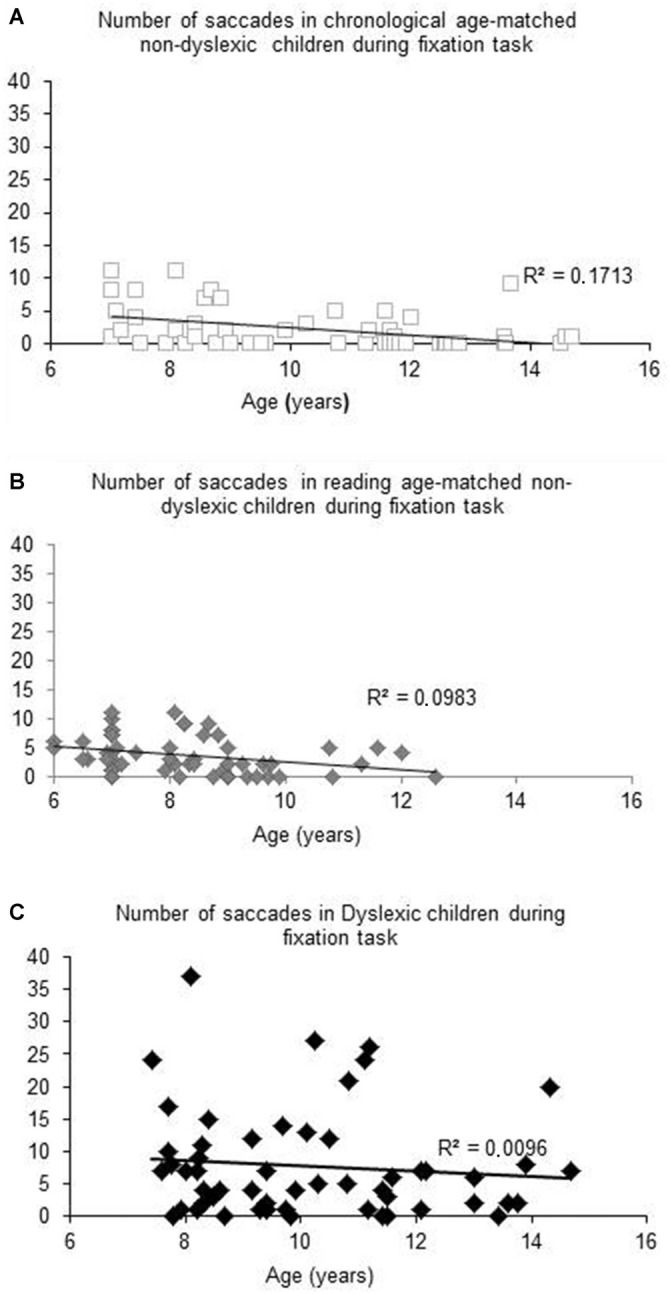
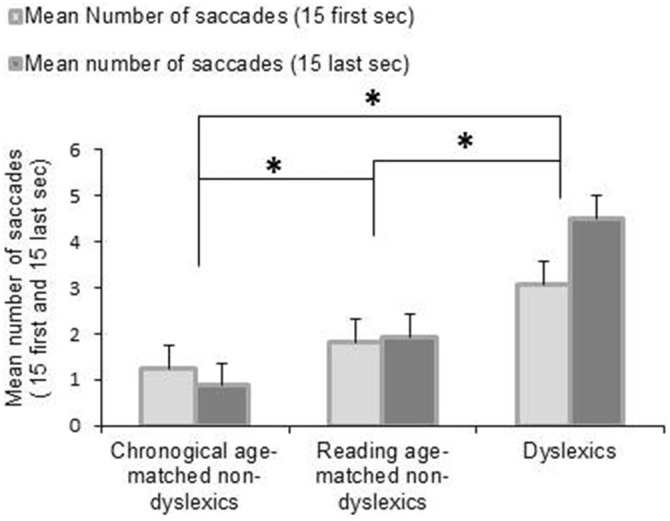
To our knowledge, behavioral studies recording visual fixations abilities in dyslexic children are scarce. The object of this article is to explore further the visual fixation ability in dyslexics compared to chronological age-matched and reading age-matched non-dyslexic children. Fifty-five dyslexic children from 7 to 14 years old, 55 chronological age-matched non-dyslexic children and 55 reading age-matched non-dyslexic children participated to this study. Eye movements from both eyes were recorded horizontally and vertically by a video-oculography system (EyeBrain(®) T2). The fixation task consisted in fixating a white-filled circle appearing in the center of the screen for 30 s. Results showed that dyslexic children produced a significantly higher number of unwanted saccades than both groups of non-dyslexic children. Moreover, the number of unwanted saccades significantly decreased with age in both groups of non-dyslexic children, but not in dyslexics. Furthermore, dyslexics made more saccades during the last 15 s of fixation period with respect to both groups of non-dyslexic children. Such poor visual fixation capability in dyslexic children could be due to impaired attention abilities, as well as to an immaturity of the cortical areas controlling the fixation system.
据我们所知,针对诵读困难儿童视觉注视能力的行为学研究较为匮乏。本文旨在进一步探究诵读困难儿童与年龄匹配及阅读能力匹配的非诵读困难儿童相比的视觉注视能力。55名7至14岁的诵读困难儿童、55名年龄匹配的非诵读困难儿童以及55名阅读能力匹配的非诵读困难儿童参与了本研究。通过视频眼动仪系统(EyeBrain(®) T2)水平和垂直记录双眼的眼动情况。注视任务是注视出现在屏幕中心的白色实心圆30秒。结果显示,诵读困难儿童产生的非自主性眼跳次数显著多于两组非诵读困难儿童。此外,两组非诵读困难儿童的非自主性眼跳次数随年龄显著减少,但诵读困难儿童并非如此。而且,在注视期的最后15秒内,诵读困难儿童的眼跳次数比两组非诵读困难儿童都多。诵读困难儿童如此糟糕的视觉注视能力可能是由于注意力受损,以及控制注视系统皮质区域发育不成熟所致。