Bergeron Julien R
Department of Biochemistry, University of Washington , Seattle, WA , USA.
PeerJ. 2016 Feb 22;4:e1718. doi: 10.7717/peerj.1718. eCollection 2016.
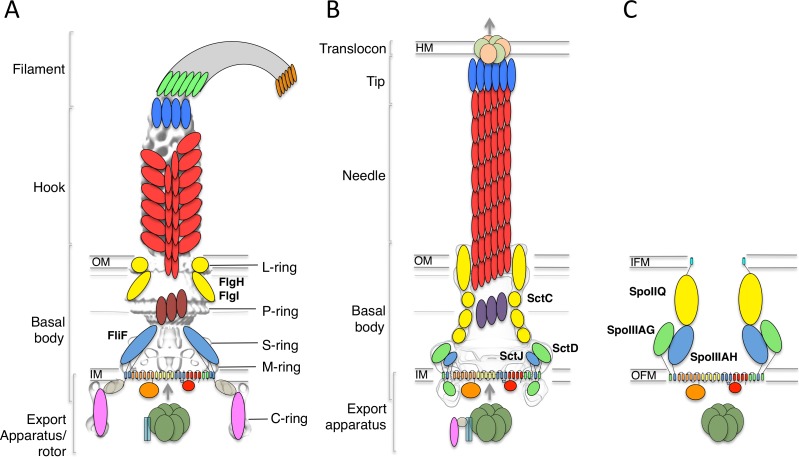
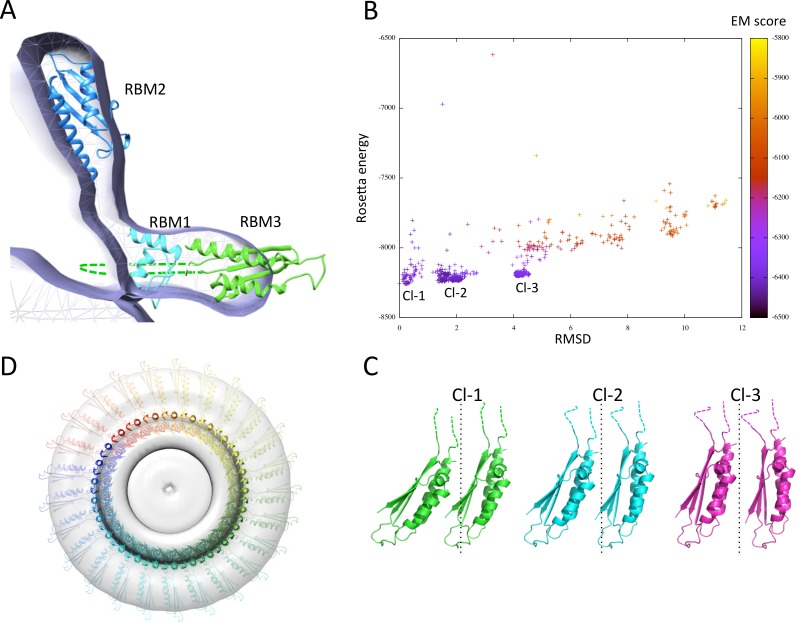
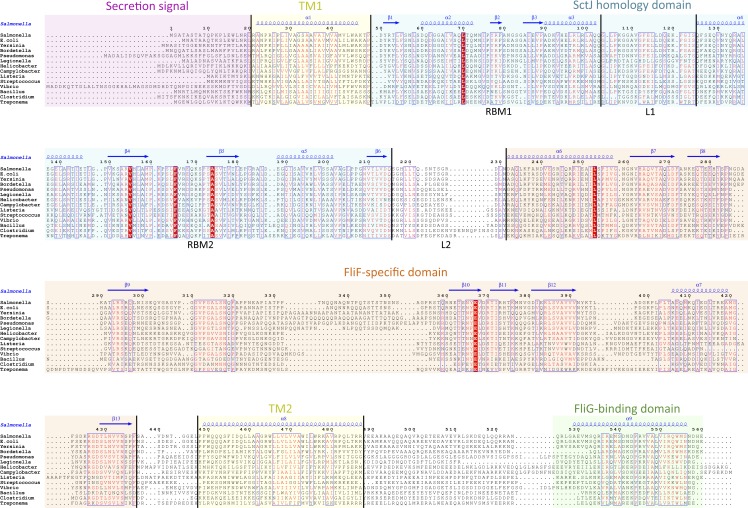
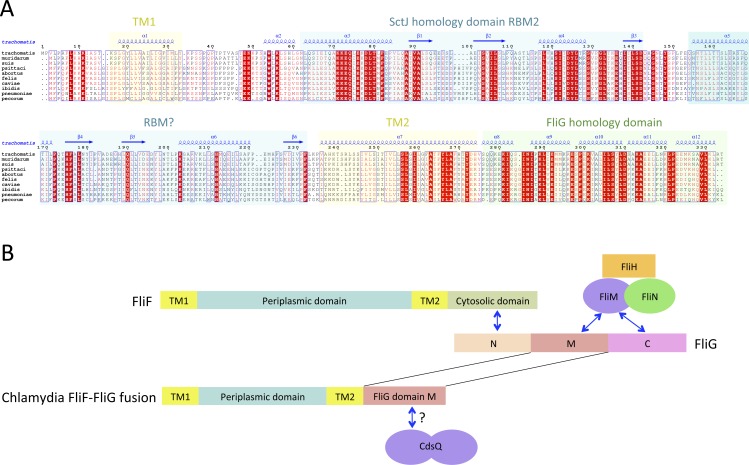
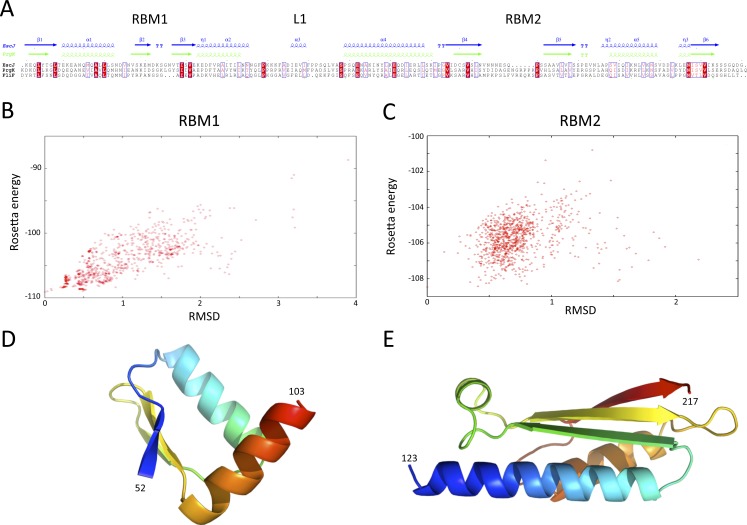
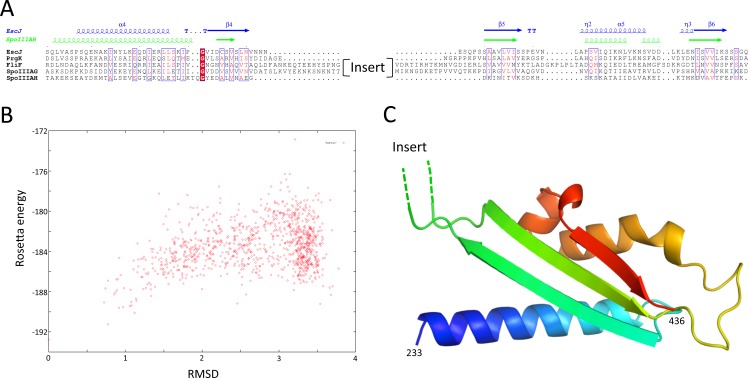
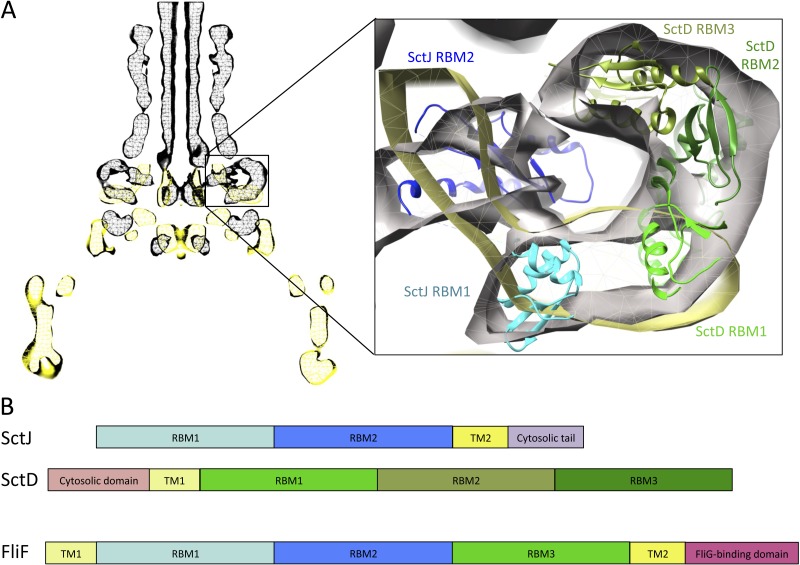
The flagellum is a large proteinaceous organelle found at the surface of many bacteria, whose primary role is to allow motility through the rotation of a long extracellular filament. It is an essential virulence factor in many pathogenic species, and is also a priming component in the formation of antibiotic-resistant biofilms. The flagellum consists of the export apparatus on the cytosolic side; the basal body and rotor, spanning the bacterial membrane(s) and periplasm; and the hook-filament, that protrudes away from the bacterial surface. Formation of the basal body MS ring region, constituted of multiple copies of the protein FliF, is one of the initial steps of flagellum assembly. However, the precise architecture of FliF is poorly understood. Here, I report a bioinformatics analysis of the FliF sequence from various bacterial species, suggesting that its periplasmic region is composed of three globular domains. The first two are homologous to that of the type III secretion system injectisome proteins SctJ, and the third possesses a similar fold to that of the sporulation complex component SpoIIIAG. I also describe that Chlamydia possesses an unusual FliF protein, lacking part of the SctJ homology domain and the SpoIIIAG-like domain, and fused to the rotor component FliG at its C-terminus. Finally, I have combined the sequence analysis of FliF with the EM map of the MS ring, to propose the first atomic model for the FliF oligomer, suggesting that FliF is structurally akin to a fusion of the two injectisome components SctJ and SctD. These results further define the relationship between the flagellum, injectisome and sporulation complex, and will facilitate future structural characterization of the flagellum basal body.
鞭毛是一种大型蛋白质细胞器,存在于许多细菌表面,其主要作用是通过长细胞外细丝的旋转实现运动。在许多致病物种中,它是一种重要的毒力因子,也是形成抗生素抗性生物膜的起始成分。鞭毛由胞质侧的输出装置、跨越细菌膜和周质的基体和转子,以及从细菌表面伸出的钩状细丝组成。由蛋白质FliF的多个拷贝构成的基体MS环区域的形成是鞭毛组装的初始步骤之一。然而,FliF的确切结构尚不清楚。在此,我报告了对来自各种细菌物种的FliF序列的生物信息学分析,表明其周质区域由三个球状结构域组成。前两个与III型分泌系统注射体蛋白SctJ的结构域同源,第三个与芽孢形成复合体成分SpoIIIAG具有相似的折叠结构。我还描述了衣原体拥有一种不寻常的FliF蛋白,它缺少部分SctJ同源结构域和SpoIIIAG样结构域,并在其C端与转子成分FliG融合。最后,我将FliF的序列分析与MS环的电子显微镜图谱相结合,提出了FliF寡聚体的第一个原子模型,表明FliF在结构上类似于两种注射体成分SctJ和SctD的融合体。这些结果进一步明确了鞭毛、注射体和芽孢形成复合体之间的关系,并将有助于未来对鞭毛基体的结构表征。