Saei Ghare Naz Marzieh, Ozgoli Giti, Aghdashi Mir Amir, Salmani Fatemeh
Department of Midwifery, School of Nursing and Midwifery Urmia Medical University , Urmia, Iran.
Glob J Health Sci. 2015 Nov 18;8(7):135-45. doi: 10.5539/gjhs.v8n7p135.
Osteoporosis is one of the fastest growing health problems around the world. Several factors can affect this silent disease. The current study aimed to determine the prevalence and risk factors of osteoporosis in women in Urmia, a city in northwestern Iran.
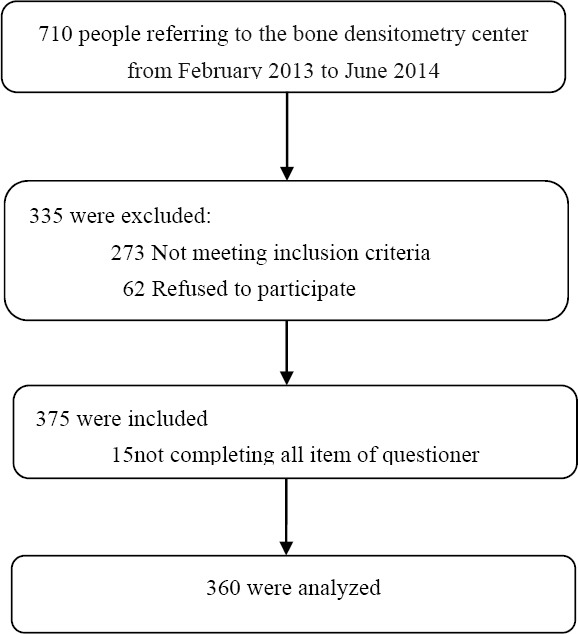
This cross‑sectional study was performed on 360 non-pregnant women over the age of 15 who referred for bone density testing to the Urmia Imam Khomeini Academic Hospital. Data were collected by questionnaire, and bone mineral density of the femoral neck and lumbar spines L1- L4 was evaluated by dual X-ray absorptiometry.
The total prevalence of osteoporosis in this study was 42.2%; prevalence of osteoporosis among women 45 years old or less was 14.3% and over the age of 45 years was 50.7%. The factors such as level of education, history of bone fracture, disease history (rheumatoid arthritis, diabetes, high blood pressure), gravidity and parity values, duration of lactation (p<0.001), nutrition dimension of lifestyle (p=0.03), and green tea consumption (p=002) showed a statistically significant association with the bone mineral density. According to the regression model, age (OR=1.081), history of bone fracture (OR=2.75), and gravidity (OR=1.14) were identified as significant risk factors for osteoporosis, while the body mass index (OR=0.94) was identified as a protector against osteoporosis.
The prevalence of osteoporosis in this study was high, and findings showed that the advancement of age, lifestyle, and reproductive factors (especially gravidity and duration of lactation) were determining factors for osteoporosis .Appropriate educational programs and interventions could help to increase the women's peak bone mass therefore reducing their risk of developing osteoporosis.
骨质疏松症是全球范围内增长最快的健康问题之一。多种因素可影响这种隐匿性疾病。本研究旨在确定伊朗西北部城市乌尔米耶女性骨质疏松症的患病率及危险因素。
本横断面研究对360名15岁以上非妊娠女性进行,这些女性因骨密度检测转诊至乌尔米耶伊玛目霍梅尼学术医院。通过问卷调查收集数据,采用双能X线吸收法评估股骨颈和腰椎L1 - L4的骨矿物质密度。
本研究中骨质疏松症的总患病率为42.2%;45岁及以下女性骨质疏松症患病率为14.3%,45岁以上为50.7%。教育水平、骨折史、疾病史(类风湿关节炎、糖尿病、高血压)、妊娠和产次值、哺乳期时长(p<0.001)、生活方式的营养维度(p=0.03)以及绿茶摄入量(p=0.02)等因素与骨矿物质密度存在统计学显著关联。根据回归模型,年龄(OR=1.081)、骨折史(OR=2.75)和妊娠(OR=1.14)被确定为骨质疏松症的显著危险因素,而体重指数(OR=0.94)被确定为预防骨质疏松症的因素。
本研究中骨质疏松症患病率较高,研究结果表明年龄增长、生活方式和生殖因素(尤其是妊娠和哺乳期时长)是骨质疏松症的决定因素。适当的教育项目和干预措施有助于增加女性的骨峰值,从而降低其患骨质疏松症的风险。