Hirsch Cordula, Striegl Britta, Mathes Stephanie, Adlhart Christian, Edelmann Michael, Bono Epifania, Gaan Sabyasachi, Salmeia Khalifah A, Hoelting Lisa, Krebs Alice, Nyffeler Johanna, Pape Regina, Bürkle Alexander, Leist Marcel, Wick Peter, Schildknecht Stefan
Particles-Biology Interactions Laboratory, Swiss Federal Laboratories for Materials Science and Technology (Empa), Lerchenfeldstrasse 5, 9014, St. Gallen, Switzerland.
ZHAW, Life Sciences and Facility Management, Einsiedlerstr. 31, 8820, Waedenswil, Switzerland.
Arch Toxicol. 2017 Jan;91(1):407-425. doi: 10.1007/s00204-016-1680-4. Epub 2016 Feb 29.
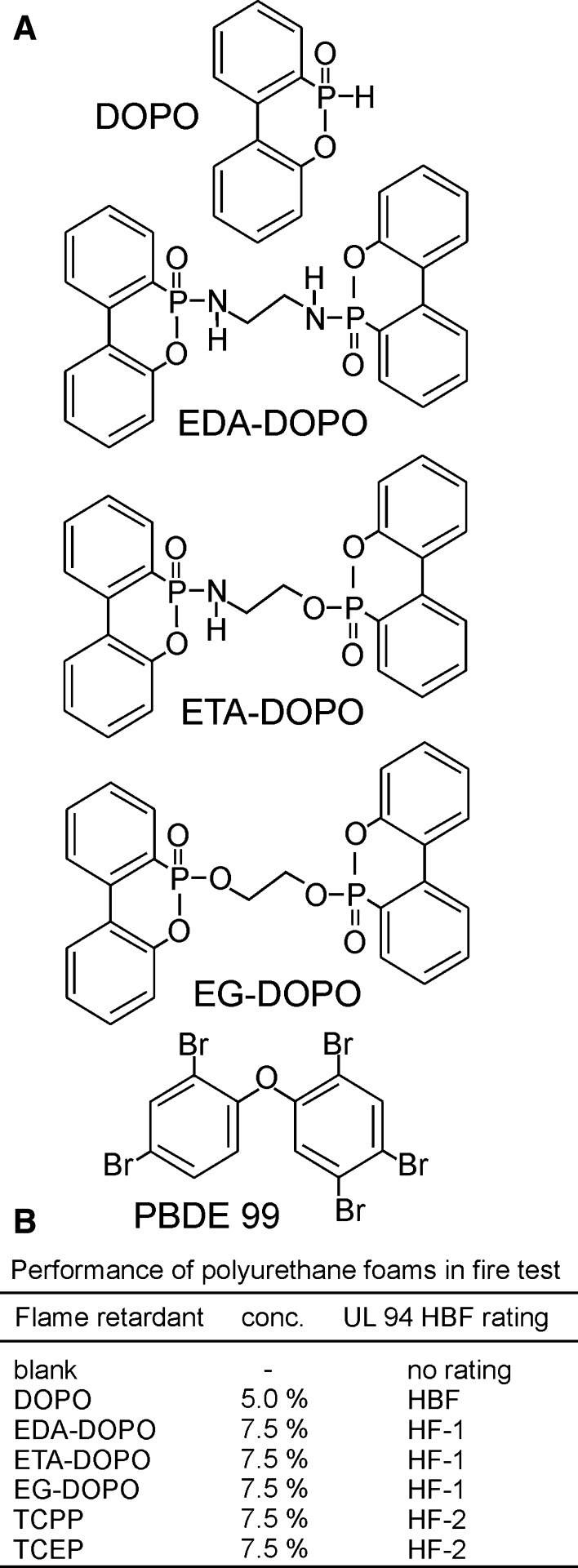
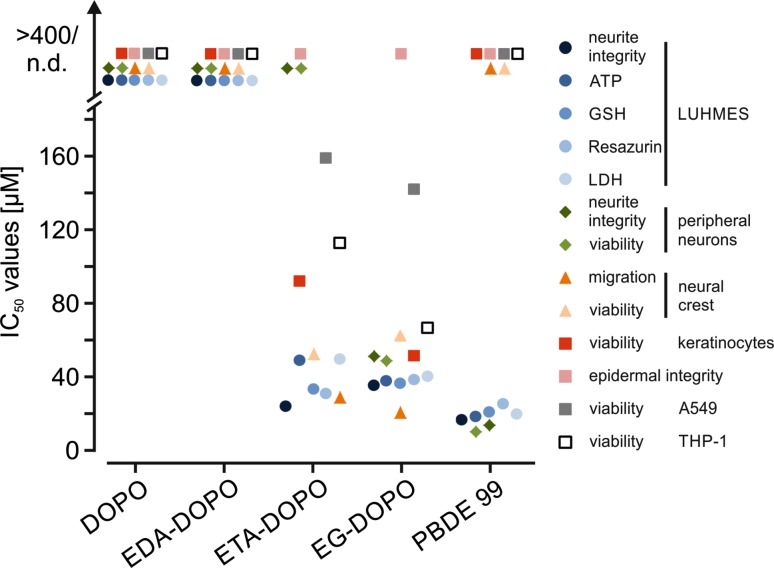
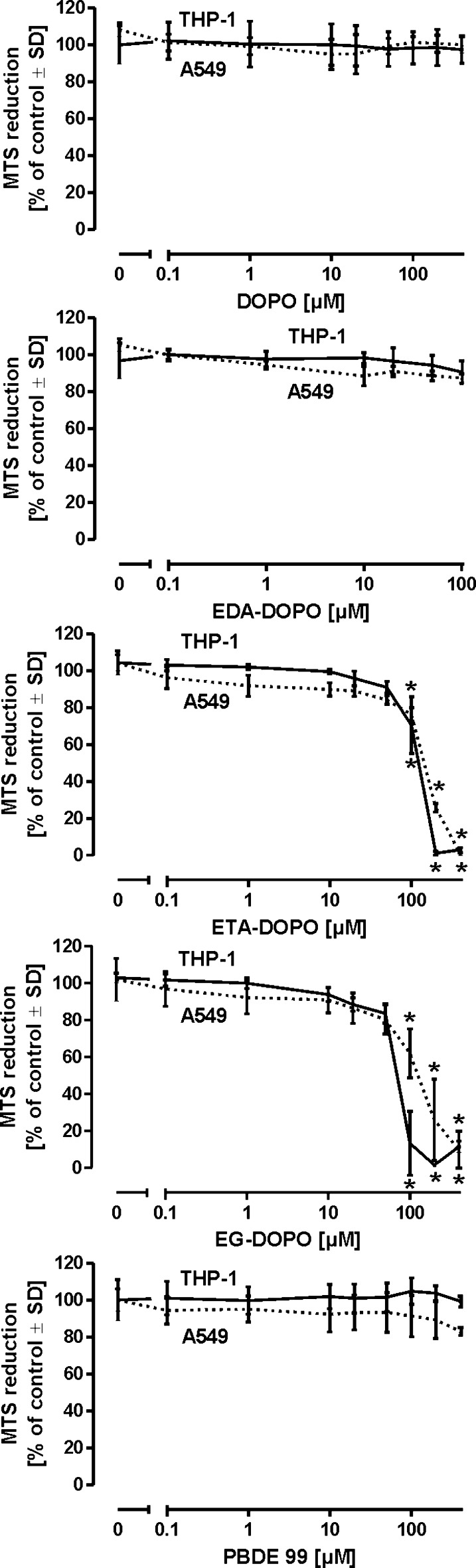
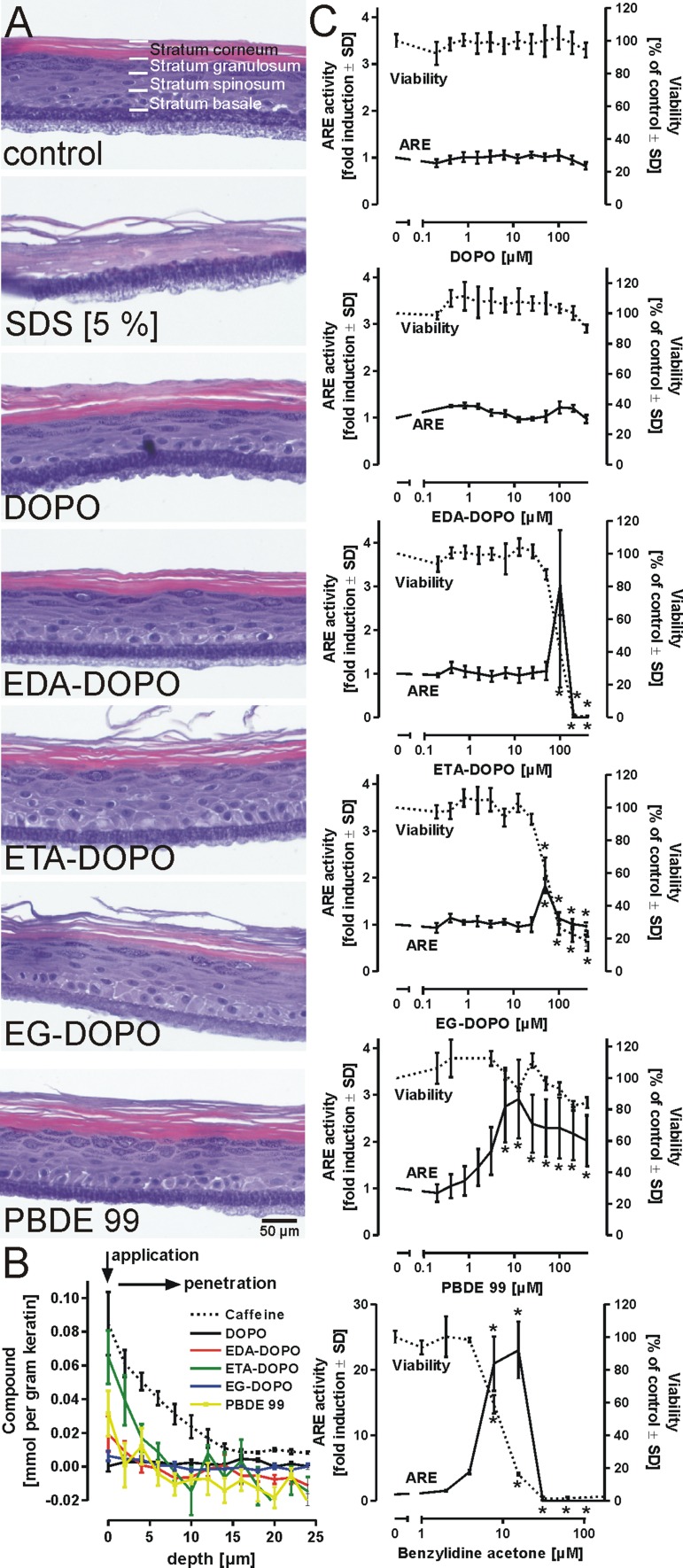
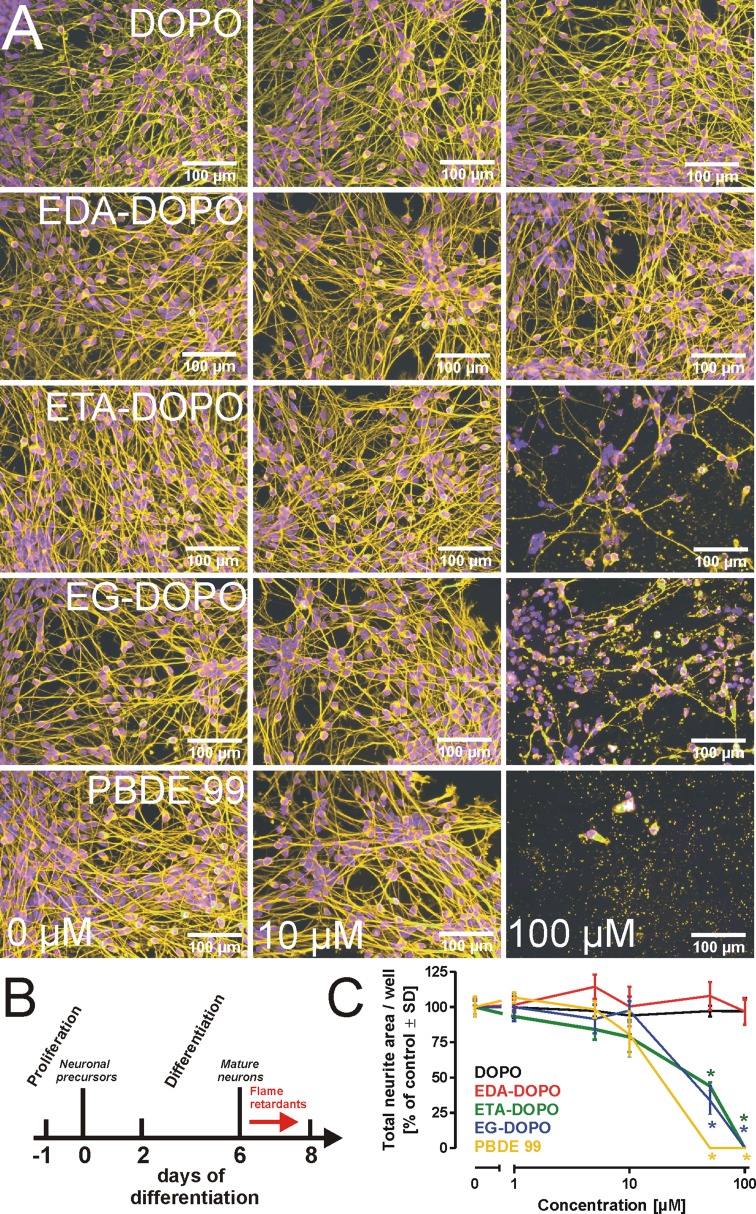
Halogen-free organophosphorus flame retardants are considered as replacements for the phased-out class of polybrominated diphenyl ethers (PBDEs). However, toxicological information on new flame retardants is still limited. Based on their excellent flame retardation potential, we have selected three novel 9,10-dihydro-9-oxa-10-phosphaphenanthrene-10-oxide (DOPO) derivatives and assessed their toxicological profile using a battery of in vitro test systems in order to provide toxicological information before their large-scale production and use. PBDE-99, applied as a reference compound, exhibited distinct neuro-selective cytotoxicity at concentrations ≥10 µM. 6-(2-((6-oxido-6H-dibenzo[c,e][1,2]oxaphosphinin-6-yl)amino)ethoxy)-6H-dibenzo[c,e][1,2]oxaphosphinine 6-oxide (ETA-DOPO) and 6,6'-(ethane-1,2-diylbis(oxy))bis(6H-dibenzo[c,e][1,2]oxaphosphinine-6-oxide) (EG-DOPO) displayed adverse effects at concentrations >10 µM in test systems reflecting the properties of human central and peripheral nervous system neurons, as well as in a set of non-neuronal cell types. DOPO and its derivative 6,6'-(ethane-1,2-diylbis(azanediyl))bis(6H-dibenzo[c,e][1,2]oxaphosphinine-6-oxide) (EDA-DOPO) were neither neurotoxic, nor did they exhibit an influence on neural crest cell migration, or on the integrity of human skin equivalents. The two compounds furthermore displayed no inflammatory activation potential, nor did they affect algae growth or daphnia viability at concentrations ≤400 µM. Based on the superior flame retardation properties, biophysical features suited for use in polyurethane foams, and low cytotoxicity of EDA-DOPO, our results suggest that it is a candidate for the replacement of currently applied flame retardants.
无卤有机磷阻燃剂被视为逐步淘汰的多溴二苯醚(PBDEs)类别的替代品。然而,关于新型阻燃剂的毒理学信息仍然有限。基于其出色的阻燃潜力,我们选择了三种新型的9,10 - 二氢 - 9 - 氧杂 - 10 - 磷杂菲 - 10 - 氧化物(DOPO)衍生物,并使用一系列体外测试系统评估了它们的毒理学特征,以便在其大规模生产和使用之前提供毒理学信息。用作参考化合物的PBDE - 99在浓度≥10 μM时表现出明显的神经选择性细胞毒性。6 - (2 - ((6 - 氧化 - 6H - 二苯并[c,e][1,2]氧杂磷杂环己烷 - 6 - 基)氨基)乙氧基)- 6H - 二苯并[c,e][1,2]氧杂磷杂环己烷6 - 氧化物(ETA - DOPO)和6,6' - (乙烷 - 1,2 - 二基双(氧基))双(6H - 二苯并[c,e][1,2]氧杂磷杂环己烷 - 6 - 氧化物)(EG - DOPO)在反映人类中枢和外周神经系统神经元特性的测试系统中,以及在一组非神经元细胞类型中,在浓度>10 μM时显示出不利影响。DOPO及其衍生物6,6' - (乙烷 - 1,2 - 二基双(氮杂二基))双(6H - 二苯并[c,e][1,2]氧杂磷杂环己烷 - 6 - 氧化物)(EDA - DOPO)既没有神经毒性,也没有对神经嵴细胞迁移或人类皮肤等效物的完整性产生影响。此外,这两种化合物在浓度≤400 μM时既没有炎症激活潜力,也没有影响藻类生长或水蚤活力。基于EDA - DOPO优异的阻燃性能、适用于聚氨酯泡沫的生物物理特性以及低细胞毒性,我们的结果表明它是替代目前应用的阻燃剂的候选物。