Zhang Qiang, Hong Yongmi, Zou Fasheng, Zhang Min, Lee Tien Ming, Song Xiangjin, Rao Jiteng
Guangdong Public Laboratory of Wild Animal Conservation and Utilization, Guangdong Entomological Institute/South China Institute of Endangered Animals, Guangzhou 510260, China.
Guangdong Key Laboratory of Integrated Pest Management in Agriculture, Guangdong Entomological Institute/South China Institute of Endangered Animals, Guangzhou 510260, China.
Sci Rep. 2016 Mar 1;6:22344. doi: 10.1038/srep22344.
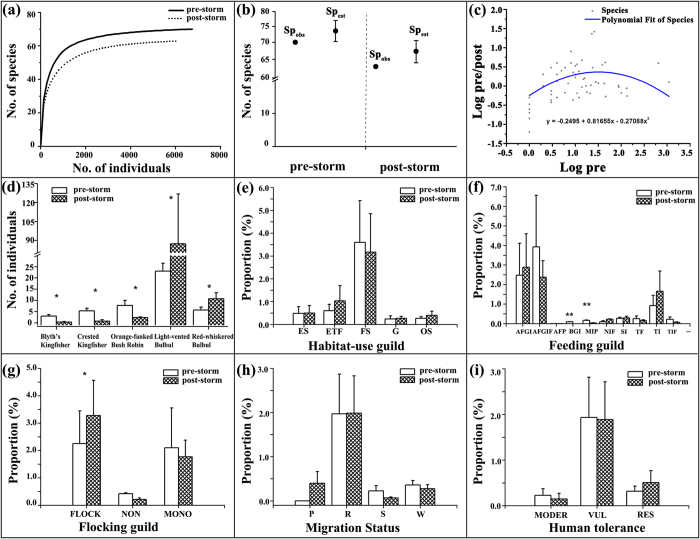
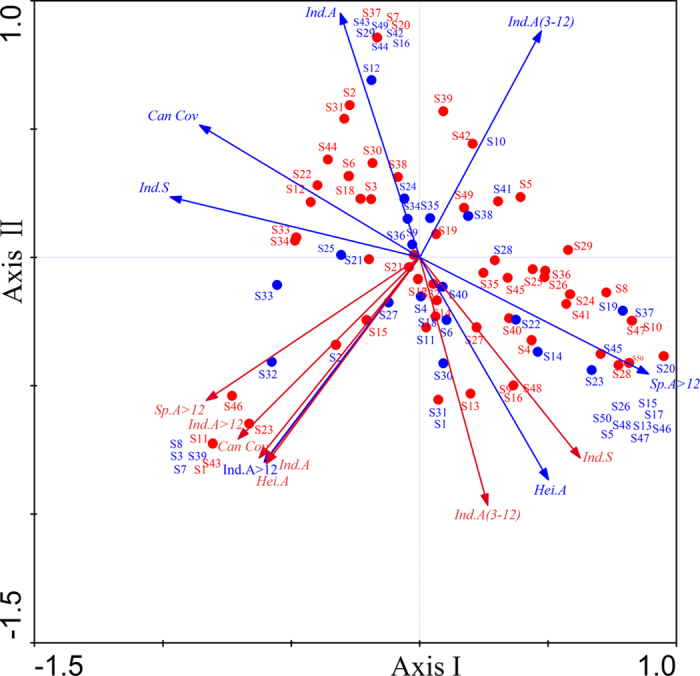
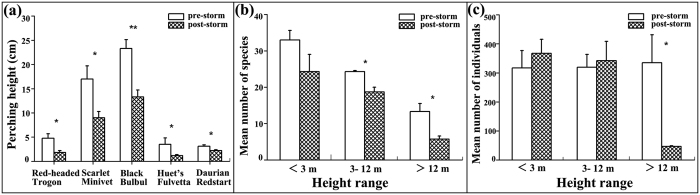
The extent to which species' traits, behavior and habitat synergistically determine their response to extreme weather events (EWE) remains poorly understood. By quantifying bird and vegetation assemblages before and after the 2008 ice storm in China, combined with interspecific interactions and foraging behaviours, we disentangled whether storm influences avian reassembly directly via functional traits (i.e. behavioral adaptations), or indirectly via habitat variations. We found that overall species richness decreased, with 20 species detected exclusively before the storm, and eight species detected exclusively after. These shifts in bird relative abundance were linked to habitat preferences, dietary guild and flocking behaviours. For instance, forest specialists at higher trophic levels (e.g. understory-insectivores, woodpeckers and kingfishers) were especially vulnerable, whereas open-habitat generalists (e.g. bulbuls) were set to benefit from potential habitat homogenization. Alongside population fluctuations, we found that community reassembly can be rapidly adjusted via foraging plasticity (i.e. increased flocking propensity and reduced perching height). And changes in preferred habitat corresponded to a variation in bird assemblages and traits, as represented by intact canopy cover and high density of large trees. Accurate predictions of community responses to EWE are crucial to understanding ecosystem disturbances, thus linking species-oriented traits to a coherent analytical framework.
物种的特征、行为和栖息地协同决定其对极端天气事件(EWE)响应的程度,目前仍知之甚少。通过量化2008年中国冰暴前后的鸟类和植被组合,并结合种间相互作用和觅食行为,我们厘清了风暴是直接通过功能性状(即行为适应)影响鸟类重新组合,还是通过栖息地变化间接影响。我们发现,总体物种丰富度下降,有20种仅在风暴前被检测到,8种仅在风暴后被检测到。鸟类相对丰度的这些变化与栖息地偏好、食性类群和集群行为有关。例如,营养级较高的森林专家物种(如林下食虫鸟、啄木鸟和翠鸟)特别脆弱,而开阔栖息地的通才物种(如鹎)则可能从潜在的栖息地同质化中受益。除了种群波动,我们发现群落重新组合可以通过觅食可塑性(即增加集群倾向和降低栖息高度)迅速调整。偏好栖息地的变化对应着鸟类组合和特征的变化,如完整的树冠覆盖和大树的高密度所代表的那样。准确预测群落对极端天气事件的响应对于理解生态系统干扰至关重要,从而将以物种为导向的特征与一个连贯的分析框架联系起来。