Loyen Anne, van der Ploeg Hidde P, Bauman Adrian, Brug Johannes, Lakerveld Jeroen
Department of Epidemiology and Biostatistics, VU University Medical Center, EMGO Institute for Health and Care Research, Amsterdam, The Netherlands.
Department of Public and Occupational Health, VU University Medical Center, EMGO Institute for Health and Care Research, Amsterdam, The Netherlands.
PLoS One. 2016 Mar 2;11(3):e0149320. doi: 10.1371/journal.pone.0149320. eCollection 2016.
Sedentary behaviour is increasingly recognized as an important health risk, but comparable data across Europe are scarce. The objective of this study was to explore the prevalence and correlates of self-reported sitting time in adults across and within the 28 European Union Member States.
This study reports data from the Special Eurobarometer 412. In 2013, 27,919 randomly selected Europeans (approximately 1000 per Member State) were interviewed face-to-face. Sitting time on a usual day was self-reported and dichotomised into sitting less- and more than 7.5 hours per day. Uni- and multivariate odds ratios of sitting more than 7.5 hours per day were assessed by country and socio-demographic variables using binary logistic regression analyses. The analyses were stratified by country to study the socio-demographic correlates of sitting time within the different countries.
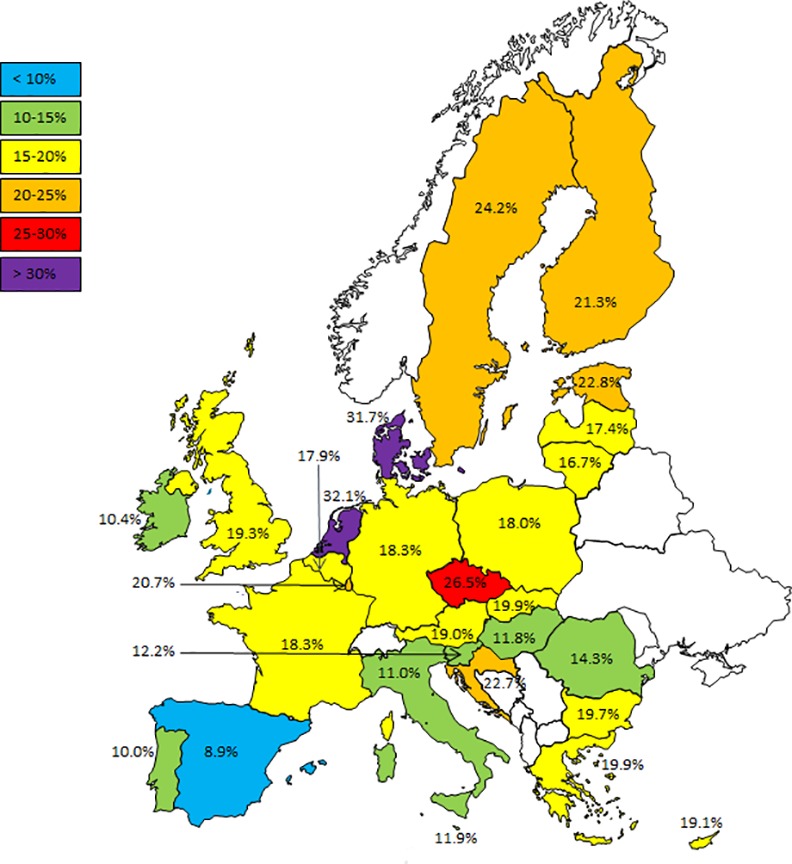
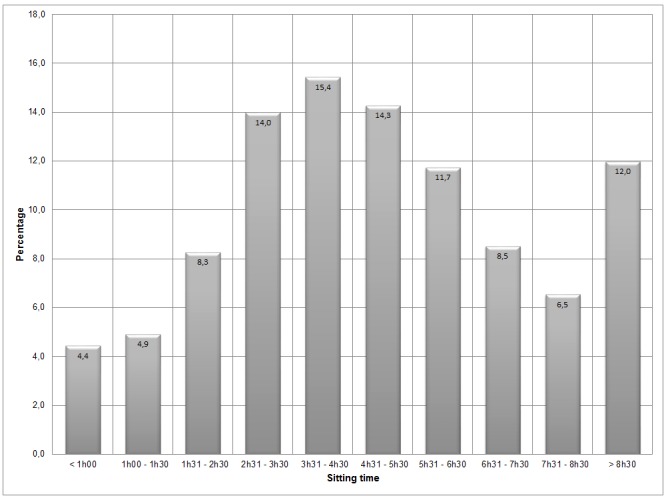
A total of 26,617 respondents were included in the analyses. Median sitting time was five hours per day. Across Europe, 18.5 percent of the respondents reported to sit more than 7.5 hours per day, with substantial variation between countries (ranging from 8.9 to 32.1 percent). In general, northern European countries reported more sitting than countries in the south of Europe. 'Current occupation' and 'age when stopped education' were found to be the strongest correlates of sitting time, both across Europe and within most Member States. Compared to manual workers, the odds ratio of sitting more than 7.5 hours per day was 5.00 for people with white collar occupations, 3.84 for students, and 3.65 for managers.
There is substantial variation in self-reported sitting time among European adults across countries as well as socio-demographic groups. While regular surveillance of (objectively measured) sedentary behaviour is needed, the results of this study provide entry points for developing targeted interventions aimed at highly sedentary populations, such as people with sedentary occupations.
久坐行为日益被视为一项重大健康风险,但欧洲各地的可比数据却很匮乏。本研究的目的是探讨欧盟28个成员国成年人自我报告的久坐时间的患病率及其相关因素。
本研究报告了特别欧洲晴雨表412的数据。2013年,随机选取了27919名欧洲人(每个成员国约1000人)进行面对面访谈。自我报告平常一天的久坐时间,并将其分为每天久坐少于7.5小时和多于7.5小时两类。使用二元逻辑回归分析,按国家和社会人口学变量评估每天久坐超过7.5小时的单因素和多因素比值比。分析按国家分层,以研究不同国家内久坐时间的社会人口学相关因素。
共有26617名受访者纳入分析。久坐时间中位数为每天5小时。在欧洲,18.5%的受访者报告每天久坐超过7.5小时,各国之间存在显著差异(从8.9%到32.1%不等)。总体而言,北欧国家报告的久坐时间多于欧洲南部国家。“当前职业”和“停止接受教育时的年龄”被发现是久坐时间最强的相关因素,在整个欧洲以及大多数成员国都是如此。与体力劳动者相比,白领职业者每天久坐超过7.5小时的比值比为5.00,学生为3.84,管理人员为3.65。
欧洲各国成年人以及社会人口学群体自我报告的久坐时间存在显著差异。虽然需要定期监测(客观测量的)久坐行为,但本研究结果为针对久坐人群(如从事久坐职业的人)制定有针对性的干预措施提供了切入点。