Prevention Research Collaboration, Sydney School of Public Health, The University of Sydney, 92-94 Parramatta Road, Camperdown, NSW 2050, Australia.
Int J Behav Nutr Phys Act. 2013 Sep 11;10:107. doi: 10.1186/1479-5868-10-107.
Prolonged sitting is an emerging health risk. However, multi-country comparative sitting data are sparse. This paper reports the prevalence and correlates of sitting time in 32 European countries.
Data from the Eurobarometer 64.3 study were used, which included nationally representative samples (n = 304-1,102) from 32 European countries. Face-to-face interviews were conducted during November and December 2005. Usual weekday sitting time was assessed using the International Physical Activity Questionnaire (short-version). Sitting time was compared by country, age, gender, years of education, general health status, usual activity and physical activity. Multivariable-adjusted analyses assessed the odds of belonging to the highest sitting quartile.
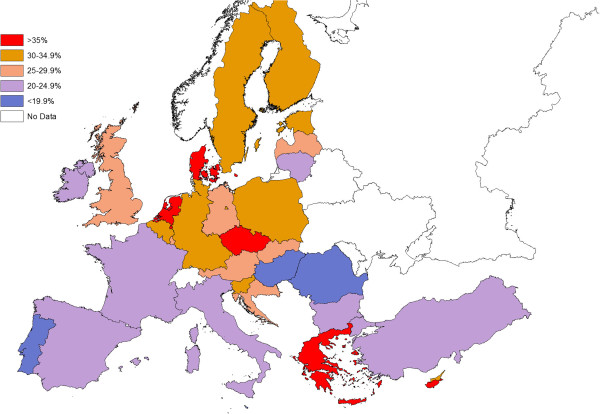
Data were available for 27,637 adults aged 15-98 years. Overall, mean reported weekday sitting time was 309 min/day (SD 184 min/day). There was a broad geographical pattern and some of the lowest amounts of daily sitting were reported in southern (Malta and Portugal means 194-236 min/day) and eastern (Romania and Hungary means 191-276 min/day) European countries; and some of the highest amounts of daily sitting were reported in northern European countries (Germany, Benelux and Scandinavian countries; means 407-335 min/day). Multivariable-adjusted analyses showed adults with low physical activity levels (OR = 5.10, CI₉₅ = 4.60-5.66), those with high sitting in their main daily activity (OR = 2.99, CI₉₅ = 2.74-3.25), those with a bad/very bad general health state (OR = 1.87, CI₉₅ = 1.63-2.15) and higher education levels (OR = 1.48, CI₉₅ = 1.38-1.59) were more likely to be in the highest quartile of daily sitting time. Adults within Greece (OR = 2.91, CI₉₅ = 2.51-3.36) and Netherlands (OR = 2.56, CI₉₅ = 2.22-2.94) were most likely to be in the highest quartile. High-sit/low-active participants comprised 10.1% of the sample. Adults self-reporting bad/very bad general health state (OR = 4.74, CI₉₅ = 3.97-5.65), those within high sitting in their main daily activities (OR = 2.87, CI₉₅ = 2.52-3.26) and adults aged ≥65 years (OR = 1.53, CI₉₅ = 1.19-1.96) and were more likely to be in the high-sit/low-active group.
Weekday sitting time and its demographic correlates varied considerably across European countries, with adults in north-western European countries sitting the most. Sitting is prevalent across Europe and merits attention by preventive interventions.
久坐是一种新出现的健康风险。然而,多国家比较久坐的数据还很匮乏。本文报告了 32 个欧洲国家成年人工作日久坐时间的流行率和相关因素。
本研究使用了欧洲民意调查(Eurobarometer)64.3 研究的数据,该研究包括来自 32 个欧洲国家的具有全国代表性的样本(n=304-1102)。2005 年 11 月至 12 月期间进行了面对面访谈。使用国际体力活动问卷(短版本)评估通常在工作日的久坐时间。根据国家、年龄、性别、受教育年限、总体健康状况、日常活动和体力活动情况比较久坐时间。多变量调整分析评估了属于最高久坐四分位数的可能性。
共有 27637 名 15-98 岁成年人的数据可用。总体而言,报告的工作日平均久坐时间为 309 分钟/天(SD 184 分钟/天)。存在广泛的地域模式,南部(马耳他和葡萄牙,均值为 194-236 分钟/天)和东部(罗马尼亚和匈牙利,均值为 191-276 分钟/天)的欧洲国家报告的每日久坐时间最少;而北欧国家(德国、比荷卢和斯堪的纳维亚国家,均值为 407-335 分钟/天)报告的每日久坐时间最多。多变量调整分析表明,低体力活动水平的成年人(OR=5.10,CI95=4.60-5.66)、主要日常活动中久坐时间较高的成年人(OR=2.99,CI95=2.74-3.25)、总体健康状况较差/非常差的成年人(OR=1.87,CI95=1.63-2.15)和受教育程度较高的成年人(OR=1.48,CI95=1.38-1.59)更有可能处于每日久坐时间的最高四分位数。希腊(OR=2.91,CI95=2.51-3.36)和荷兰(OR=2.56,CI95=2.22-2.94)的成年人最有可能处于最高四分位数。高坐/低活跃的参与者占样本的 10.1%。报告总体健康状况较差/非常差的成年人(OR=4.74,CI95=3.97-5.65)、主要日常活动中久坐时间较高的成年人(OR=2.87,CI95=2.52-3.26)和年龄≥65 岁的成年人(OR=1.53,CI95=1.19-1.96)更有可能属于高坐/低活跃组。
欧洲各国工作日久坐时间及其人口统计学相关因素差异很大,西北欧国家的成年人坐得最多。久坐行为在整个欧洲都很普遍,值得预防干预措施关注。