Zhou Yuehua, Gu Pingqing, Shi Weijie, Li Jingyun, Hao Qun, Cao Xiaomei, Lu Qin, Zeng Yu
Department of Obstetrics and Gynecology of Tongren Hospital, Shanghai Jiao Tong University School of Medicine, Shanghai 200036, P.R. China.
Department of Clinical Laboratory, Nanjing Maternity and Child Health Care Hospital Affiliated to Nanjing Medical University, Nanjing, Jiangsu 210029, P.R. China.
Int J Mol Med. 2016 Apr;37(4):931-8. doi: 10.3892/ijmm.2016.2499. Epub 2016 Feb 22.
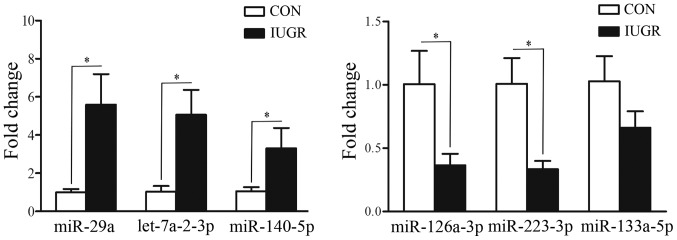
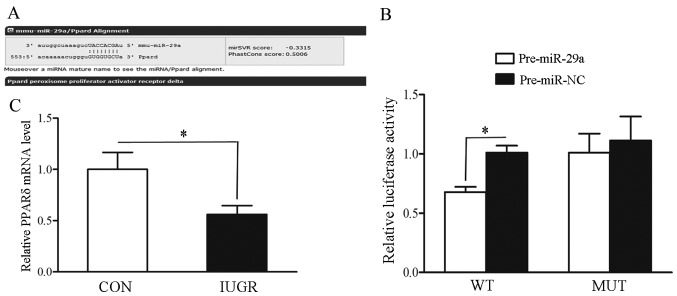
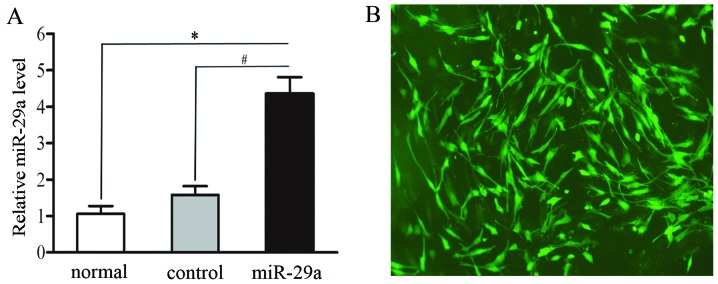
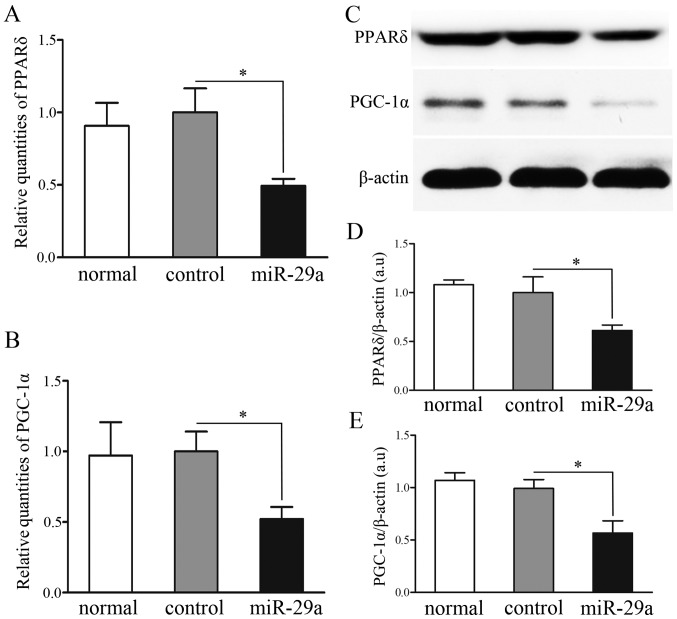
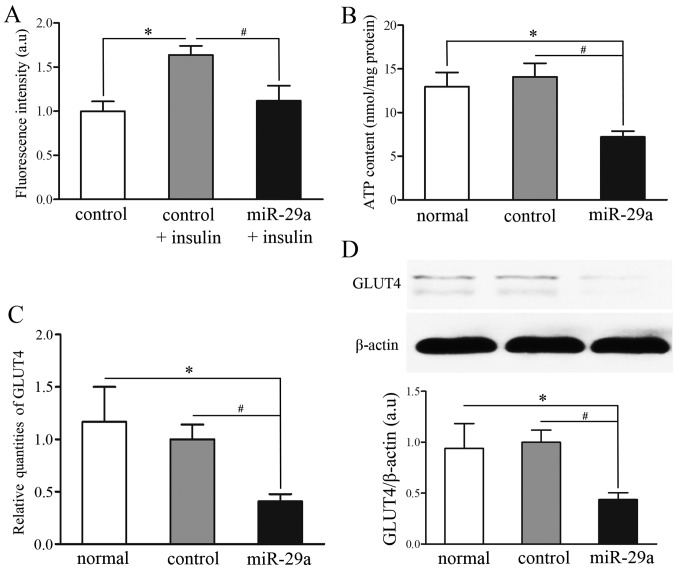
Intrauterine growth retardation (IUGR) induces metabolic syndrome, which is often characterized by insulin resistance (IR), in adults. Previous research has shown that microRNAs (miRNAs or miRs) play a role in the target genes involved in this process, but the mechanisms remain unclear. In the present study, we examined miRNA profiles using samples of skeletal muscles from both IUGR and control rat offspring whose mothers were fed either a protein-restricted diet or a diet which involved normal amounts of protein during pregnancy, respectively. miR‑29a was found to be upregulated in the skeletal muscles of IUGR offspring. The luciferase reporter assay confirmed the direct interaction between miR‑29a and peroxisome proliferator‑activated receptor δ (PPARδ). Overexpression of miR‑29a in the skeletal muscle cell line C2C12 suppressed the expression of its target gene PPARδ, which, in turn, influenced the expression of its coactivator, peroxisome proliferator-activated receptor-γ coactivator-1α (PGC-1α). Thus, PPARδ/PGC-1α‑dependent signals together reduced insulin-dependent glucose uptake and adenosine triphosphate (ATP) production. Overexpression of miR‑29a also caused a decrease in levels of glucose transporter 4 (GLUT4), the most important glucose transporter in skeletal muscle, which partially induced a decrease insulin‑dependent glucose uptake. These findings provide evidence for a novel micro-RNA‑mediated mechanism of PPARδ regulation, and we also noted the IR-promoting actions of miR-29a in skeletal muscles of IUGR.
宫内生长受限(IUGR)会诱发代谢综合征,其在成年人中通常表现为胰岛素抵抗(IR)。先前的研究表明,微小RNA(miRNA或miR)在参与此过程的靶基因中发挥作用,但其机制仍不清楚。在本研究中,我们分别使用来自IUGR大鼠后代和对照大鼠后代的骨骼肌样本检测了miRNA谱,这些后代的母亲在孕期分别被喂食蛋白质限制饮食或正常蛋白质含量饮食。发现miR-29a在IUGR后代的骨骼肌中上调。荧光素酶报告基因检测证实了miR-29a与过氧化物酶体增殖物激活受体δ(PPARδ)之间的直接相互作用。miR-29a在骨骼肌细胞系C2C12中的过表达抑制了其靶基因PPARδ的表达,这反过来又影响了其共激活因子过氧化物酶体增殖物激活受体γ共激活因子-1α(PGC-1α)的表达。因此,PPARδ/PGC-1α依赖性信号共同降低了胰岛素依赖性葡萄糖摄取和三磷酸腺苷(ATP)生成。miR-29a的过表达还导致骨骼肌中最重要的葡萄糖转运蛋白葡萄糖转运蛋白4(GLUT4)水平降低,这部分诱导了胰岛素依赖性葡萄糖摄取的减少。这些发现为一种新的miRNA介导的PPARδ调节机制提供了证据,并且我们还注意到miR-29a在IUGR骨骼肌中的促胰岛素抵抗作用。