Elia Nadia, von Elm Erik, Chatagner Alexandra, Pöpping Daniel M, Tramèr Martin R
Division of Anaesthesiology, Geneva University Hospitals, Geneva, Switzerland Institute of Global Health, University of Geneva, Geneva, Switzerland.
Cochrane Switzerland, Institute of Social and Preventive Medicine, Lausanne, Switzerland.
BMJ Open. 2016 Mar 2;6(3):e010442. doi: 10.1136/bmjopen-2015-010442.
To study whether systematic reviewers apply procedures to counter-balance some common forms of research malpractice such as not publishing completed research, duplicate publications, or selective reporting of outcomes, and to see whether they identify and report misconduct.
Cross-sectional analysis of systematic reviews and survey of their authors.
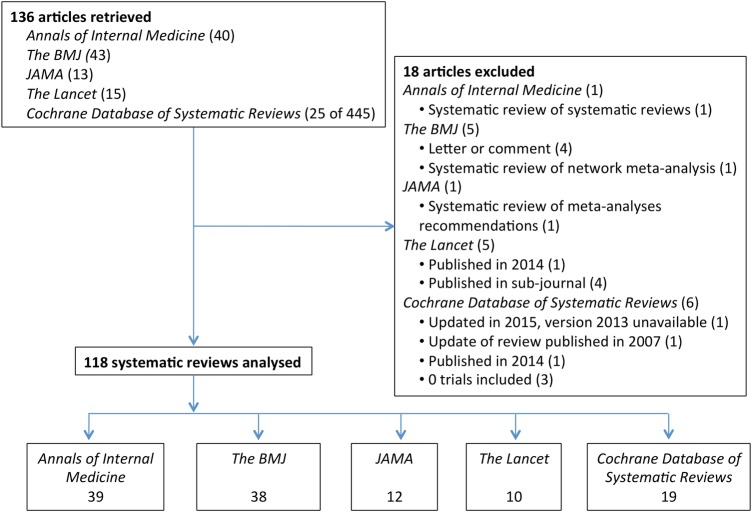
118 systematic reviews published in four journals (Ann Int Med, BMJ, JAMA, Lancet), and the Cochrane Library, in 2013.
Number (%) of reviews that applied procedures to reduce the impact of: (1) publication bias (through searching of unpublished trials), (2) selective outcome reporting (by contacting the authors of the original studies), (3) duplicate publications, (4) sponsors' and (5) authors' conflicts of interest, on the conclusions of the review, and (6) looked for ethical approval of the studies. Number (%) of reviewers who suspected misconduct are reported. The procedures applied were compared across journals.
80 (68%) reviewers confirmed their data. 59 (50%) reviews applied three or more procedures; 11 (9%) applied none. Unpublished trials were searched in 79 (66%) reviews. Authors of original studies were contacted in 73 (62%). Duplicate publications were searched in 81 (69%). 27 reviews (23%) reported sponsors of the included studies; 6 (5%) analysed their impact on the conclusions of the review. Five reviews (4%) looked at conflicts of interest of study authors; none of them analysed their impact. Three reviews (2.5%) looked at ethical approval of the studies. Seven reviews (6%) suspected misconduct; only 2 (2%) reported it explicitly. Procedures applied differed across the journals.
Only half of the systematic reviews applied three or more of the six procedures examined. Sponsors, conflicts of interest of authors and ethical approval remain overlooked. Research misconduct is sometimes identified, but rarely reported. Guidance on when, and how, to report suspected misconduct is needed.
研究系统评价者是否采用程序来平衡一些常见的研究不当行为,如不发表已完成的研究、重复发表或选择性报告结果,并观察他们是否识别和报告不当行为。
对系统评价进行横断面分析,并对其作者进行调查。
2013年发表在四种期刊(《内科学年鉴》《英国医学杂志》《美国医学会杂志》《柳叶刀》)以及考克兰图书馆上的118篇系统评价。
采用程序以减少以下因素对评价结论影响的评价数量(%):(1)发表偏倚(通过检索未发表的试验),(2)选择性结果报告(通过联系原始研究的作者),(3)重复发表,(4)资助者以及(5)作者的利益冲突,以及(6)寻求研究的伦理批准。报告怀疑存在不当行为的评价者数量(%)。比较各期刊所采用的程序。
80位(68%)评价者确认了他们的数据。59篇(50%)评价采用了三种或更多程序;11篇(9%)未采用任何程序。79篇(66%)评价检索了未发表的试验。73篇(62%)联系了原始研究的作者。81篇(69%)检索了重复发表情况。27篇评价(23%)报告了纳入研究的资助者;6篇(5%)分析了其对评价结论的影响。5篇评价(4%)关注了研究作者的利益冲突;其中无一分析其影响。3篇评价(2.5%)关注了研究的伦理批准。7篇评价(6%)怀疑存在不当行为;只有2篇(2%)明确报告了不当行为。各期刊所采用的程序有所不同。
只有一半的系统评价采用了所考察的六种程序中的三种或更多。资助者、作者的利益冲突和伦理批准仍然被忽视。有时能识别出研究不当行为,但很少报告。需要关于何时以及如何报告怀疑的不当行为的指南。