Rivinius Rasmus, Helmschrott Matthias, Ruhparwar Arjang, Schmack Bastian, Erbel Christian, Gleissner Christian A, Akhavanpoor Mohammadreza, Frankenstein Lutz, Darche Fabrice F, Schweizer Patrick A, Thomas Dierk, Ehlermann Philipp, Bruckner Tom, Katus Hugo A, Doesch Andreas O
Department of Cardiology, Angiology and Pneumology, Heidelberg University Hospital, Heidelberg, Germany.
Department of Cardiac Surgery, Heidelberg University Hospital, Heidelberg, Germany.
Drug Des Devel Ther. 2016 Feb 16;10:677-86. doi: 10.2147/DDDT.S96126. eCollection 2016.
Amiodarone is a frequently used antiarrhythmic drug in patients with end-stage heart failure. Given its long half-life, pre-transplant use of amiodarone has been controversially discussed, with divergent results regarding morbidity and mortality after heart transplantation (HTX).
The aim of this study was to investigate the effects of long-term use of amiodarone before HTX on early post-transplant atrial fibrillation (AF) and mortality after HTX.
Five hundred and thirty patients (age ≥18 years) receiving HTX between June 1989 and December 2012 were included in this retrospective single-center study. Patients with long-term use of amiodarone before HTX (≥1 year) were compared to those without long-term use (none or <1 year of amiodarone). Primary outcomes were early post-transplant AF and mortality after HTX. The Kaplan-Meier estimator using log-rank tests was applied for freedom from early post-transplant AF and survival.
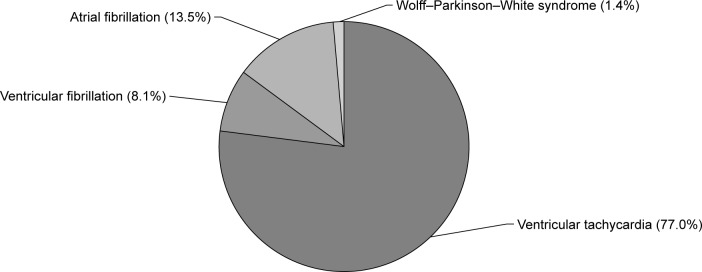
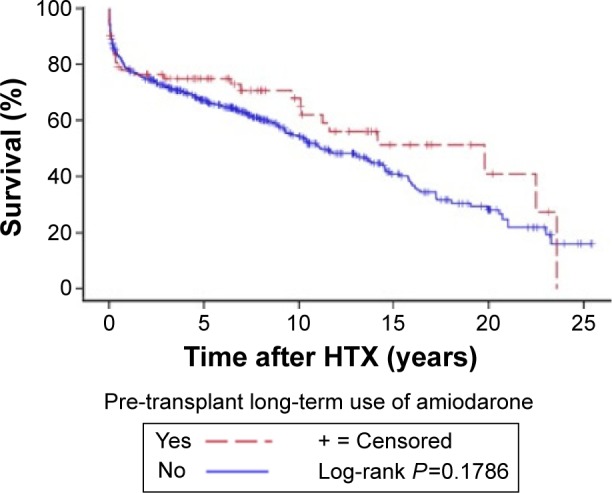
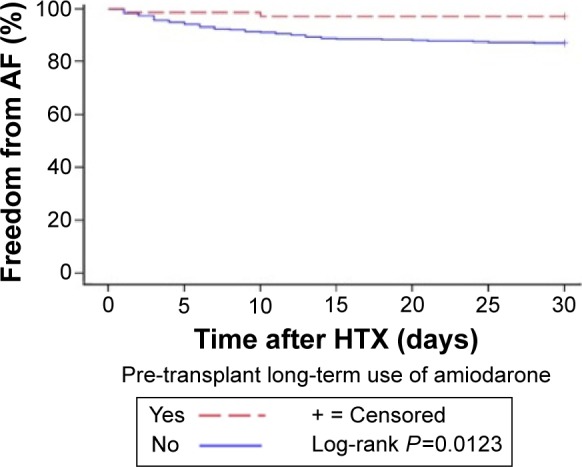
Of the 530 patients, 74 (14.0%) received long-term amiodarone therapy, with a mean duration of 32.3±26.3 months. Mean daily dose was 223.0±75.0 mg. Indications included AF, Wolff-Parkinson-White syndrome, ventricular tachycardia, and ventricular fibrillation. Patients with long-term use of amiodarone before HTX had significantly lower rates of early post-transplant AF (P=0.0105). Further, Kaplan-Meier analysis of freedom from early post-transplant AF showed significantly lower rates of AF in this group (P=0.0123). There was no statistically significant difference between patients with and without long-term use of amiodarone prior to HTX in 1-year (P=0.8596), 2-year (P=0.8620), 5-year (P=0.2737), or overall follow-up mortality after HTX (P=0.1049). Moreover, Kaplan-Meier survival analysis showed no statistically significant difference in overall survival (P=0.1786).
Long-term use of amiodarone in patients before HTX significantly reduces early post-transplant AF and is not associated with increased mortality after HTX.
胺碘酮是终末期心力衰竭患者常用的抗心律失常药物。鉴于其半衰期长,心脏移植(HTX)前使用胺碘酮一直存在争议,关于心脏移植后的发病率和死亡率结果不一。
本研究旨在探讨心脏移植前长期使用胺碘酮对移植后早期房颤(AF)及心脏移植后死亡率的影响。
本回顾性单中心研究纳入了1989年6月至2012年12月期间接受心脏移植的530例患者(年龄≥18岁)。将心脏移植前长期使用胺碘酮(≥1年)的患者与未长期使用(未使用或使用胺碘酮<1年)的患者进行比较。主要结局为移植后早期房颤和心脏移植后死亡率。采用对数秩检验的Kaplan-Meier估计法计算移植后早期房颤的无事件生存率和生存率。
530例患者中,74例(14.0%)接受了长期胺碘酮治疗,平均疗程为32.3±26.3个月。平均每日剂量为223.0±75.0mg。适应证包括房颤、预激综合征、室性心动过速和室颤。心脏移植前长期使用胺碘酮的患者移植后早期房颤发生率显著降低(P=0.0105)。此外,Kaplan-Meier分析显示该组移植后早期房颤发生率显著降低(P=0.0123)。心脏移植前长期使用胺碘酮与未长期使用胺碘酮的患者在1年(P=0.8596)、2年(P=0.8620)、5年(P=0.2737)或心脏移植后总体随访死亡率(P=0.1049)方面无统计学显著差异。此外,Kaplan-Meier生存分析显示总体生存率无统计学显著差异(P=0.1786)。
心脏移植前患者长期使用胺碘酮可显著降低移植后早期房颤发生率,且与心脏移植后死亡率增加无关。