Rivinius Rasmus, Helmschrott Matthias, Ruhparwar Arjang, Schmack Bastian, Darche Fabrice F, Thomas Dierk, Bruckner Tom, Katus Hugo A, Ehlermann Philipp, Doesch Andreas O
Department of Cardiology, Angiology and Pneumology, Heidelberg University Hospital, Heidelberg, Germany,
Department of Cardiac Surgery, Heidelberg University Hospital, Heidelberg, Germany.
Clin Epidemiol. 2018 Sep 27;10:1359-1369. doi: 10.2147/CLEP.S171929. eCollection 2018.
COPD is associated with reduced physical activity, an increased risk for pulmonary infections, and impaired survival in nontransplant patients. The aim of this study was to investigate the influence of COPD in patients after heart transplantation (HTX).
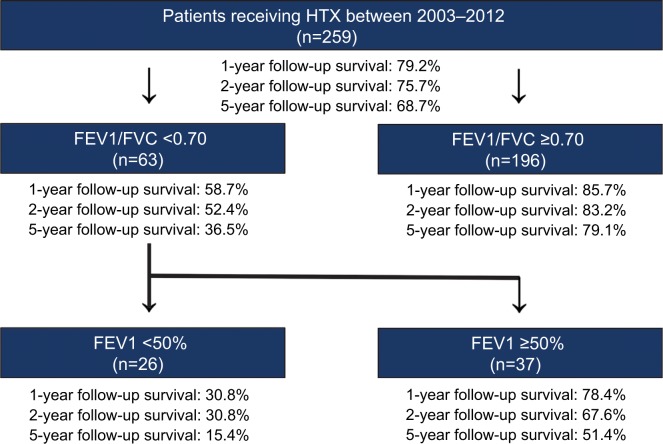
We performed an observational retrospective single-center study of 259 patients receiving HTX at Heidelberg University Hospital between 2003 and 2012. Patients were stratified by the Tiffeneau index (forced expiratory volume in 1 second/forced vital capacity [FEV1/FVC]) <0.70 before HTX. The analysis included demographics, posttransplant medication, length of the initial hospital stay after HTX, early posttransplant atrial fibrillation (AF), mortality, and causes of death.
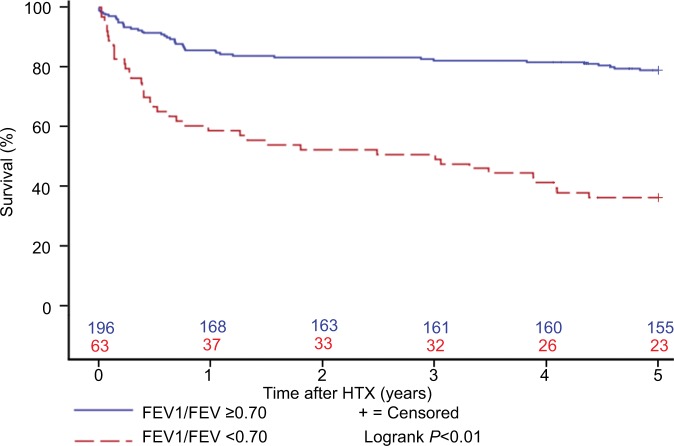
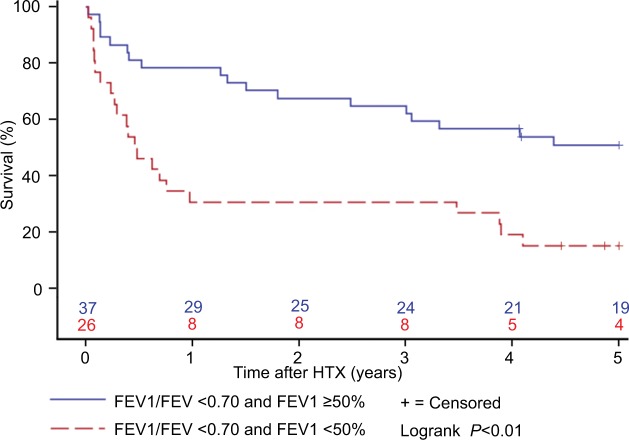
In total, 63 (24.3%) patients had an FEV1/FVC <0.70. These patients showed a prolonged hospital stay after HTX (52.0 days vs 43.4 days, mean difference (MD) = 8.6 days, 95% CI: 0.2, 17.0 days), a higher rate of early posttransplant AF (19.0% vs 8.2%, MD = 10.8%, 95% CI: 0.4%, 21.2%), and an increased 30-day mortality (9.5% vs 2.6%, HR = 3.79, 95% CI: 1.16, 12.40). Kaplan- Meier analysis showed a significant inferior 5-year survival in patients with an FEV1/FVC <0.70, along with a higher percentage of death due to transplant failure and infection/sepsis. In addition, a multivariate analysis for mortality within 5 years after HTX indicated an FEV1/FVC <0.70 as a significant risk factor for impaired 5-year posttransplant survival (HR =4.77, 95% CI: 2.76, 8.22).
COPD in patients after HTX is associated with a prolonged hospital stay, early posttransplant AF, and impaired posttransplant survival.
慢性阻塞性肺疾病(COPD)与非移植患者的体力活动减少、肺部感染风险增加及生存率受损有关。本研究旨在调查COPD对心脏移植(HTX)术后患者的影响。
我们对2003年至2012年间在海德堡大学医院接受HTX的259例患者进行了一项观察性回顾性单中心研究。根据HTX术前的蒂夫诺指数(1秒用力呼气量/用力肺活量[FEV1/FVC])<0.70对患者进行分层。分析内容包括人口统计学资料、移植后用药情况、HTX术后首次住院时间、移植后早期房颤(AF)、死亡率及死亡原因。
共有63例(24.3%)患者的FEV1/FVC<0.70。这些患者HTX术后住院时间延长(52.0天对43.4天,平均差值[MD]=8.6天,95%置信区间[CI]:0.2,17.0天),移植后早期AF发生率更高(19.0%对8.2%,MD=10.8%,95%CI:0.4%,21.2%),30天死亡率增加(9.5%对2.6%,风险比[HR]=3.79,95%CI:1.16,12.40)。Kaplan-Meier分析显示,FEV1/FVC<0.70的患者5年生存率显著较低,且因移植失败和感染/脓毒症导致的死亡百分比更高。此外,对HTX术后5年内死亡率的多因素分析表明,FEV1/FVC<0.70是移植后5年生存率受损的一个显著危险因素(HR=4.77,95%CI:2.76,8.22)。
HTX术后患者的COPD与住院时间延长、移植后早期AF及移植后生存率受损有关。