van Griensven Johan, Gadisa Endalamaw, Aseffa Abraham, Hailu Asrat, Beshah Abate Mulugeta, Diro Ermias
Department of Clinical Sciences, Institute of Tropical Medicine, Antwerp, Belgium.
Armauer Hansen Research Institute (AHRI), Addis Ababa, Ethiopia.
PLoS Negl Trop Dis. 2016 Mar 3;10(3):e0004495. doi: 10.1371/journal.pntd.0004495. eCollection 2016 Mar.
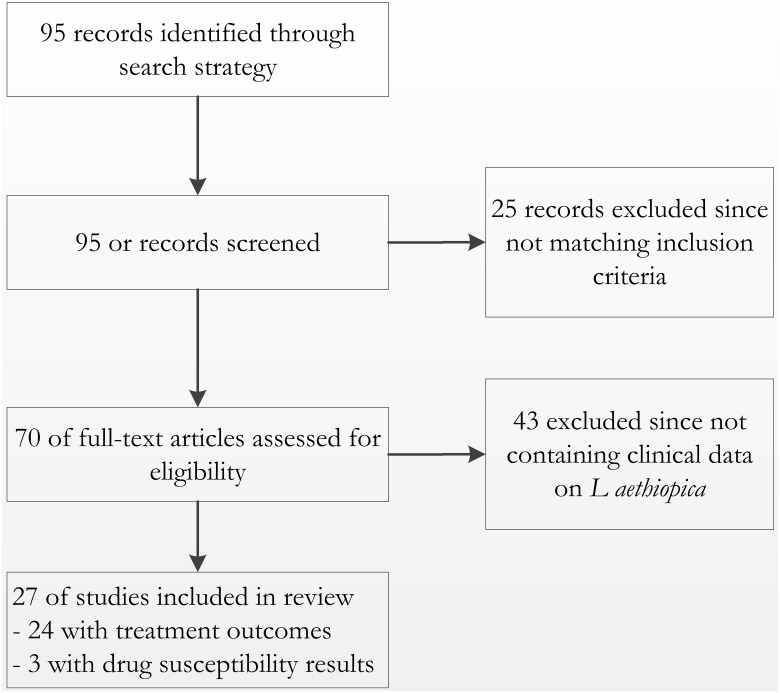
Leishmania aethiopica is the etiological agent of cutaneous leishmaniasis (CL) in Ethiopia and can cause severe and complicated cases such as diffuse CL (DCL), mucocutaneous leishmaniasis or extensive CL, requiring systemic treatment. Despite the substantial burden, evidence-based treatment guidelines are lacking. We conducted a systematic review of clinical studies reporting on treatment outcomes of CL due to L aethiopica in order to help identify potentially efficacious medications on CL that can be taken forward for clinical trials. We identified a total of 24 records reporting on 506 treatment episodes of CL presumably due to L aethiopica. The most commonly used drugs were antimonials (n = 201), pentamidine (n = 150) and cryotherapy (n = 103). There were 20 case reports/series, with an overall poor study quality. We only identified two small and/or poor quality randomized controlled trials conducted a long time ago. There were two prospective non-randomized studies reporting on cryotherapy, antimonials and pentamidine. With cryotherapy, cure rates were 60-80%, and 69-85% with antimonials. Pentamidine appeared effective against complicated CL, also in cases non-responsive to antimonials. However, all studies suffered from methodological limitations. Data on miltefosine, paromomycin and liposomal amphotericin B are extremely scarce. Only a few studies are available on DCL. The only potentially effective treatment options for DCL seem to be antimonials with paromomycin in combination or pentamidine, but none have been properly evaluated. In conclusion, the evidence-base for treatment of complicated CL due to L aethiopica is extremely limited. While antimonials remain the most available CL treatment in Ethiopia, their efficacy and safety in CL should be better defined. Most importantly, alternative first line treatments (such as miltefosine or paromomycin) should be explored. High quality trials on CL due to L aethiopica are urgently needed, exploring group sequential methods to evaluate several options in parallel.
埃塞俄比亚利什曼原虫是埃塞俄比亚皮肤利什曼病(CL)的病原体,可导致严重和复杂的病例,如弥漫性CL(DCL)、黏膜皮肤利什曼病或广泛性CL,需要进行全身治疗。尽管负担沉重,但缺乏循证治疗指南。我们对报告埃塞俄比亚利什曼原虫所致CL治疗结果的临床研究进行了系统评价,以帮助确定可能对CL有效的药物,以便推进临床试验。我们共识别出24份记录,报告了大概由埃塞俄比亚利什曼原虫所致的506例CL治疗病例。最常用的药物是锑剂(n = 201)、喷他脒(n = 150)和冷冻疗法(n = 103)。有20例病例报告/系列研究,总体研究质量较差。我们仅识别出两项很久以前开展的小型和/或质量较差的随机对照试验。有两项前瞻性非随机研究报告了冷冻疗法、锑剂和喷他脒的情况。采用冷冻疗法时,治愈率为60 - 80%,采用锑剂时为69 - 85%。喷他脒似乎对复杂的CL有效,对锑剂无反应的病例也有效。然而,所有研究都存在方法学局限性。关于米替福新、巴龙霉素和脂质体两性霉素B的数据极为稀少。关于DCL仅有少数研究。DCL唯一可能有效的治疗选择似乎是锑剂与巴龙霉素联合使用或喷他脒,但均未得到恰当评估。总之,埃塞俄比亚利什曼原虫所致复杂CL的治疗循证极为有限。虽然锑剂仍是埃塞俄比亚最常用的CL治疗药物,但其在CL中的疗效和安全性应得到更好的界定。最重要的是,应探索替代一线治疗方法(如米替福新或巴龙霉素)。迫切需要开展关于埃塞俄比亚利什曼原虫所致CL的高质量试验,探索成组序贯方法以并行评估多种选择。