Raghavan Ram K, Goodin Douglas G, Neises Daniel, Anderson Gary A, Ganta Roman R
Kansas State Veterinary Diagnostic Laboratory, Department of Diagnostic Medicine and Pathobiology, Kansas State University, Manhattan, Kansas, United States of America.
Center for Excellence in Vector Borne Diseases, Department of Diagnostic Medicine and Pathobiology, Kansas State University, Manhattan, Kansas, United States of America.
PLoS One. 2016 Mar 4;11(3):e0150180. doi: 10.1371/journal.pone.0150180. eCollection 2016.
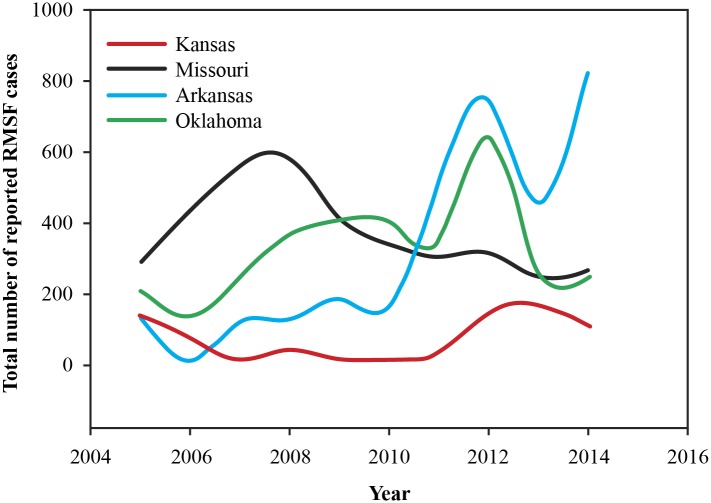
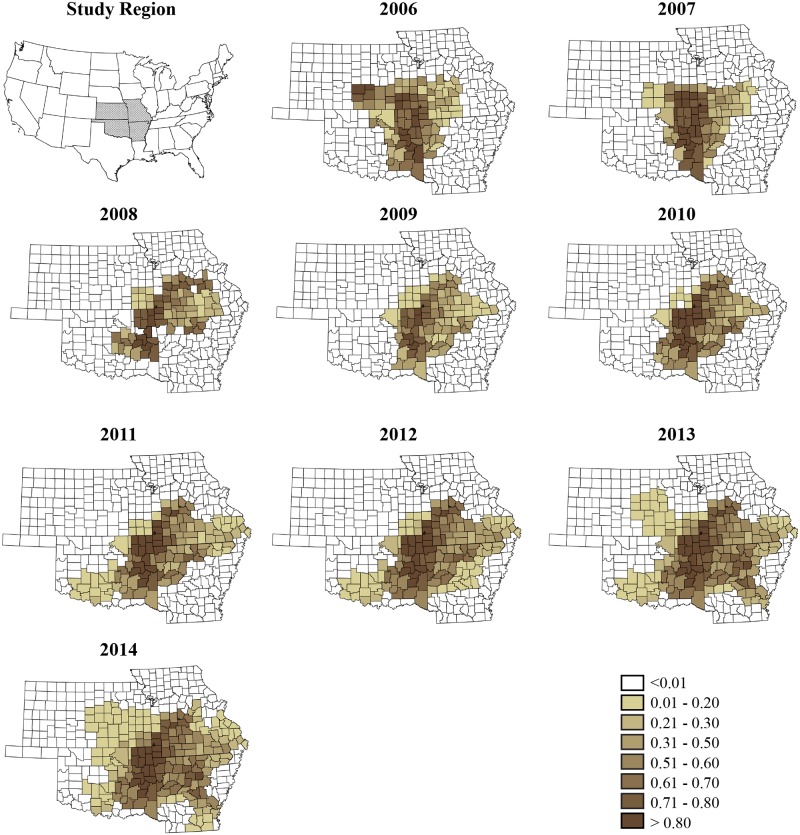
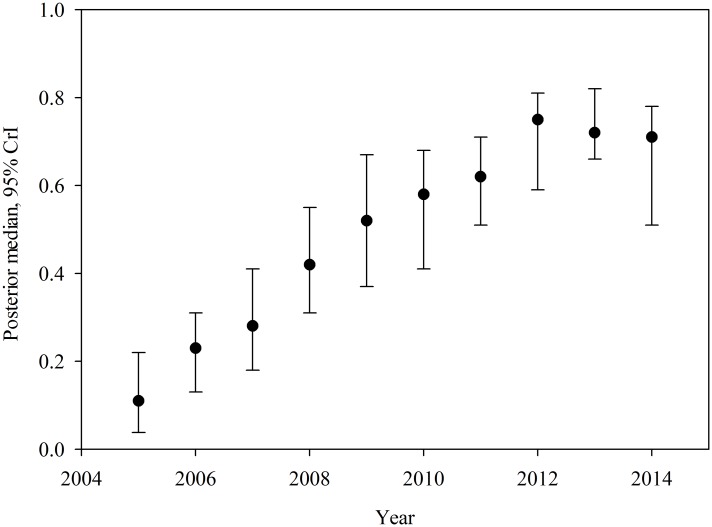
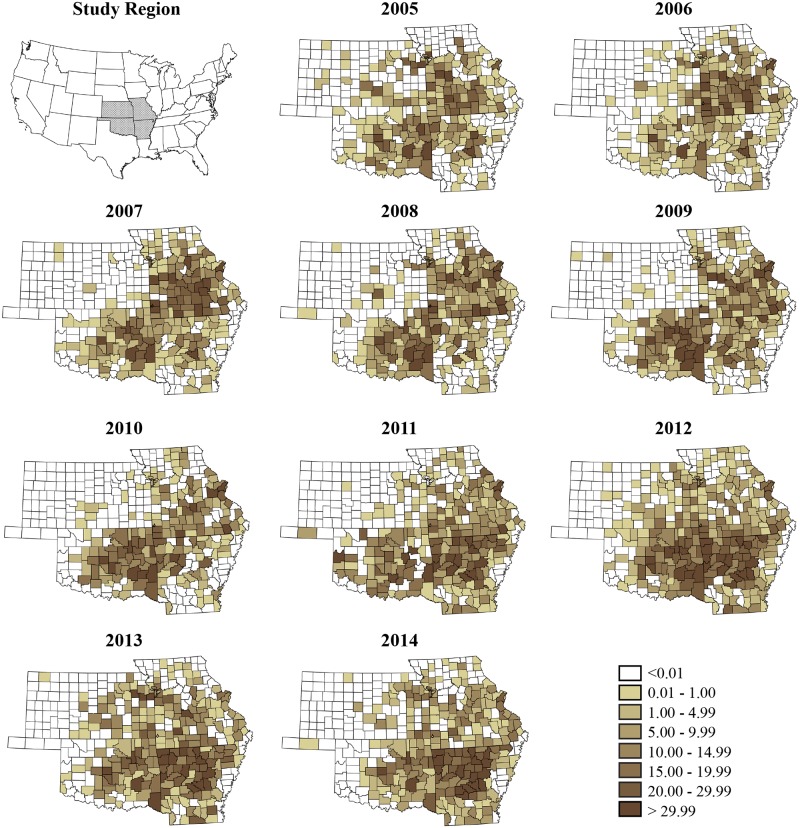
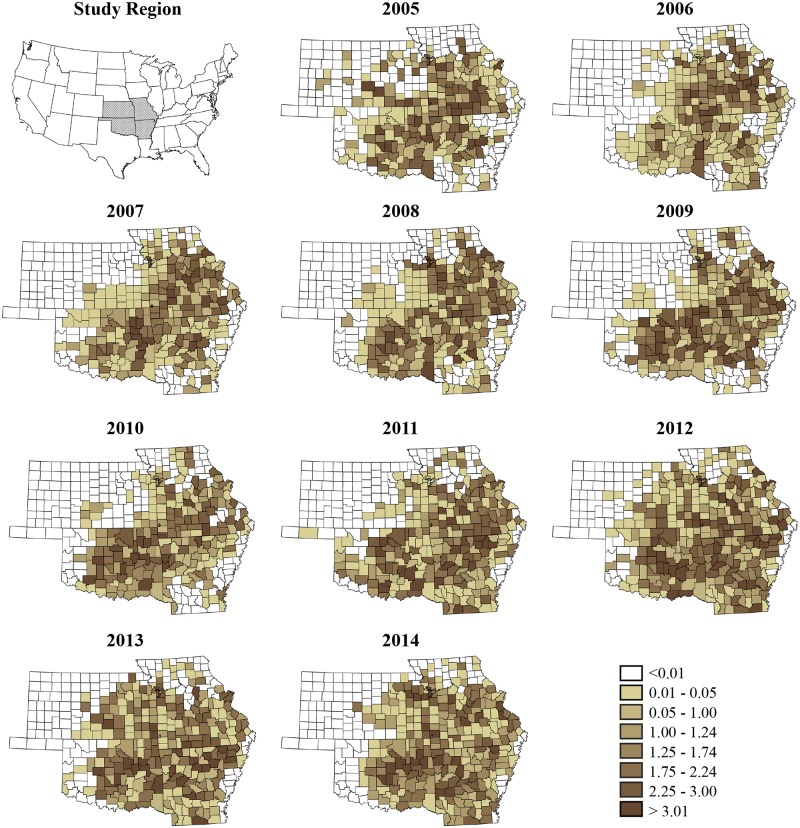
This study aims to examine the spatio-temporal dynamics of Rocky Mountain spotted fever (RMSF) prevalence in four contiguous states of Midwestern United States, and to determine the impact of environmental and socio-economic factors associated with this disease. Bayesian hierarchical models were used to quantify space and time only trends and spatio-temporal interaction effect in the case reports submitted to the state health departments in the region. Various socio-economic, environmental and climatic covariates screened a priori in a bivariate procedure were added to a main-effects Bayesian model in progressive steps to evaluate important drivers of RMSF space-time patterns in the region. Our results show a steady increase in RMSF incidence over the study period to newer geographic areas, and the posterior probabilities of county-specific trends indicate clustering of high risk counties in the central and southern parts of the study region. At the spatial scale of a county, the prevalence levels of RMSF is influenced by poverty status, average relative humidity, and average land surface temperature (>35°C) in the region, and the relevance of these factors in the context of climate-change impacts on tick-borne diseases are discussed.
本研究旨在考察美国中西部四个相邻州落基山斑疹热(RMSF)流行的时空动态,并确定与该疾病相关的环境和社会经济因素的影响。在提交给该地区各州卫生部门的病例报告中,采用贝叶斯分层模型来量化仅空间和时间趋势以及时空交互效应。在逐步回归过程中,将通过双变量程序事先筛选出的各种社会经济、环境和气候协变量添加到主效应贝叶斯模型中,以评估该地区RMSF时空模式的重要驱动因素。我们的结果表明,在研究期间RMSF发病率稳步上升至新地理区域,且特定县趋势的后验概率表明高风险县集中在研究区域的中部和南部。在县的空间尺度上,RMSF的流行水平受该地区贫困状况、平均相对湿度和平均地表温度(>35°C)的影响,并讨论了这些因素在气候变化对蜱传疾病影响背景下的相关性。