Tong Qiang, Weaver Michael R, Kosmacek Elizabeth A, O'Connor Brian P, Harmacek Laura, Venkataraman Sujatha, Oberley-Deegan Rebecca E
Department of Biochemistry and Molecular Biology, University of Nebraska Medical Center, Omaha, NE, 68198, USA; Department of Gastrointestinal Surgery, Union Hospital, Tongji Medical College, Huazhong University of Science and Technology, Wuhan 430022, China.
Department of Medicine, National Jewish Health, Denver, CO 80206, USA.
Free Radic Biol Med. 2016 May;94:185-94. doi: 10.1016/j.freeradbiomed.2016.02.036. Epub 2016 Mar 2.
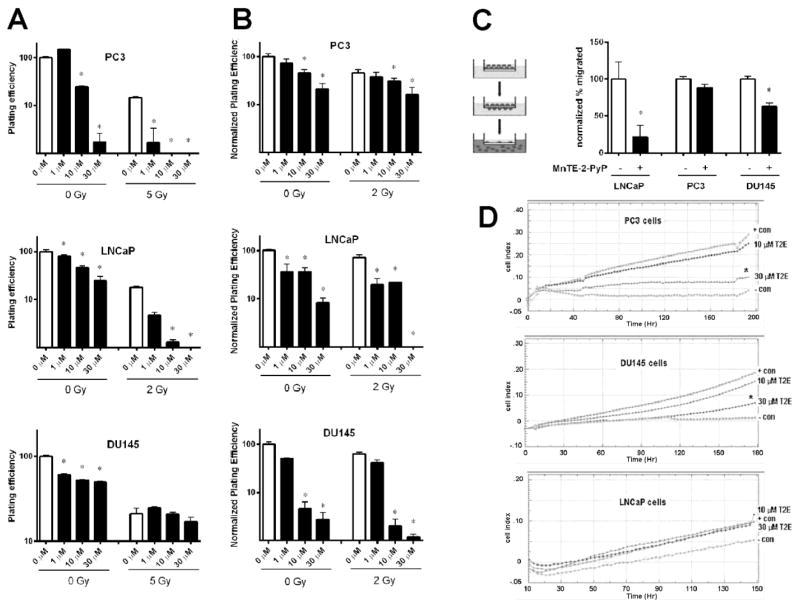
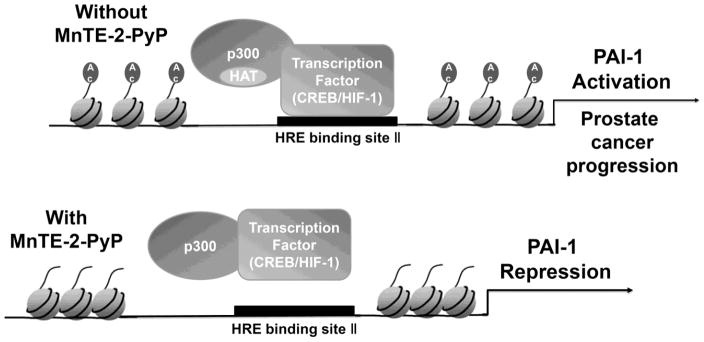
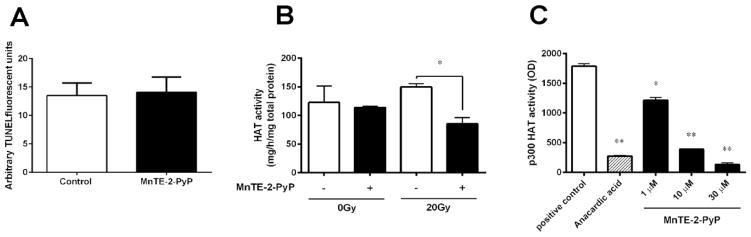
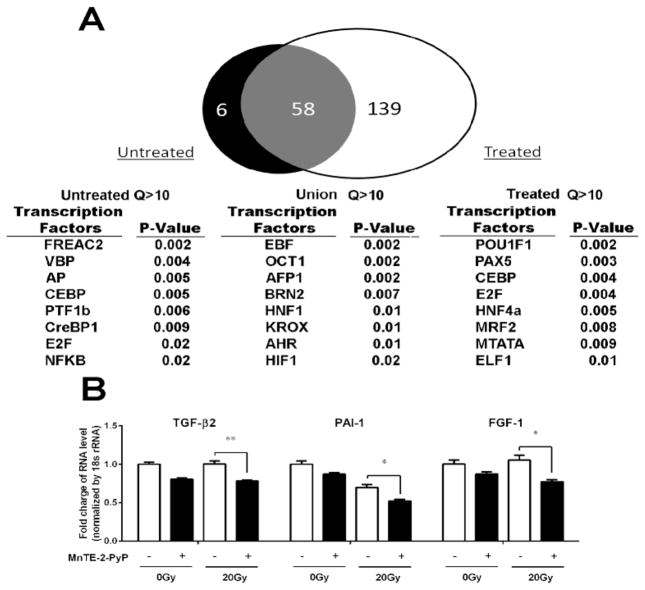
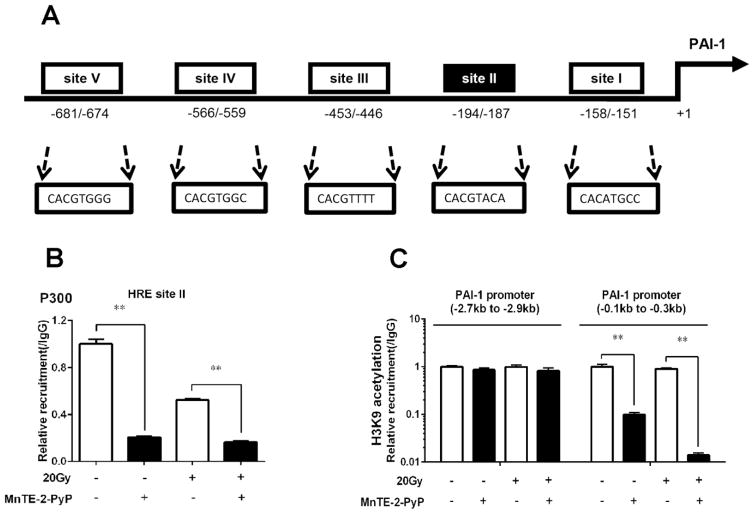
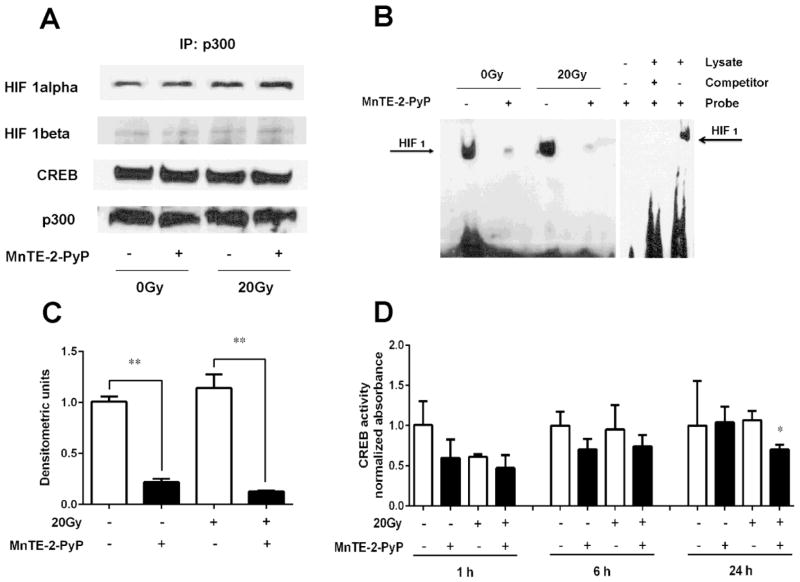
To improve radiation therapy-induced quality of life impairments for prostate cancer patients, the development of radio-protectors is needed. Our previous work has demonstrated that MnTE-2-PyP significantly protects urogenital tissues from radiation-induced damage. So, in order for MnTE-2-PyP to be used clinically as a radio-protector, it is fully necessary to explore the effect of MnTE-2-PyP on human prostate cancer progression. MnTE-2-PyP inhibited prostate cancer growth in the presence and absence of radiation and also inhibited prostate cancer migration and invasion. MnTE-2-PyP altered p300 DNA binding, which resulted in the inhibition of HIF-1β and CREB signaling pathways. Accordingly, we also found that MnTE-2-PyP reduced the expression of three genes regulated by HIF-1β and/or CREB: TGF-β2, FGF-1 and PAI-1. Specifically, MnTE-2-PyP decreased p300 complex binding to a specific HRE motif within the PAI-1 gene promoter region, suppressed H3K9 acetylation, and consequently, repressed PAI-1 expression. Mechanistically, less p300 transcriptional complex binding is not due to the reduction of binding between p300 and HIF-1/CREB transcription factors, but through inhibiting the binding of HIF-1/CREB transcription factors to DNA. Our data provide an in depth mechanism by which MnTE-2-PyP reduces prostate cancer growth and metastasis, which validates the clinical use of MnTE-2-PyP as a radio-protector to enhance treatment outcomes in prostate cancer radiotherapy.
为改善前列腺癌患者因放射治疗引起的生活质量损害,需要开发放射防护剂。我们之前的研究表明,MnTE-2-PyP能显著保护泌尿生殖组织免受辐射损伤。因此,为使MnTE-2-PyP能作为放射防护剂用于临床,全面探究MnTE-2-PyP对人类前列腺癌进展的影响是完全必要的。MnTE-2-PyP在有或无辐射的情况下均能抑制前列腺癌生长,还能抑制前列腺癌的迁移和侵袭。MnTE-2-PyP改变了p300的DNA结合,从而导致HIF-1β和CREB信号通路受到抑制。相应地,我们还发现MnTE-2-PyP降低了受HIF-1β和/或CREB调控的三个基因的表达:TGF-β2、FGF-1和PAI-1。具体而言,MnTE-2-PyP减少了p300复合物与PAI-1基因启动子区域内特定HRE基序的结合,抑制了H3K9乙酰化,进而抑制了PAI-1的表达。从机制上来说,p300转录复合物结合减少并非由于p300与HIF-1/CREB转录因子之间结合的减少,而是通过抑制HIF-1/CREB转录因子与DNA的结合。我们的数据提供了一个深入的机制,通过该机制MnTE-2-PyP可减少前列腺癌的生长和转移,这验证了MnTE-2-PyP作为放射防护剂在前列腺癌放疗中增强治疗效果的临床应用。