Kawahara Takashi, Furuya Kazuhiro, Nakamura Manami, Sakamaki Kentaro, Osaka Kimito, Ito Hiroki, Ito Yusuke, Izumi Koji, Ohtake Shinji, Miyoshi Yasuhide, Makiyama Kazuhide, Nakaigawa Noboru, Yamanaka Takeharu, Miyamoto Hiroshi, Yao Masahiro, Uemura Hiroji
Department of Urology, Graduate School of Medicine, Yokohama City University, Yokohama, Japan.
Departments of Urology and Renal Transportation, Yokohama City University Medical Center, Yokohama, Japan.
BMC Cancer. 2016 Mar 5;16:185. doi: 10.1186/s12885-016-2219-z.
There is no reliable biomarker for predicting the prognosis of patients who undergo radical cystectomy for bladder cancer. Recent studies have shown that the neutrophil-to-lymphocyte ratio (NLR) could function as a useful prognostic factor in several types of malignancies. This study aimed to assess the usefulness of NLR in bladder cancer.
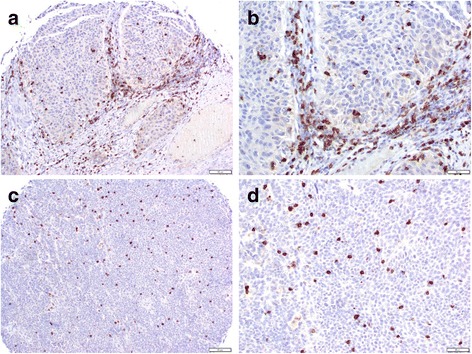
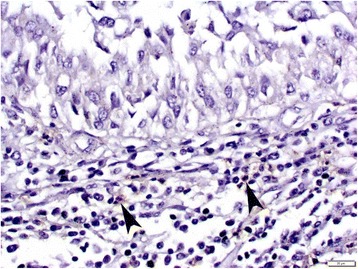
A total of 74 patients who underwent radical cystectomy in our institutions from 1999 to 2014 were analyzed. The NLR was calculated using the patients' neutrophil and lymphocyte counts before radical cystectomy. An immunohistochemical analysis was also performed to detect tumor infiltrating neutrophils (CD66b) and lymphocytes (CD8) in bladder cancer specimens.
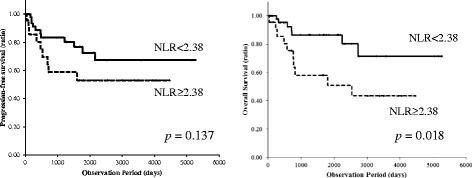
A univariate analysis showed that the patients with a high NLR (≥2.38; HR = 4.84; p = 0.007), high C-reactive protein level (>0.08; HR = 10.06; p = 0.030), or pathological lymph node metastasis (HR = 4.73; p = 0.030) had a significantly higher risk of cancer-specific mortality. Kaplan-Meier and log-rank tests further revealed that NLR was strongly correlated with overall survival (p = 0.018), but not progression-free survival (p = 0.137). In a multivariate analysis, all of these were found to be independent risk factors (HR = 4.62, 10.8, and 12.35, respectively). The number of CD8-positive lymphocytes was significantly increased in high-grade (p = 0.001) and muscle-invasive (p = 0.012) tumors, in comparison to low-grade and non-muscle-invasive tumors, respectively.
The NLR predicted the prognosis of patients who underwent radical cystectomy and might therefore function as a reliable biomarker in cases of invasive bladder cancer.
目前尚无可靠的生物标志物可用于预测接受膀胱癌根治性膀胱切除术患者的预后。近期研究表明,中性粒细胞与淋巴细胞比值(NLR)可作为多种恶性肿瘤有用的预后因素。本研究旨在评估NLR在膀胱癌中的作用。
对1999年至2014年在我们机构接受根治性膀胱切除术的74例患者进行分析。NLR通过根治性膀胱切除术前行患者中性粒细胞和淋巴细胞计数计算得出。还进行了免疫组化分析以检测膀胱癌标本中的肿瘤浸润中性粒细胞(CD66b)和淋巴细胞(CD8)。
单因素分析显示,NLR高(≥2.38;HR = 4.84;p = 0.007)、C反应蛋白水平高(>0.08;HR = 10.06;p = 0.030)或病理淋巴结转移(HR = 4.73;p = 0.030)的患者癌症特异性死亡风险显著更高。Kaplan-Meier和对数秩检验进一步显示,NLR与总生存期密切相关(p = 0.018),但与无进展生存期无关(p = 0.137)。多因素分析发现,所有这些均为独立危险因素(HR分别为4.62、10.8和12.35)。与低级别和非肌层浸润性肿瘤相比,高级别(p = 0.001)和肌层浸润性(p = 0.012)肿瘤中CD8阳性淋巴细胞数量显著增加。
NLR可预测接受根治性膀胱切除术患者的预后,因此可能作为浸润性膀胱癌病例中一种可靠的生物标志物。