Sorensen Steffen Filskov, Zhou Wei, Dolled-Filhart Marisa, Georgsen Jeanette Baehr, Wang Zhen, Emancipator Kenneth, Wu Dianna, Busch-Sørensen Michael, Meldgaard Peter, Hager Henrik
Department of Oncology, Aarhus University Hospital, Norrebrogade 44, DK-8000 Aarhus C, Denmark.
Merck & Co., Inc., 2000 Galloping Hill Rd, Kenilworth, NJ, USA.
Transl Oncol. 2016 Feb;9(1):64-69. doi: 10.1016/j.tranon.2016.01.003.
Recent clinical trial results have suggested that programmed cell death ligand 1 (PD-L1) expression measured by immunohistochemistry may predict response to anti-programmed cell death 1 (PD-1) therapy. Results on the association between PD-L1 expression and survival among patients with advanced non-small cell lung cancer (NSCLC) treated with chemotherapy are inconsistent.
We evaluated the relationship between PD-L1 expression and overall survival (OS) among 204 patients with advanced NSCLC treated at Aarhus University Hospital, Aarhus, Denmark, from 2007 to 2012. PD-L1 expression was measured using a prototype immunohistochemistry assay with the anti-PD-L1 22C3 antibody (Merck). PD-L1 strong positivity and weak positivity were defined to be traceable to the clinical trial version of the assay.
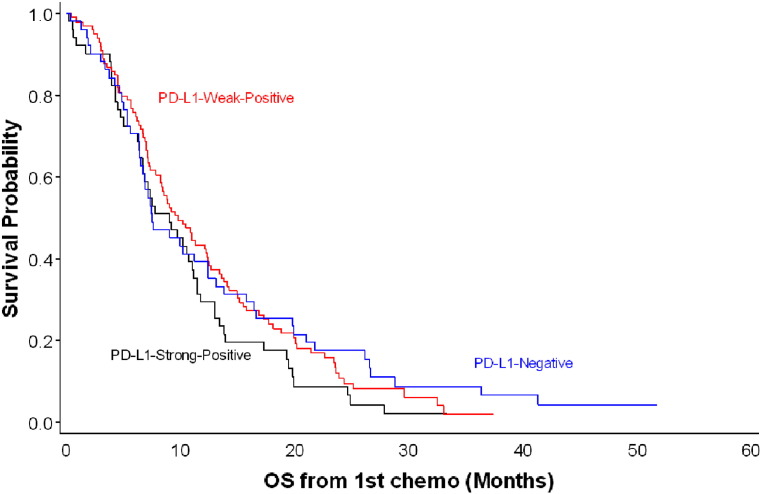
Twenty-five percent of patients had PD-L1 strong-positive tumors, and 50% had PD-L1 weak-positive tumors. No statistically significant association was found between PD-L1 expression and survival; adjusted hazard ratio of 1.34 (95% confidence interval, 0.88-2.03; median OS, 9.0 months) for the PD-L1 strong-positive group and 1.07 (0.74-1.55; median OS, 9.8 months) for the PD-L1 weak-positive group compared with the PD-L1-negative group (median OS, 7.5 months). No association was seen between PD-L1 expression and OS when PD-L1 expression levels were stratified by median or tertiles.
In concordance with previous studies, we found PD-L1 measured by immunohistochemistry to be frequently expressed in patients with advanced NSCLC. However, PD-L1 expression is not a strong prognostic marker in patients with advanced NSCLC treated with chemotherapy.
近期临床试验结果表明,通过免疫组织化学检测的程序性细胞死亡配体1(PD-L1)表达可能预测对抗程序性细胞死亡蛋白1(PD-1)治疗的反应。关于接受化疗的晚期非小细胞肺癌(NSCLC)患者中PD-L1表达与生存之间的关联结果并不一致。
我们评估了2007年至2012年在丹麦奥胡斯奥胡斯大学医院接受治疗的204例晚期NSCLC患者中PD-L1表达与总生存期(OS)之间的关系。使用抗PD-L1 22C3抗体(默克公司)的原型免疫组织化学检测法测量PD-L1表达。PD-L1强阳性和弱阳性的定义可追溯到该检测法的临床试验版本。
25%的患者肿瘤为PD-L1强阳性,50%为PD-L1弱阳性。未发现PD-L1表达与生存之间存在统计学显著关联;与PD-L1阴性组(中位OS,7.5个月)相比,PD-L1强阳性组的调整后风险比为1.34(95%置信区间,0.88 - 2.03;中位OS,9.0个月),PD-L1弱阳性组为1.07(0.74 - 1.55;中位OS,9.8个月)。当按中位数或三分位数对PD-L1表达水平进行分层时,未发现PD-L1表达与OS之间存在关联。
与先前研究一致,我们发现通过免疫组织化学检测的PD-L1在晚期NSCLC患者中经常表达。然而,PD-L1表达在接受化疗的晚期NSCLC患者中不是一个强有力的预后标志物。