Brattoli Biagio, Mostafavi Mohammad, Lee Taebum, Jung Wonkyung, Ryu Jeongun, Park Seonwook, Park Jongchan, Pereira Sergio, Shin Seunghwan, Choi Sangjoon, Kim Hyojin, Yoo Donggeun, Ali Siraj M, Paeng Kyunghyun, Ock Chan-Young, Cho Soo Ick, Kim Seokhwi
Lunit, Seoul, Republic of Korea.
Department of Pathology and Translational Genomics, Samsung Medical Center, Sungkyunkwan University School of Medicine, Seoul, Republic of Korea.
NPJ Precis Oncol. 2024 Dec 3;8(1):277. doi: 10.1038/s41698-024-00770-z.
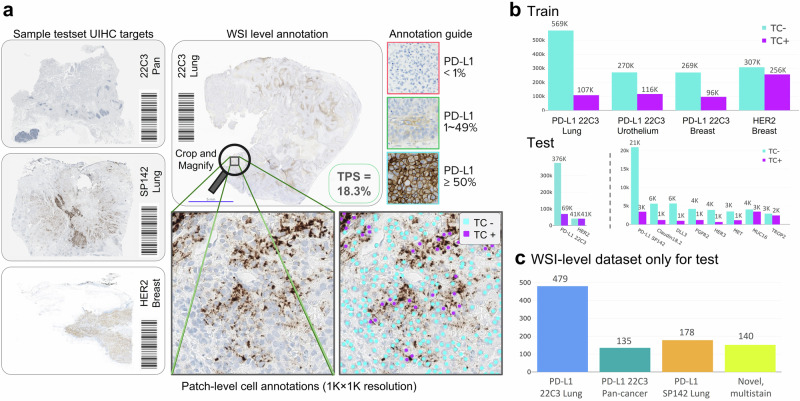
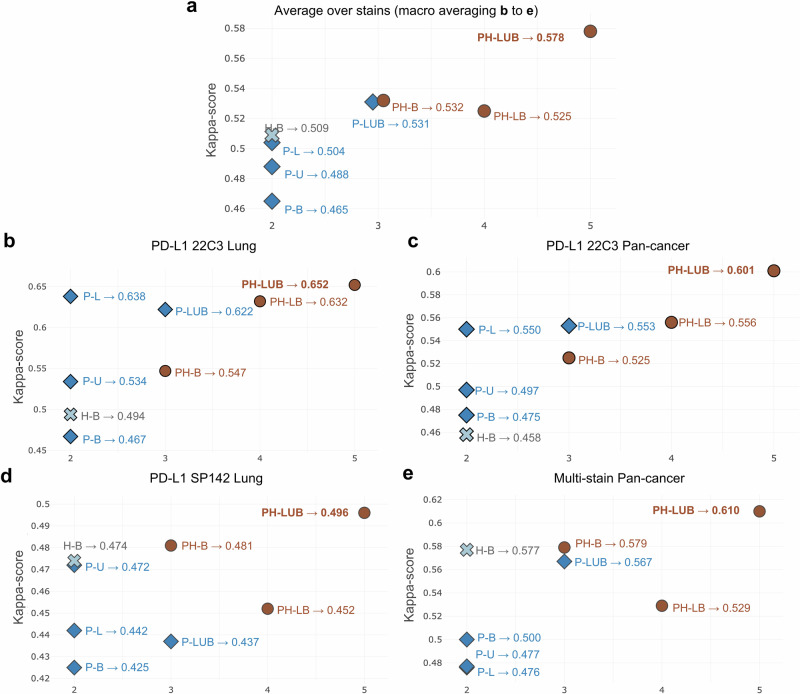
Immunohistochemistry (IHC) is the common companion diagnostics in targeted therapies. However, quantifying protein expressions in IHC images present a significant challenge, due to variability in manual scoring and inherent subjective interpretation. Deep learning (DL) offers a promising approach to address these issues, though current models require extensive training for each cancer and IHC type, limiting the practical application. We developed a Universal IHC (UIHC) analyzer, a DL-based tool that quantifies protein expression across different cancers and IHC types. This multi-cohort trained model outperformed conventional single-cohort models in analyzing unseen IHC images (Kappa score 0.578 vs. up to 0.509) and demonstrated consistent performance across varying positive staining cutoff values. In a discovery application, the UIHC model assigned higher tumor proportion scores to MET amplification cases, but not MET exon 14 splicing or other non-small cell lung cancer cases. This UIHC model represents a novel role for DL that further advances quantitative analysis of IHC.
免疫组织化学(IHC)是靶向治疗中常用的伴随诊断方法。然而,由于手动评分的变异性和固有的主观解释,对IHC图像中的蛋白质表达进行量化是一项重大挑战。深度学习(DL)为解决这些问题提供了一种很有前景的方法,不过目前的模型需要针对每种癌症和IHC类型进行广泛训练,这限制了其实际应用。我们开发了一种通用免疫组织化学(UIHC)分析仪,这是一种基于深度学习的工具,可对不同癌症和IHC类型的蛋白质表达进行量化。这种多队列训练的模型在分析未见过的IHC图像时优于传统的单队列模型(卡帕值为0.578,而单队列模型最高为0.509),并且在不同的阳性染色临界值下都表现出一致的性能。在一项探索性应用中,UIHC模型为MET扩增病例赋予了更高的肿瘤比例评分,但对MET第14外显子剪接或其他非小细胞肺癌病例则不然。这种UIHC模型代表了深度学习的一种新作用,进一步推动了免疫组织化学的定量分析。