Giverso Chiara, Ciarletta Pasquale
Dipartimento di Matematica - MOX, Politecnico di Milano and Fondazione CEN, Piazza Leonardo da Vinci, 32-20133 Milano, Italy.
CNRS and Sorbonne Universités, UPMC Univ Paris 06, UMR 7190, Institut Jean le Rond d'Alembert, 4 place Jussieu case 162, 75005 Paris, France.
Sci Rep. 2016 Mar 7;6:22610. doi: 10.1038/srep22610.
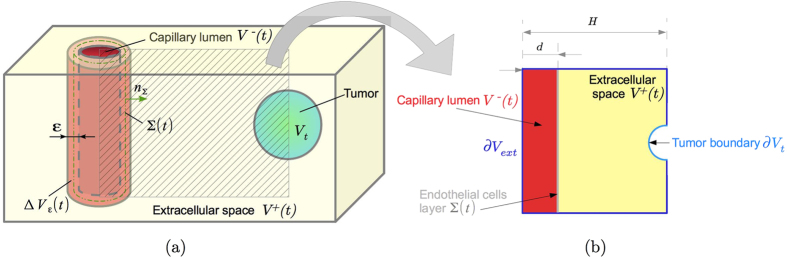
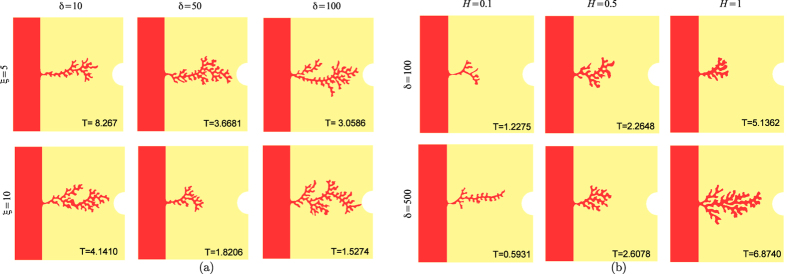
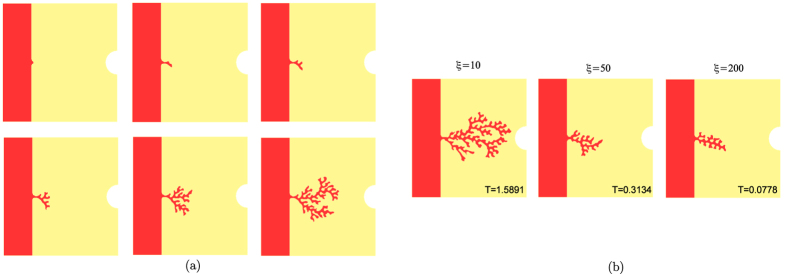
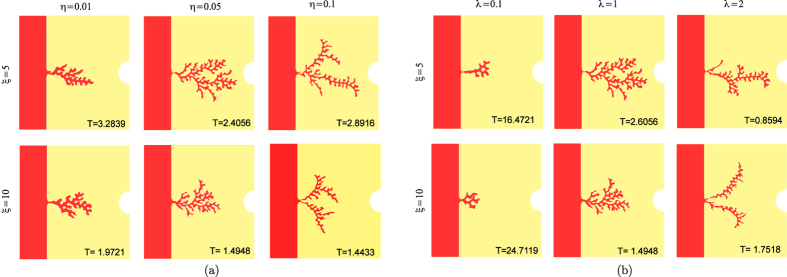
The hypoxic conditions within avascular solid tumours may trigger the secretion of chemical factors, which diffuse to the nearby vasculature and promote the formation of new vessels eventually joining the tumour. Mathematical models of this process, known as tumour angiogenesis, have mainly investigated the formation of the new capillary networks using reaction-diffusion equations. Since angiogenesis involves the growth dynamics of the endothelial cells sprouting, we propose in this work an alternative mechanistic approach, developing a surface growth model for studying capillary formation and network dynamics. The model takes into account the proliferation of endothelial cells on the pre-existing capillary surface, coupled with the bulk diffusion of the vascular endothelial growth factor (VEGF). The thermo-dynamical consistency is imposed by means of interfacial and bulk balance laws. Finite element simulations show that both the morphology and the dynamics of the sprouting vessels are controlled by the bulk diffusion of VEGF and the chemo-mechanical and geometric properties at the capillary interface. Similarly to dendritic growth processes, we suggest that the emergence of tree-like vessel structures during tumour angiogenesis may result from the free boundary instability driven by competition between chemical and mechanical phenomena occurring at different length-scales.
无血管实体瘤内的缺氧环境可能会触发化学因子的分泌,这些化学因子扩散到附近的脉管系统,最终促进新血管形成并与肿瘤相连。这个过程被称为肿瘤血管生成,其数学模型主要使用反应扩散方程来研究新毛细血管网络的形成。由于血管生成涉及内皮细胞芽生的生长动力学,我们在这项工作中提出了一种替代的机制方法,开发一种表面生长模型来研究毛细血管形成和网络动力学。该模型考虑了内皮细胞在已有毛细血管表面的增殖,以及血管内皮生长因子(VEGF)的体扩散。通过界面和体平衡定律来保证热力学一致性。有限元模拟表明,芽生血管的形态和动力学均受VEGF的体扩散以及毛细血管界面处的化学力学和几何特性控制。与树枝状生长过程类似,我们认为肿瘤血管生成过程中树状血管结构的出现可能是由不同长度尺度上发生的化学和机械现象之间的竞争所驱动的自由边界不稳定性导致的。