Tuyet-Hanh Tran Thi, Lee Jong-Koo, Oh Juhwan, Van Minh Hoang, Ou Lee Chul, Hoan Le Thi, Nam You-Seon, Long Tran Khanh
Hanoi School of Public Health, Hanoi, Vietnam;
JW LEE Center for Global Medicine, Seoul National University College of Medicine, Seoul, Republic of Korea.
Glob Health Action. 2016 Feb 29;9:29434. doi: 10.3402/gha.v9.29434. eCollection 2016.
Despite progress made by the Millennium Development Goal (MDG) number 7.C, Vietnam still faces challenges with regard to the provision of access to safe drinking water and basic sanitation.
This paper describes household trends in access to improved water sources and sanitation facilities separately, and analyses factors associated with access to improved water sources and sanitation facilities in combination.
Secondary data from the Vietnam Multiple Indicator Cluster Survey in 2000, 2006, and 2011 were analyzed. Descriptive statistics and tests of significance describe trends over time in access to water and sanitation by location, demographic and socio-economic factors. Binary logistic regressions (2000, 2006, and 2011) describe associations between access to water and sanitation, and geographic, demographic, and socio-economic factors.
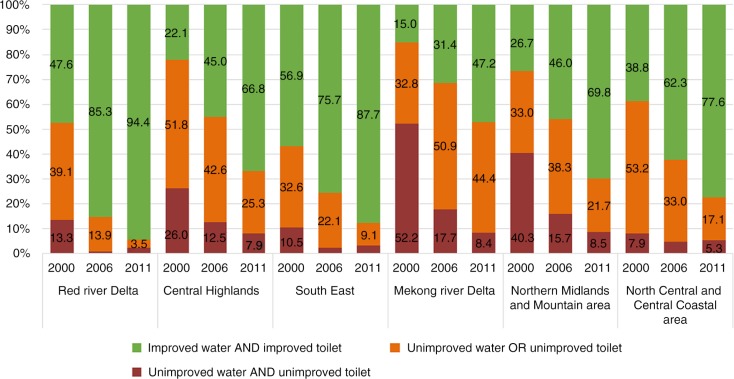
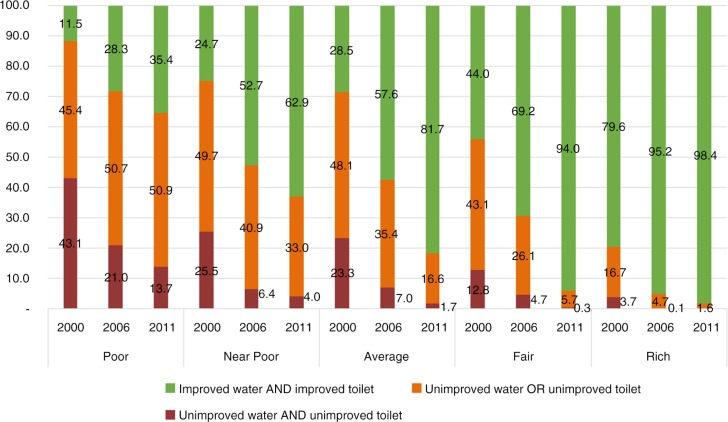
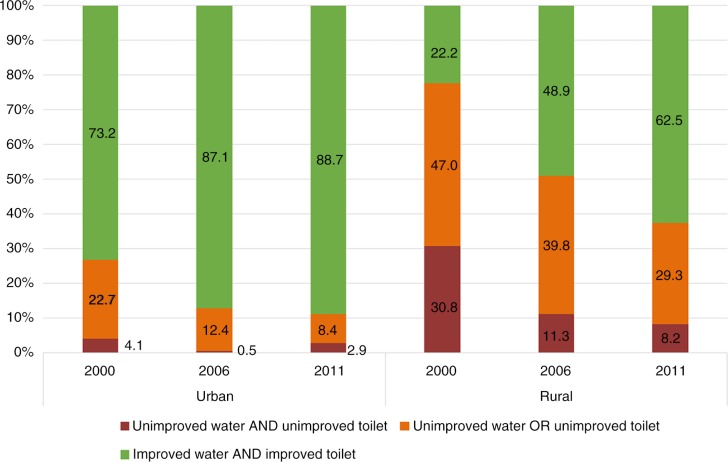
There have been some outstanding developments in access to improved water sources and sanitation facilities from 2000 to 2011. In 2011, the proportion of households with access to improved water sources and sanitation facilities reached 90% and 77%, respectively, meeting the 2015 MDG targets for safe drinking water and basic sanitation set at 88% and 75%, respectively. However, despite these achievements, in 2011, only 74% of households overall had access to combined improved drinking water and sanitation facilities. There were also stark differences between regions. In 2011, only 47% of households had access to both improved water and sanitation facilities in the Mekong River Delta compared with 94% in the Red River Delta. In 2011, households in urban compared to rural areas were more than twice as likely (odds ratio [OR]: 2.2; 95% confidence interval [CI]: 1.9-2.5) to have access to improved water and sanitation facilities in combination, and households in the highest compared with the lowest wealth quintile were over 40 times more likely (OR: 42.3; 95% CI: 29.8-60.0).
More efforts are required to increase household access to both improved water and sanitation facilities in the Mekong River Delta, South East and Central Highlands regions of Vietnam. There is also a need to address socio-economic factors associated with inadequate access to improved sanitation facilities.
尽管千年发展目标7.C取得了进展,但越南在提供安全饮用水和基本卫生设施方面仍面临挑战。
本文分别描述了家庭获得改善水源和卫生设施的趋势,并综合分析了与获得改善水源和卫生设施相关的因素。
对2000年、2006年和2011年越南多指标类集调查的二手数据进行了分析。描述性统计和显著性检验描述了按地点、人口和社会经济因素划分的获得水和卫生设施的时间趋势。二元逻辑回归(2000年、2006年和2011年)描述了获得水和卫生设施与地理、人口和社会经济因素之间的关联。
2000年至2011年期间,在获得改善水源和卫生设施方面取得了一些显著进展。2011年,获得改善水源和卫生设施的家庭比例分别达到90%和77%,分别达到了2015年千年发展目标中安全饮用水和基本卫生设施的目标,分别为88%和75%。然而,尽管取得了这些成就,2011年总体上只有74%的家庭能够同时获得改善的饮用水和卫生设施。各地区之间也存在明显差异。2011年,湄公河三角洲只有47%的家庭能够同时获得改善的水和卫生设施,而红河三角洲这一比例为94%。2011年,城市家庭与农村家庭相比,同时获得改善水和卫生设施的可能性高出两倍多(优势比[OR]:2.2;95%置信区间[CI]:1.9 - 2.5),最富有五分位数的家庭与最贫穷五分位数的家庭相比,同时获得改善水和卫生设施的可能性高出40倍以上(OR:42.3;95% CI:29.8 - 60.0)。
需要做出更多努力,以增加越南湄公河三角洲、东南部和中部高地地区家庭同时获得改善水和卫生设施的机会。还需要解决与获得改善卫生设施不足相关的社会经济因素。