Turner Ray W, Asmara Hadhimulya, Engbers Jordan D T, Miclat Jason, Rizwan Arsalan P, Sahu Giriraj, Zamponi Gerald W
a Hotchkiss Brain Institute, University of Calgary , Calgary , AB , Canada.
Channels (Austin). 2016 Jul 3;10(4):313-9. doi: 10.1080/19336950.2016.1161988. Epub 2016 Mar 7.
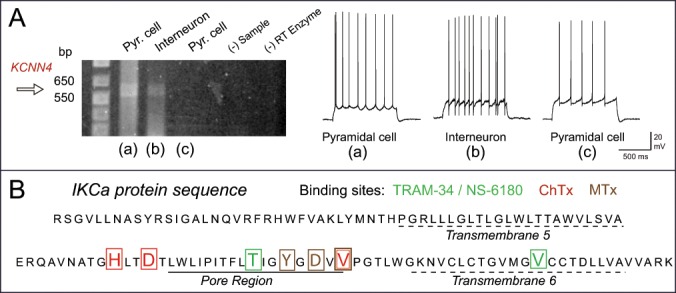
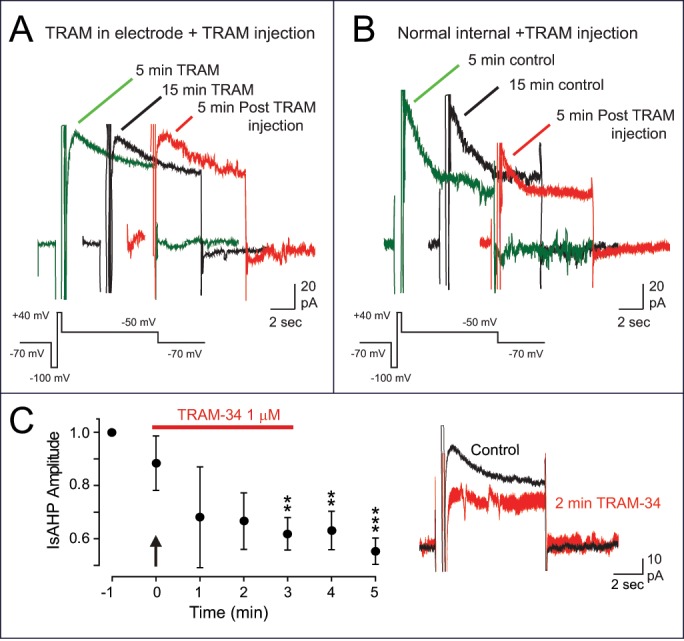
Our previous work reported that KCa3.1 (IKCa) channels are expressed in CA1 hippocampal pyramidal cells and contribute to the slow afterhyperpolarization that regulates spike accommodation in these cells. The current report presents data from single cell RT-PCR that further reveals mRNA in CA1 cells that corresponds to the sequence of an IKCa channel from transmembrane segments 5 through 6 including the pore region, revealing the established binding sites for 4 different IKCa channel blockers. A comparison of methods to internally apply the IKCa channel blocker TRAM-34 shows that including the drug in an electrode from the onset of an experiment is unviable given the speed of drug action upon gaining access for whole-cell recordings. Together the data firmly establish IKCa channel expression in CA1 neurons and clarify methodological requirements to obtain a block of IKCa channel activity through internal application of TRAM-34.
我们之前的研究报告称,KCa3.1(IKCa)通道在海马CA1区锥体细胞中表达,并参与调节这些细胞中动作电位适应的缓慢超极化后电位。本报告展示了单细胞逆转录聚合酶链反应(RT-PCR)的数据,进一步揭示了CA1细胞中与IKCa通道从跨膜片段5到6(包括孔区)序列相对应的信使核糖核酸(mRNA),揭示了4种不同IKCa通道阻滞剂的既定结合位点。对内部应用IKCa通道阻滞剂TRAM-34的方法进行比较表明,鉴于在全细胞记录获得通路时药物作用的速度,从实验开始就将药物包含在电极中是不可行的。这些数据共同有力地证实了IKCa通道在CA1神经元中的表达,并阐明了通过内部应用TRAM-34来阻断IKCa通道活性的方法学要求。