Rupp Niels J, Schüffler Peter J, Zhong Qing, Falkner Florian, Rechsteiner Markus, Rüschoff Jan H, Fankhauser Christian, Drach Matthias, Largo Remo, Tremp Mathias, Poyet Cedric, Sulser Tullio, Kristiansen Glen, Moch Holger, Buhmann Joachim, Müntener Michael, Wild Peter J
Institute of Surgical Pathology, University Hospital Zurich, Schmelzbergstrasse 12, 8091 Zurich, Switzerland.
Department of Computer Science, ETH Zurich, Universitaetstr 6, 8092 Zurich, Switzerland.
J Pathol Inform. 2016 Jan 29;7:3. doi: 10.4103/2153-3539.175376. eCollection 2016.
Intratumoral hypoxia plays an important role with regard to tumor biology and susceptibility to radio- and chemotherapy. For further investigation of hypoxia-related changes, areas of certain hypoxia must be reliably detected within cancer tissues. Pimonidazole, a 2-nitroimindazole, accumulates in hypoxic tissue and can be easily visualized using immunohistochemistry.
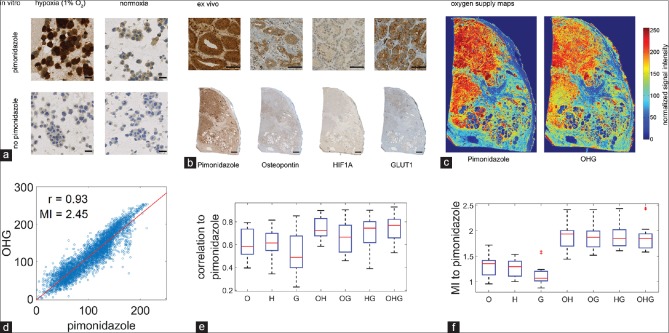
To improve detection of highly hypoxic versus normoxic areas in prostate cancer, immunoreactivity of pimonidazole and a combination of known hypoxia-related proteins was used to create computational oxygen supply maps of prostate cancer. Pimonidazole was intravenously administered before radical prostatectomy in n = 15 patients, using the da Vinci robot-assisted surgical system. Prostatectomy specimens were immediately transferred into buffered formaldehyde, fixed overnight, and completely embedded in paraffin. Pimonidazole accumulation and hypoxia-related protein expression were visualized by immunohistochemistry. Oxygen supply maps were created using the normalized information from pimonidazole and hypoxia-related proteins.
Based on pimonidazole staining and other hypoxia.related proteins (osteopontin, hypoxia-inducible factor 1-alpha, and glucose transporter member 1) oxygen supply maps in prostate cancer were created. Overall, oxygen supply maps consisting of information from all hypoxia-related proteins showed high correlation and mutual information to the golden standard of pimonidazole. Here, we describe an improved computer-based ex vivo model for an accurate detection of oxygen supply in human prostate cancer tissue.
This platform can be used for precise colocalization of novel candidate hypoxia-related proteins in a representative number of prostate cancer cases, and improve issues of single marker correlations. Furthermore, this study provides a source for further in situ tests and biochemical investigations.
肿瘤内缺氧在肿瘤生物学以及对放疗和化疗的敏感性方面起着重要作用。为了进一步研究与缺氧相关的变化,必须在癌组织内可靠地检测到特定的缺氧区域。匹莫硝唑是一种2-硝基咪唑,可在缺氧组织中蓄积,并且使用免疫组织化学方法可轻松将其可视化。
为了更好地检测前列腺癌中高缺氧区域与正常氧区域,利用匹莫硝唑的免疫反应性以及已知的缺氧相关蛋白组合来创建前列腺癌的计算性氧供应图。在15例患者行根治性前列腺切除术之前,使用达芬奇机器人辅助手术系统静脉注射匹莫硝唑。前列腺切除标本立即转移至缓冲甲醛中,固定过夜,然后完全包埋于石蜡中。通过免疫组织化学观察匹莫硝唑的蓄积及缺氧相关蛋白的表达。利用来自匹莫硝唑和缺氧相关蛋白的标准化信息创建氧供应图。
基于匹莫硝唑染色及其他缺氧相关蛋白(骨桥蛋白、缺氧诱导因子1-α和葡萄糖转运蛋白1)创建了前列腺癌的氧供应图。总体而言,由所有缺氧相关蛋白信息组成的氧供应图与匹莫硝唑这一黄金标准显示出高度相关性和互信息。在此,我们描述了一种改进的基于计算机的体外模型,用于准确检测人前列腺癌组织中的氧供应。
该平台可用于在大量具有代表性的前列腺癌病例中对新型候选缺氧相关蛋白进行精确共定位,并改善单一标志物相关性的问题。此外,本研究为进一步的原位检测和生化研究提供了一个来源。