• 文献检索
  • 文档翻译
  • 深度研究
  • 学术资讯
  • Suppr Zotero 插件Zotero 插件
  • 邀请有礼
  • 套餐&价格
  • 历史记录
应用&插件
Suppr Zotero 插件Zotero 插件浏览器插件Mac 客户端Windows 客户端微信小程序
定价
高级版会员购买积分包购买API积分包
服务
文献检索文档翻译深度研究API 文档MCP 服务
关于我们
关于 Suppr公司介绍联系我们用户协议隐私条款
关注我们

Suppr 超能文献

核心技术专利:CN118964589B侵权必究
粤ICP备2023148730 号-1Suppr @ 2026

文献检索

告别复杂PubMed语法,用中文像聊天一样搜索,搜遍4000万医学文献。AI智能推荐,让科研检索更轻松。

立即免费搜索

文件翻译

保留排版,准确专业,支持PDF/Word/PPT等文件格式,支持 12+语言互译。

免费翻译文档

深度研究

AI帮你快速写综述,25分钟生成高质量综述,智能提取关键信息,辅助科研写作。

立即免费体验

天气因素对柬埔寨登革热发病率的影响及干预措施的意义

Effects of weather factors on dengue fever incidence and implications for interventions in Cambodia.

作者信息

Choi Youngjo, Tang Choon Siang, McIver Lachlan, Hashizume Masahiro, Chan Vibol, Abeyasinghe Rabindra Romauld, Iddings Steven, Huy Rekol

机构信息

World Health Organization, Phnom Penh, Cambodia.

Australian National University, Canberra, Australia.

出版信息

BMC Public Health. 2016 Mar 8;16:241. doi: 10.1186/s12889-016-2923-2.

DOI:10.1186/s12889-016-2923-2
PMID:26955944
原文链接:https://pmc.ncbi.nlm.nih.gov/articles/PMC4784273/
Abstract

BACKGROUND

Dengue viruses and their mosquito vectors are sensitive to their environment. Temperature, rainfall and humidity have well-defined roles in the transmission cycle. Therefore changes in these conditions may contribute to increasing incidence. The aim of this study was to examine the relationship between weather factors and dengue incidence in three provinces in Cambodia, in order to strengthen the evidence basis of dengue control strategies in this high-burden country.

METHODS

We developed negative binomial models using monthly average maximum, minimum, mean temperatures and monthly cumulative rainfall over the period from January 1998 to December 2012. We adopted piecewise linear functions to estimate the incidence rate ratio (IRR) between dengue incidence and weather factors for simplicity in interpreting the coefficients. We estimated the values of parameters below cut-points defined in terms of the results of sensitivity tests over a 0-3 month lagged period.

RESULTS

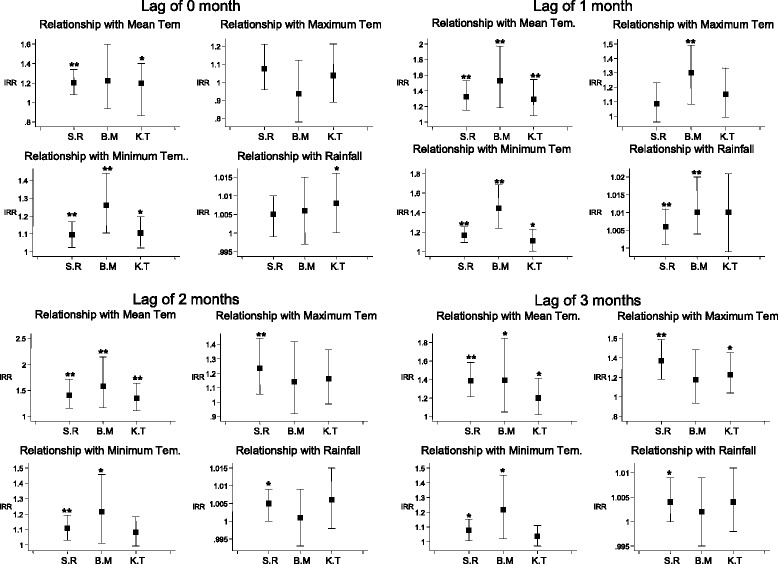
Mean temperature was significantly associated with dengue incidence in all three provinces, but incidence did not correlate well with maximum temperature in Banteay Meanchey, nor with minimum temperature in Kampong Thom at a lag of three months in the negative binomial model. The monthly cumulative rainfall influence on the dengue incidence was significant in all three provinces, but not consistently over a 0-3 month lagged period. Rainfall significantly affected the dengue incidence at a lag of 0 to 3 months in Siem Reap, but it did not have an impact at a lag of 2 to 3 months in Banteay Meanchey, nor at a lag of 2 months in Kampong Thom.

CONCLUSIONS

The association between dengue incidence and weather factors also apparently varies by locality, suggesting that a prospective dengue early warning system would likely be best implemented at a local or regional scale, rather than nation-wide in Cambodia. Such spatial down-scaling would also enable dengue control measures to be better targeted, timed and implemented.

摘要

背景

登革病毒及其蚊媒对环境敏感。温度、降雨和湿度在传播循环中具有明确作用。因此,这些条件的变化可能导致发病率上升。本研究旨在探讨柬埔寨三个省份天气因素与登革热发病率之间的关系,以加强这个高负担国家登革热防控策略的证据基础。

方法

我们利用1998年1月至2012年12月期间的月平均最高温度、最低温度、平均温度和月累计降雨量建立了负二项式模型。为便于解释系数,我们采用分段线性函数来估计登革热发病率与天气因素之间的发病率比(IRR)。我们根据0至3个月滞后期间敏感性测试结果定义的切点以下的参数值进行估计。

结果

在所有三个省份,平均温度均与登革热发病率显著相关,但在负二项式模型中,班迭棉吉省的发病率与最高温度相关性不佳,磅通省在滞后三个月时发病率与最低温度相关性也不佳。月累计降雨量对所有三个省份的登革热发病率均有显著影响,但在0至3个月的滞后期间并非始终如此。降雨在暹粒省滞后0至3个月时对登革热发病率有显著影响,但在班迭棉吉省滞后2至三个月时没有影响,在磅通省滞后2个月时也没有影响。

结论

登革热发病率与天气因素之间的关联显然也因地区而异,这表明前瞻性登革热预警系统可能最好在柬埔寨的地方或区域层面实施,而非全国范围。这种空间尺度缩小还将使登革热防控措施能够更好地靶向、定时和实施。
https://cdn.ncbi.nlm.nih.gov/pmc/blobs/a585/4784273/83c6045556b8/12889_2016_2923_Fig4_HTML.jpg
https://cdn.ncbi.nlm.nih.gov/pmc/blobs/a585/4784273/f0f2d5075f5f/12889_2016_2923_Fig1_HTML.jpg
https://cdn.ncbi.nlm.nih.gov/pmc/blobs/a585/4784273/fdd10ab1442a/12889_2016_2923_Fig2_HTML.jpg
https://cdn.ncbi.nlm.nih.gov/pmc/blobs/a585/4784273/4460ee1b848f/12889_2016_2923_Fig3_HTML.jpg
https://cdn.ncbi.nlm.nih.gov/pmc/blobs/a585/4784273/83c6045556b8/12889_2016_2923_Fig4_HTML.jpg
https://cdn.ncbi.nlm.nih.gov/pmc/blobs/a585/4784273/f0f2d5075f5f/12889_2016_2923_Fig1_HTML.jpg
https://cdn.ncbi.nlm.nih.gov/pmc/blobs/a585/4784273/fdd10ab1442a/12889_2016_2923_Fig2_HTML.jpg
https://cdn.ncbi.nlm.nih.gov/pmc/blobs/a585/4784273/4460ee1b848f/12889_2016_2923_Fig3_HTML.jpg
https://cdn.ncbi.nlm.nih.gov/pmc/blobs/a585/4784273/83c6045556b8/12889_2016_2923_Fig4_HTML.jpg

相似文献

1
Effects of weather factors on dengue fever incidence and implications for interventions in Cambodia.天气因素对柬埔寨登革热发病率的影响及干预措施的意义
BMC Public Health. 2016 Mar 8;16:241. doi: 10.1186/s12889-016-2923-2.
2
Developing a dengue prediction model based on climate in Tawau, Malaysia.基于马来西亚斗湖气候开发登革热预测模型。
Acta Trop. 2019 Sep;197:105055. doi: 10.1016/j.actatropica.2019.105055. Epub 2019 Jun 8.
3
Empirical model for estimating dengue incidence using temperature, rainfall, and relative humidity: a 19-year retrospective analysis in East Delhi.利用温度、降雨量和相对湿度估算登革热发病率的经验模型:东德里19年回顾性分析
Epidemiol Health. 2016 Nov 27;38:e2016052. doi: 10.4178/epih.e2016052. eCollection 2016.
4
Weather factors influencing the occurrence of dengue fever in Nakhon Si Thammarat, Thailand.影响泰国那空是他玛叻府登革热发病的气象因素。
Trop Biomed. 2013 Dec;30(4):631-41.
5
The association between dengue incidences and provincial-level weather variables in Thailand from 2001 to 2014.2001 年至 2014 年泰国登革热发病率与省级天气变量的关联。
PLoS One. 2019 Dec 26;14(12):e0226945. doi: 10.1371/journal.pone.0226945. eCollection 2019.
6
Spatial epidemiology and climatic predictors of paediatric dengue infections captured via sentinel site surveillance, Phnom Penh Cambodia 2011-2012.2011 - 2012年柬埔寨金边通过哨点监测获取的小儿登革热感染的空间流行病学及气候预测因素
BMC Public Health. 2014 Jun 28;14:658. doi: 10.1186/1471-2458-14-658.
7
Non-linear effects of mean temperature and relative humidity on dengue incidence in Guangzhou, China.平均温度和相对湿度对中国广州登革热发病率的非线性影响。
Sci Total Environ. 2018 Jul 1;628-629:766-771. doi: 10.1016/j.scitotenv.2018.02.136. Epub 2018 Feb 20.
8
Climatic factors influencing dengue incidence in an epidemic area of Nepal.影响尼泊尔一个流行地区登革热发病率的气候因素。
BMC Res Notes. 2019 Mar 13;12(1):131. doi: 10.1186/s13104-019-4185-4.
9
Imported dengue cases, weather variation and autochthonous dengue incidence in Cairns, Australia.澳大利亚凯恩斯的输入性登革热病例、天气变化与本地登革热发病率
PLoS One. 2013 Dec 13;8(12):e81887. doi: 10.1371/journal.pone.0081887. eCollection 2013.
10
Different responses of dengue to weather variability across climate zones in Queensland, Australia.澳大利亚昆士兰州不同气候带登革热对天气变化的不同反应。
Environ Res. 2020 May;184:109222. doi: 10.1016/j.envres.2020.109222. Epub 2020 Feb 6.

引用本文的文献

1
Environmental Determinants of Dengue Fever: ‎A Re-Emerging Threat in the Middle East.登革热的环境决定因素:中东地区新出现的威胁
Health Sci Rep. 2025 Aug 18;8(8):e71177. doi: 10.1002/hsr2.71177. eCollection 2025 Aug.
2
Time series analysis of dengue incidence and its association with meteorological risk factors in Bangladesh.孟加拉国登革热发病率的时间序列分析及其与气象风险因素的关联。
PLoS One. 2025 Aug 18;20(8):e0323238. doi: 10.1371/journal.pone.0323238. eCollection 2025.
3
Explainable artificial intelligence for predicting dengue outbreaks in Bangladesh using eco-climatic triggers.

本文引用的文献

1
Spatial epidemiology and climatic predictors of paediatric dengue infections captured via sentinel site surveillance, Phnom Penh Cambodia 2011-2012.2011 - 2012年柬埔寨金边通过哨点监测获取的小儿登革热感染的空间流行病学及气候预测因素
BMC Public Health. 2014 Jun 28;14:658. doi: 10.1186/1471-2458-14-658.
2
Regional differences in the growing incidence of dengue Fever in Vietnam explained by weather variability.天气变化解释越南登革热发病率上升的地区差异。
Trop Med Health. 2014 Mar;42(1):25-33. doi: 10.2149/tmh.2013-24. Epub 2013 Dec 18.
3
Climate change and dengue: a critical and systematic review of quantitative modelling approaches.
利用生态气候触发因素预测孟加拉国登革热疫情的可解释人工智能。
Glob Epidemiol. 2025 Jun 5;10:100210. doi: 10.1016/j.gloepi.2025.100210. eCollection 2025 Dec.
4
Analysing dengue fever spread in Kenya using the Zero-Inflated Poisson model.使用零膨胀泊松模型分析肯尼亚登革热的传播情况。
J Public Health Afr. 2025 Feb 28;16(1):781. doi: 10.4102/jphia.v16i1.781. eCollection 2025.
5
Mapping climate change interaction with human health through DPSIR framework: Qatar perspective.通过DPSIR框架绘制气候变化与人类健康的相互作用:卡塔尔视角
Heliyon. 2025 Feb 4;11(3):e42455. doi: 10.1016/j.heliyon.2025.e42455. eCollection 2025 Feb 15.
6
Disentangling climate's dual role in dengue dynamics: A multiregion causal analysis study.厘清气候在登革热动态中的双重作用:一项多区域因果分析研究。
Sci Adv. 2025 Feb 14;11(7):eadq1901. doi: 10.1126/sciadv.adq1901. Epub 2025 Feb 12.
7
Dengue in Tomorrow: Predictive Insights From ARIMA and SARIMA Models in Bangladesh: A Time Series Analysis.明日登革热:孟加拉国自回归积分滑动平均(ARIMA)模型和季节性自回归积分滑动平均(SARIMA)模型得出的预测性见解:一项时间序列分析
Health Sci Rep. 2024 Dec 18;7(12):e70276. doi: 10.1002/hsr2.70276. eCollection 2024 Dec.
8
Review of dengue vectors in Cambodia: distribution, bionomics, vector competence, control and insecticide resistance.柬埔寨登革热媒介的研究综述:分布、生物学、媒介效能、控制和抗药性。
Parasit Vectors. 2024 Oct 9;17(1):424. doi: 10.1186/s13071-024-06481-5.
9
Bayesian spatio-temporal analysis of dengue transmission in Lao PDR.老挝人民民主共和国登革热传播的贝叶斯时空分析。
Sci Rep. 2024 Sep 12;14(1):21327. doi: 10.1038/s41598-024-71807-3.
10
Antibodies to D7L salivary proteins as a new serological tool to estimate human exposure to mosquitoes.抗 D7L 唾液蛋白抗体作为一种新的血清学工具来估计人类接触蚊子的情况。
Front Immunol. 2024 May 1;15:1368066. doi: 10.3389/fimmu.2024.1368066. eCollection 2024.
气候变化与登革热:定量建模方法的批判性和系统性综述。
BMC Infect Dis. 2014 Mar 26;14:167. doi: 10.1186/1471-2334-14-167.
4
Climate and dengue transmission: evidence and implications.气候与登革热传播:证据与影响。
Environ Health Perspect. 2013 Nov-Dec;121(11-12):1264-72. doi: 10.1289/ehp.1306556. Epub 2013 Sep 20.
5
Time series regression studies in environmental epidemiology.时间序列回归研究在环境流行病学中的应用。
Int J Epidemiol. 2013 Aug;42(4):1187-95. doi: 10.1093/ije/dyt092. Epub 2013 Jun 12.
6
Analysis of effects of meteorological factors on dengue incidence in Sri Lanka using time series data.利用时间序列数据分析气象因素对斯里兰卡登革热发病率的影响。
PLoS One. 2013 May 9;8(5):e63717. doi: 10.1371/journal.pone.0063717. Print 2013.
7
Can human movements explain heterogeneous propagation of dengue fever in Cambodia?人类活动能否解释柬埔寨登革热的异质传播?
PLoS Negl Trop Dis. 2012;6(12):e1957. doi: 10.1371/journal.pntd.0001957. Epub 2012 Dec 6.
8
The economic burden of dengue.登革热的经济负担。
Am J Trop Med Hyg. 2012 May;86(5):743-744. doi: 10.4269/ajtmh.2012.12-0157.
9
Climate-based models for understanding and forecasting dengue epidemics.基于气候的登革热流行理解和预测模型。
PLoS Negl Trop Dis. 2012;6(2):e1470. doi: 10.1371/journal.pntd.0001470. Epub 2012 Feb 14.
10
Population dynamics of Aedes aegypti and dengue as influenced by weather and human behavior in San Juan, Puerto Rico.波多黎各圣胡安的天气和人类行为对埃及伊蚊和登革热的种群动态的影响。
PLoS Negl Trop Dis. 2011 Dec;5(12):e1378. doi: 10.1371/journal.pntd.0001378. Epub 2011 Dec 20.