Nymo Ingebjørg H, Arias Maykel A, Pardo Julián, Álvarez María Pilar, Alcaraz Ana, Godfroid Jacques, Jiménez de Bagüés María Pilar
Arctic Infection Biology, The Faculty of Biosciences, Fisheries and Economics, University of Tromsø (UiT)-The Arctic University of Norway, Tromsø, Norway.
Unidad de Tecnología en Producción y Sanidad Animal, Centro de Investigación y Tecnología Agroalimentaria (CITA), Instituto Agroalimentario de Aragón - IA2 (CITA-Universidad de Zaragoza), Zaragoza, Spain.
PLoS One. 2016 Mar 9;11(3):e0150432. doi: 10.1371/journal.pone.0150432. eCollection 2016.
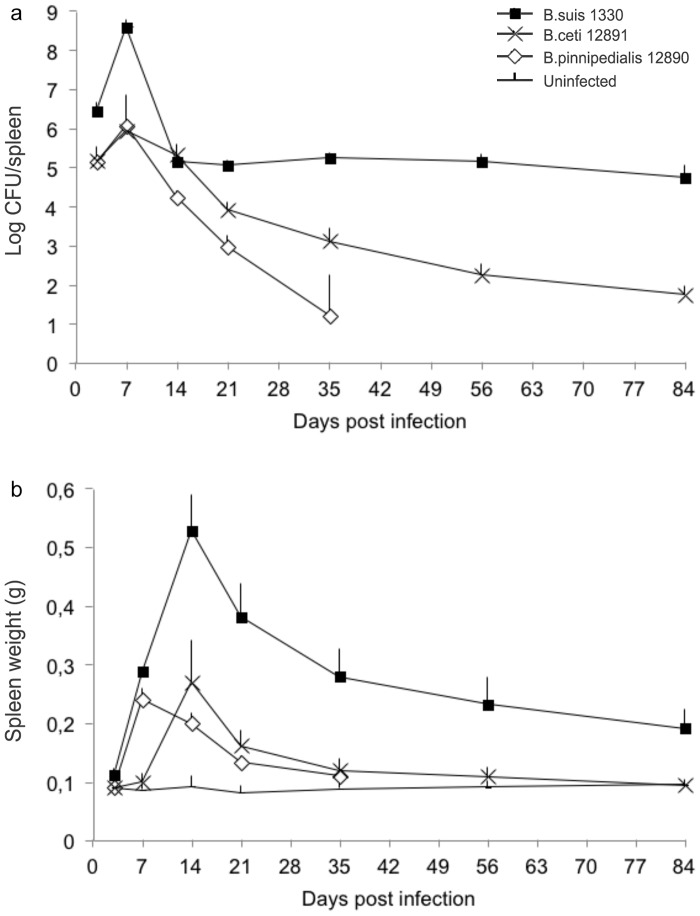
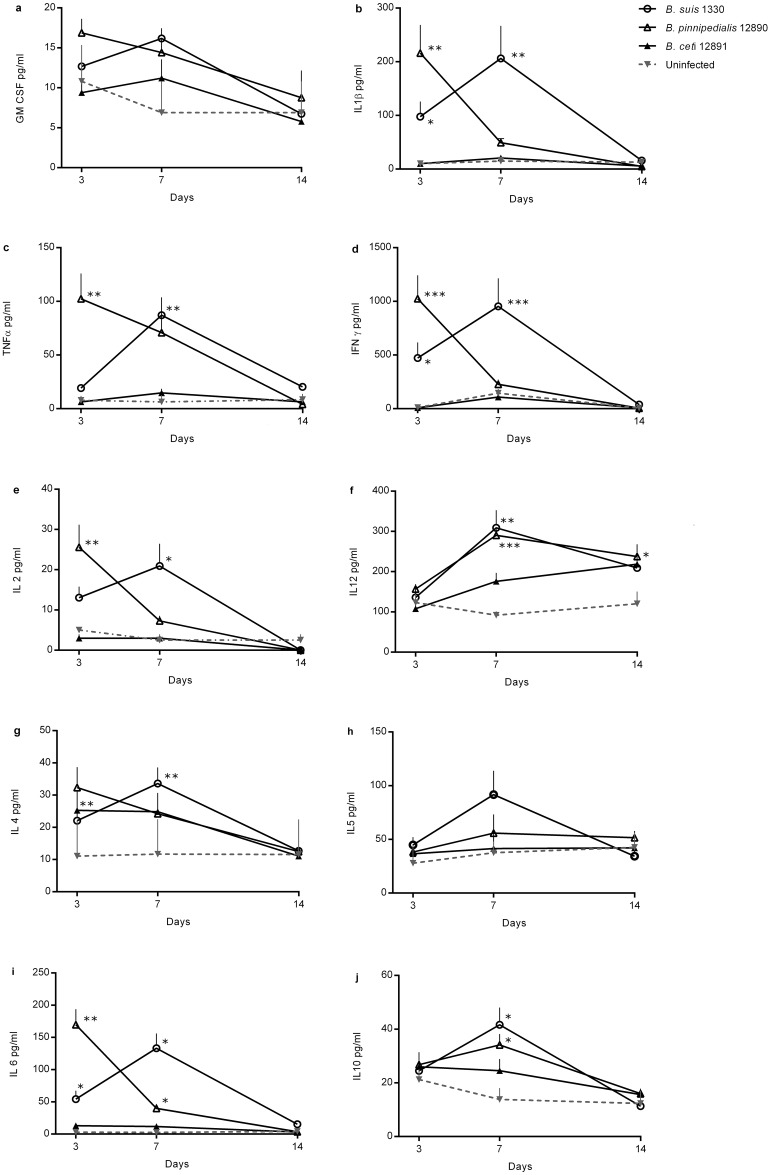
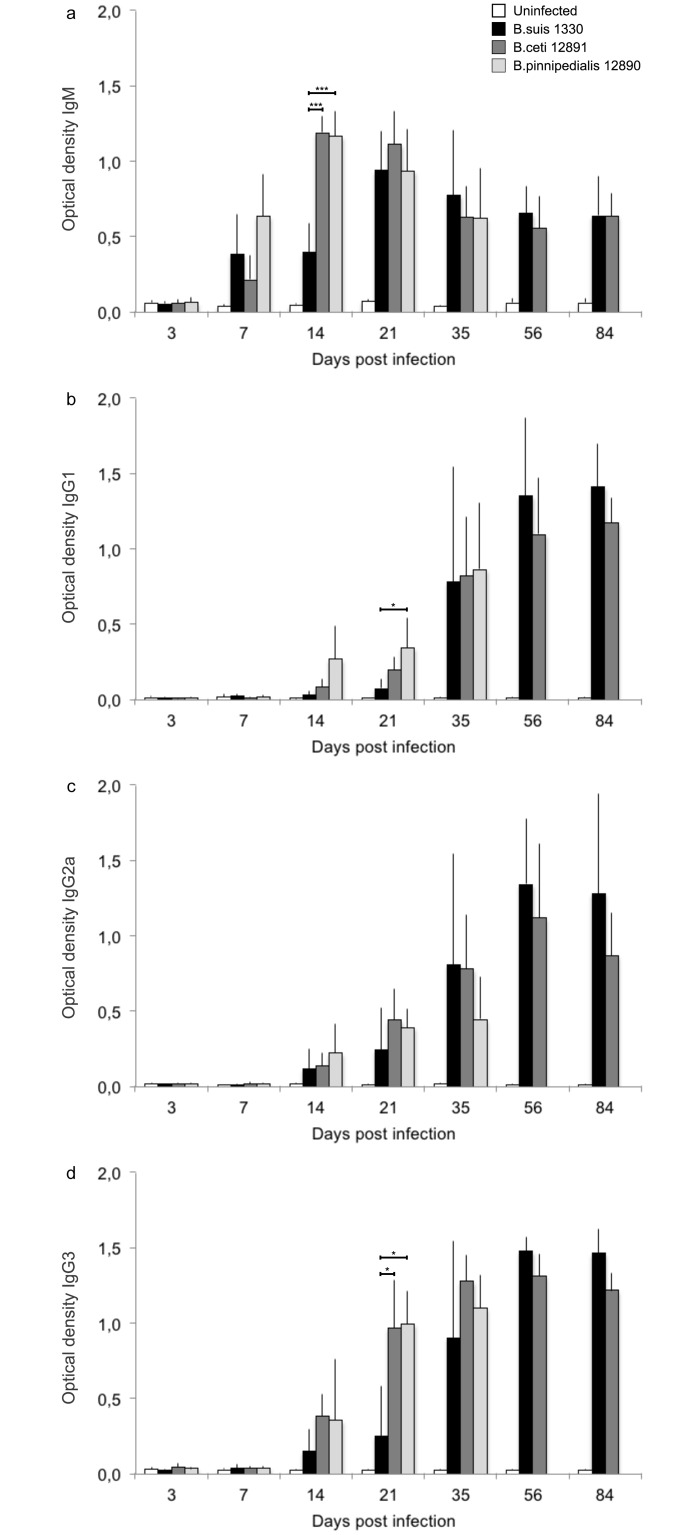
Brucellosis is a zoonosis of worldwide distribution with numerous animal host species. Since the novel isolation of Brucella spp. from marine mammals in 1994 the bacteria have been isolated from various marine mammal hosts. The marine mammal reference strains Brucella pinnipedialis 12890 (harbour seal, Phoca vitulina) and Brucella ceti 12891 (harbour porpoise, Phocoena phocoena) were included in genus Brucella in 2007, however, their pathogenicity in the mouse model is pending. Herein this is evaluated in BALB/c mice with Brucella suis 1330 as a control. Both marine mammal strains were attenuated, however, B. ceti was present at higher levels than B. pinnipedialis in blood, spleen and liver throughout the infection, in addition B. suis and B. ceti were isolated from brains and faeces at times with high levels of bacteraemia. In B. suis-infected mice serum cytokines peaked at day 7. In B. pinnipedialis-infected mice, levels were similar, but peaked predominantly at day 3 and an earlier peak in spleen weight likewise implied an earlier response. The inflammatory response induced pathology in the spleen and liver. In B. ceti-infected mice, most serum cytokine levels were comparable to those in uninfected mice, consistent with a limited inflammatory response, which also was indicated by restricted spleen and liver pathology. Specific immune responses against all three strains were detected in vitro after stimulation of splenocytes from infected mice with the homologous heat-killed brucellae. Antibody responses in vivo were also induced by the three brucellae. The immunological pattern of B. ceti in combination with persistence in organs and limited pathology has heretofore not been described for other brucellae. These two marine mammal wildtype strains show an attenuated pattern in BALB/c mice only previously described for Brucella neotomea.
布鲁氏菌病是一种分布于全球的人畜共患病,有众多动物宿主物种。自1994年首次从海洋哺乳动物中分离出布鲁氏菌属细菌以来,已从各种海洋哺乳动物宿主中分离出该细菌。海洋哺乳动物参考菌株海豹布鲁氏菌12890(港海豹,斑海豹)和鲸布鲁氏菌12891(港湾鼠海豚,鼠海豚)于2007年被归入布鲁氏菌属,然而,它们在小鼠模型中的致病性尚待确定。在此,以猪布鲁氏菌1330作为对照,在BALB/c小鼠中对其进行评估。两种海洋哺乳动物菌株均减毒,然而,在整个感染过程中,鲸布鲁氏菌在血液、脾脏和肝脏中的水平高于海豹布鲁氏菌,此外,在菌血症水平较高时,猪布鲁氏菌和鲸布鲁氏菌有时可从脑和粪便中分离出来。在感染猪布鲁氏菌的小鼠中,血清细胞因子在第7天达到峰值。在感染海豹布鲁氏菌的小鼠中,水平相似,但主要在第3天达到峰值,脾脏重量的早期峰值同样暗示了更早的反应。炎症反应在脾脏和肝脏中引发了病变。在感染鲸布鲁氏菌的小鼠中,大多数血清细胞因子水平与未感染小鼠相当,这与有限的炎症反应一致,脾脏和肝脏病变受限也表明了这一点。在用同源热灭活布鲁氏菌刺激感染小鼠的脾细胞后,在体外检测到针对所有三种菌株的特异性免疫反应。这三种布鲁氏菌在体内也诱导了抗体反应。鲸布鲁氏菌的免疫模式以及在器官中的持续存在和有限的病变,此前尚未在其他布鲁氏菌中描述过。这两种海洋哺乳动物野生型菌株在BALB/c小鼠中表现出减毒模式,此前仅在新托梅布鲁氏菌中描述过。