
热休克蛋白B8的转录诱导介导了导致运动神经元疾病的错误折叠蛋白的清除。
Transcriptional induction of the heat shock protein B8 mediates the clearance of misfolded proteins responsible for motor neuron diseases.
作者信息
Crippa Valeria, D'Agostino Vito G, Cristofani Riccardo, Rusmini Paola, Cicardi Maria E, Messi Elio, Loffredo Rosa, Pancher Michael, Piccolella Margherita, Galbiati Mariarita, Meroni Marco, Cereda Cristina, Carra Serena, Provenzani Alessandro, Poletti Angelo
机构信息
Laboratory of Experimental Neurobiology, C. Mondino National Neurological Institute, Pavia, Italy.
Centre for Integrative Biology (CIBIO), Università degli Studi di Trento, Trento, Italy.
出版信息
Sci Rep. 2016 Mar 10;6:22827. doi: 10.1038/srep22827.
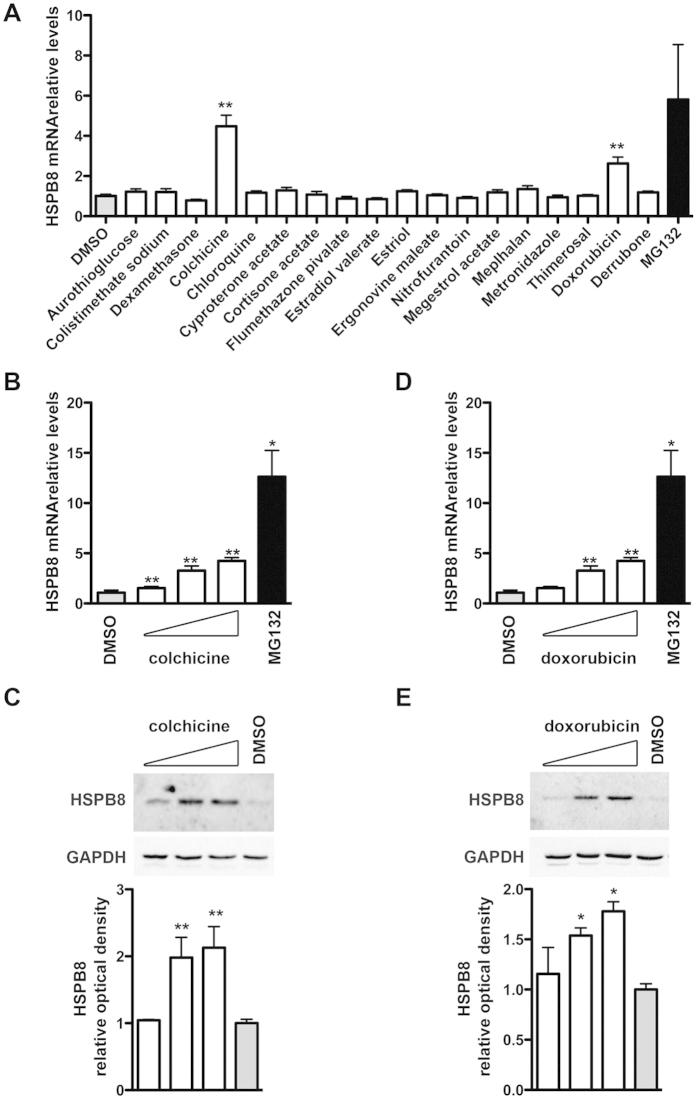
Neurodegenerative diseases (NDs) are often associated with the presence of misfolded protein inclusions. The chaperone HSPB8 is upregulated in mice, the human brain and muscle structures affected during NDs progression. HSPB8 exerts a potent pro-degradative activity on several misfolded proteins responsible for familial NDs forms. Here, we demonstrated that HSPB8 also counteracts accumulation of aberrantly localized misfolded forms of TDP-43 and its 25 KDa fragment involved in most sporadic cases of Amyotrophic Lateral Sclerosis (sALS) and of Fronto Lateral Temporal Dementia (FLTD). HSPB8 acts with BAG3 and the HSP70/HSC70-CHIP complex enhancing the autophagic removal of misfolded proteins. We performed a high-through put screening (HTS) to find small molecules capable of inducing HSPB8 in neurons for therapeutic purposes. We identified two compounds, colchicine and doxorubicin, that robustly up-regulated HSPB8 expression. Both colchicine and doxorubicin increased the expression of the master regulator of autophagy TFEB, the autophagy linker p62/SQSTM1 and the autophagosome component LC3. In line, both drugs counteracted the accumulation of TDP-43 and TDP-25 misfolded species responsible for motoneuronal death in sALS. Thus, analogs of colchicine and doxorubicin able to induce HSPB8 and with better safety and tolerability may result beneficial in NDs models.
神经退行性疾病(NDs)通常与错误折叠的蛋白质聚集体的存在有关。伴侣蛋白HSPB8在小鼠、人类大脑以及NDs进展过程中受影响的肌肉结构中上调。HSPB8对几种导致家族性NDs形式的错误折叠蛋白具有强大的促降解活性。在此,我们证明HSPB8还能对抗异常定位的TDP - 43错误折叠形式及其25 kDa片段的积累,这些与大多数散发性肌萎缩侧索硬化症(sALS)和额颞叶痴呆(FLTD)病例有关。HSPB8与BAG3以及HSP70/HSC70 - CHIP复合物共同作用,增强自噬对错误折叠蛋白的清除。我们进行了高通量筛选(HTS),以寻找能够在神经元中诱导HSPB8表达用于治疗目的的小分子。我们鉴定出两种化合物,秋水仙碱和阿霉素,它们能强烈上调HSPB8的表达。秋水仙碱和阿霉素都增加了自噬主要调节因子TFEB、自噬接头蛋白p62/SQSTM1和自噬体成分LC3的表达。同样,这两种药物都能对抗导致sALS运动神经元死亡的TDP - 43和TDP - 25错误折叠物种的积累。因此,能够诱导HSPB8且具有更好安全性和耐受性的秋水仙碱和阿霉素类似物可能对NDs模型有益。




 Zotero 插件