Lemes Ítalo Ribeiro, Ferreira Paulo Henrique, Linares Stephanie Nogueira, Machado Aryane Flauzino, Pastre Carlos Marcelo, Netto Jayme
Department of Physiotherapy, Universidade Estadual Paulista, Presidente Prudente, São Paulo, Brazil.
Faculty of Health Sciences, Discipline of Physiotherapy, The University of Sydney, Sydney, New South Wales, Australia.
Br J Sports Med. 2016 Dec;50(23):1438-1442. doi: 10.1136/bjsports-2015-094715. Epub 2016 Mar 8.
To evaluate the effects of resistance training on metabolic syndrome risk factors through comparison with a control group.
Meta-analysis comparing resistance training interventions with control groups. Two independent reviewers selected the studies and assessed their quality and data. The pooled mean differences between resistance training and the control group were calculated using a fixed-effects model.
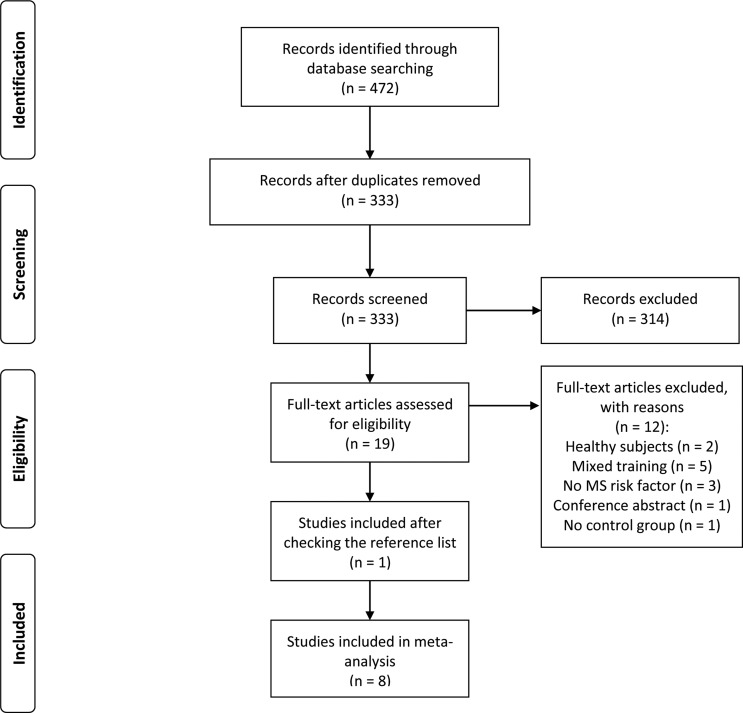
The MEDLINE, PEDro, EMBASE, SPORTDiscus and The Cochrane Library databases were searched from their earliest records to 10 January 2015.
Randomised controlled trials that compared the effect of resistance training on metabolic syndrome risk factors with a control group were included. All types of resistance training, irrespective of intensity, frequency or duration, were eligible.
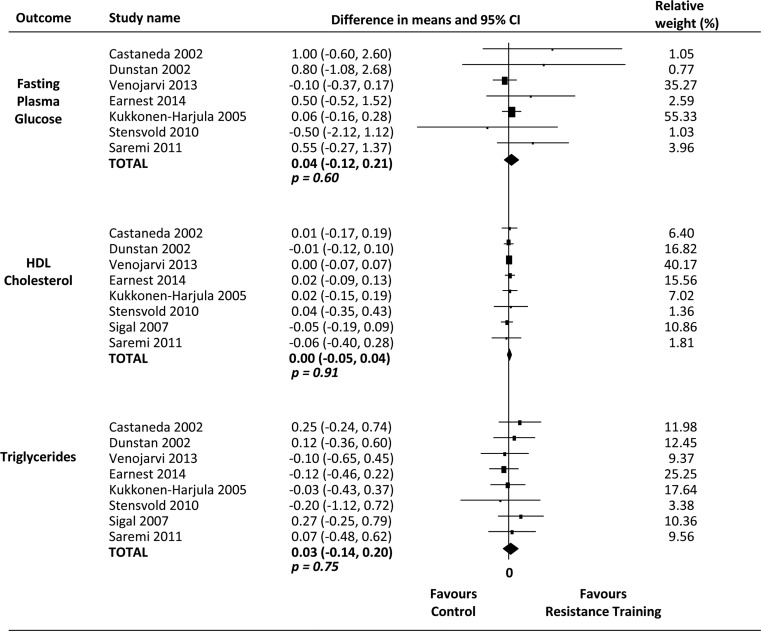
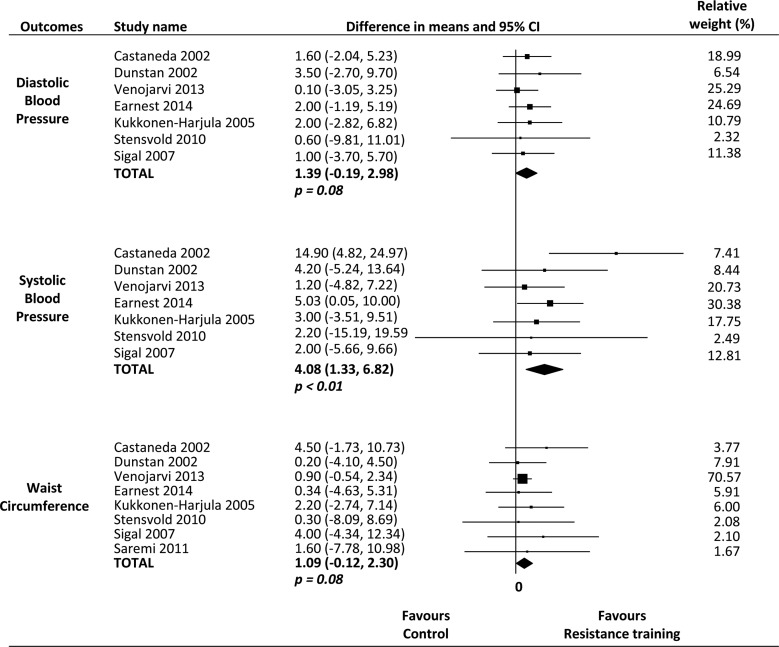
Only systolic blood pressure was significantly reduced, by 4.08 mm Hg (95% CI 1.33 to 6.82; p<0.01), following resistance training. The pooled effect showed a reduction of 0.04 mmol/L (95% CI -0.12, 0.21; p>0.05) for fasting plasma glucose, 0.00 (95% CI -0.05, 0.04; p>0.05) for high-density lipoprotein (HDL) cholesterol, 0.03 (95% CI -0.14, 0.20; p>0.05) for triglycerides, 1.39 mm Hg (95% CI -0.19, 2.98; p=0.08) for diastolic blood pressure and 1.09 cm (95% CI -0.12, 2.30; p=0.08) for waist circumference. Inconsistency (I) for all meta-analysis was 0%.
Resistance training may help reduce systolic blood pressure levels, stroke mortality and mortality from heart disease in people with metabolic syndrome.
CRD42015016538.
通过与对照组比较,评估抗阻训练对代谢综合征风险因素的影响。
将抗阻训练干预措施与对照组进行比较的荟萃分析。两名独立评审员筛选研究并评估其质量和数据。使用固定效应模型计算抗阻训练组与对照组之间的合并平均差异。
检索MEDLINE、PEDro、EMBASE、SPORTDiscus和考克兰图书馆数据库,检索时间从各数据库最早记录至2015年1月10日。
纳入将抗阻训练对代谢综合征风险因素的影响与对照组进行比较的随机对照试验。所有类型的抗阻训练均符合条件,无论其强度、频率或持续时间如何。
抗阻训练后,仅收缩压显著降低,降低了4.08 mmHg(95%置信区间1.33至6.82;p<0.01)。合并效应显示,空腹血糖降低0.04 mmol/L(95%置信区间-0.12,0.21;p>0.05),高密度脂蛋白(HDL)胆固醇降低0.00(95%置信区间-0.05,0.04;p>0.05),甘油三酯降低0.03(95%置信区间-0.14,0.20;p>0.05),舒张压降低1.39 mmHg(95%置信区间-0.19,2.98;p=0.08),腰围降低1.09 cm(95%置信区间-0.12,2.30;p=0.08)。所有荟萃分析的不一致性(I)为0%。
抗阻训练可能有助于降低代谢综合征患者的收缩压水平、中风死亡率和心脏病死亡率。
CRD42015016538。