Kato Motoyasu, Shukuya Takehito, Mori Keita, Kanemaru Ryota, Honma Yuichiro, Nanjo Yuta, Muraki Keiko, Shibayama Rina, Koyama Ryo, Shimada Naoko, Takahashi Fumiyuki, Takahashi Kazuhisa
Department of Respiratory Medicine, Juntendo University Graduate School of Medicine, 3-1-3, Hongo, Bunkyo-ku, Tokyo, 113-8431, Japan.
Clinical Trial Coordination Office, Shizuoka Cancer Center, 1007 Shimonagakubo, Nagaizumi-cho, Suntou-gun, Shizuoka, 411-8777, Japan.
BMC Cancer. 2016 Mar 10;16:203. doi: 10.1186/s12885-016-2233-1.
Advanced non-small cell lung cancer (NSCLC) patients often develop thromboembolic events, including cerebral infarction (CI). However, the relationship between advanced NSCLC and CI has not been thoroughly investigated. We examined the association between advanced NSCLC and CI and risk factors for CI in advanced or post-operative recurrent NSCLC patients.
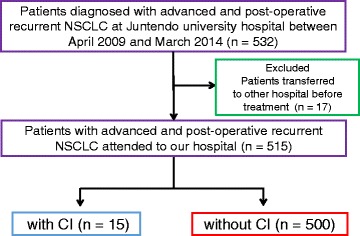
We retrospectively investigated 515 patients diagnosed with advanced or post-operative recurrent NSCLC at Juntendo University Hospital between April 2009 and March 2014.
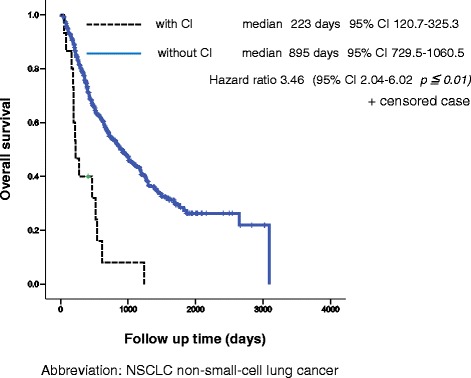
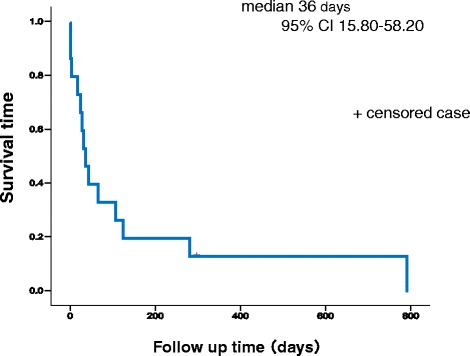
Among the 515 patients evaluated, 15 patients (2.9%) developed CI after diagnosis of advanced or post-operative recurrent NSCLC. Univariate and multivariate analyses were conducted, and brain metastasis was the only significant independent risk factor for CI (odds ratio 5.24, 95% confidence interval 1.72-16.10, p = 0.004). The incidence was 6.3% in these patients. The median survival time was 36 days, and 1-year survival rate was 6.7% after development of CI. Overall survival from diagnosis of advanced NSCLC or post-operative recurrence was significantly shorter in patients with CI than in patients without CI (223 days versus 895 days; HR, 3.46; 95% confidence interval, 2.04-6.02; p = 0.001).
The incidence of CI is high in advanced or post-operative recurrent NSCLC, and is especially higher in patients with brain metastasis than in those without brain metastasis. Moreover, CI may affect patient's prognosis. Careful monitoring for the development of CI in patients with advanced or post-operative recurrent NSCLC is needed, especially for patients with brain metastasis.
晚期非小细胞肺癌(NSCLC)患者常发生血栓栓塞事件,包括脑梗死(CI)。然而,晚期NSCLC与CI之间的关系尚未得到充分研究。我们研究了晚期NSCLC与CI之间的关联以及晚期或术后复发性NSCLC患者发生CI的危险因素。
我们回顾性调查了2009年4月至2014年3月在顺天堂大学医院诊断为晚期或术后复发性NSCLC的515例患者。
在评估的515例患者中,15例(2.9%)在诊断为晚期或术后复发性NSCLC后发生CI。进行了单因素和多因素分析,脑转移是CI唯一显著的独立危险因素(比值比5.24,95%置信区间1.72 - 16.10,p = 0.004)。这些患者的发病率为6.3%。CI发生后的中位生存时间为36天,1年生存率为6.7%。晚期NSCLC诊断或术后复发后的总生存期,CI患者显著短于无CI患者(223天对895天;HR,3.46;95%置信区间,2.04 - 6.02;p = 0.001)。
晚期或术后复发性NSCLC中CI的发生率较高,尤其是有脑转移的患者高于无脑转移的患者。此外,CI可能影响患者的预后。需要对晚期或术后复发性NSCLC患者,尤其是有脑转移的患者,仔细监测CI的发生情况。