Stork Cheryl, Zheng Sika
Division of Biomedical Sciences, School of Medicine, University of California at Riverside, 201 SOMRB, 900 University Avenue, Riverside, CA, 92521, USA.
Methods Mol Biol. 2016;1421:137-51. doi: 10.1007/978-1-4939-3591-8_12.
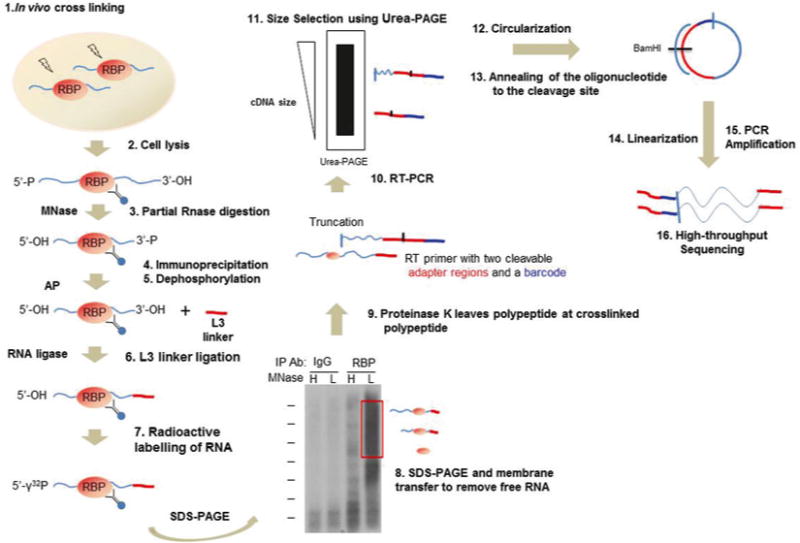
UV crosslinking immunoprecipitation (CLIP) is an increasingly popular technique to study protein-RNA interactions in tissues and cells. Whole cells or tissues are ultraviolet irradiated to generate a covalent bond between RNA and proteins that are in close contact. After partial RNase digestion, antibodies specific to an RNA binding protein (RBP) or a protein-epitope tag is then used to immunoprecipitate the protein-RNA complexes. After stringent washing and gel separation the RBP-RNA complex is excised. The RBP is protease digested to allow purification of the bound RNA. Reverse transcription of the RNA followed by high-throughput sequencing of the cDNA library is now often used to identify protein bound RNA on a genome-wide scale. UV irradiation can result in cDNA truncations and/or mutations at the crosslink sites, which complicates the alignment of the sequencing library to the reference genome and the identification of the crosslinking sites. Meanwhile, one or more amino acids of a crosslinked RBP can remain attached to its bound RNA due to incomplete digestion of the protein. As a result, reverse transcriptase may not read through the crosslink sites, and produce cDNA ending at the crosslinked nucleotide. This is harnessed by one variant of CLIP methods to identify crosslinking sites at a nucleotide resolution. This method, individual nucleotide resolution CLIP (iCLIP) circularizes cDNA to capture the truncated cDNA and also increases the efficiency of ligating sequencing adapters to the library. Here, we describe the detailed procedure of iCLIP.
紫外线交联免疫沉淀(CLIP)是一种在组织和细胞中研究蛋白质-RNA相互作用的越来越流行的技术。对全细胞或组织进行紫外线照射,以在紧密接触的RNA和蛋白质之间产生共价键。经过部分核糖核酸酶消化后,然后使用针对RNA结合蛋白(RBP)或蛋白质表位标签的特异性抗体免疫沉淀蛋白质-RNA复合物。经过严格洗涤和凝胶分离后,切下RBP-RNA复合物。对RBP进行蛋白酶消化,以纯化结合的RNA。现在经常使用RNA的逆转录,然后对cDNA文库进行高通量测序,以在全基因组范围内鉴定与蛋白质结合的RNA。紫外线照射可导致cDNA在交联位点处截断和/或突变,这使得测序文库与参考基因组的比对以及交联位点的鉴定变得复杂。同时,由于蛋白质消化不完全,交联的RBP的一个或多个氨基酸可能仍与其结合的RNA相连。结果,逆转录酶可能无法通读交联位点,并产生在交联核苷酸处终止的cDNA。CLIP方法的一种变体利用这一点以核苷酸分辨率鉴定交联位点。这种方法,即单核苷酸分辨率CLIP(iCLIP),可使cDNA环化以捕获截短的cDNA,还提高了将测序接头连接到文库的效率。在此,我们描述了iCLIP的详细步骤。