Heras-Sandoval David, Pedraza-Chaverri José, Pérez-Rojas Jazmin M
Departamento de Biología, Facultad de Química, Universidad Nacional Autónoma de México, Ciudad Universitaria, 04510, México, DF, México.
Laboratorio de Farmacología, Subdirección de Investigación Básica, Instituto Nacional de Cancerología (INCan), Av. San Fernando #22, Tlalpan 14080, Apartado Postal 22026, México, DF, México.
J Neuroinflammation. 2016 Mar 10;13(1):61. doi: 10.1186/s12974-016-0525-7.
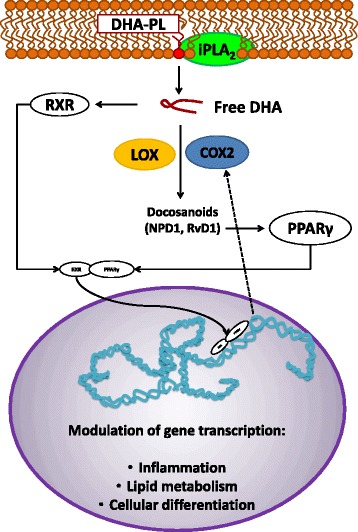
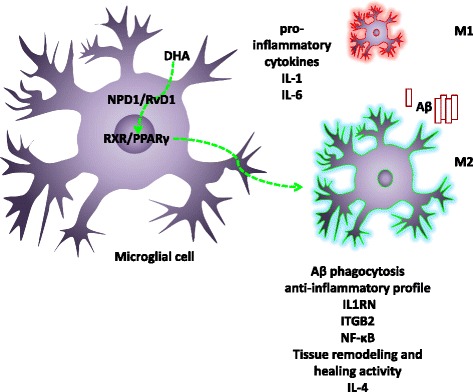
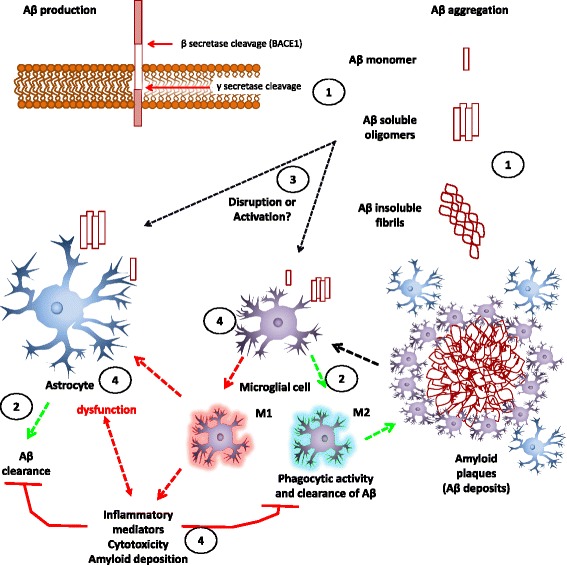
Docosahexaenoic acid (DHA) is an omega-3 (ω-3) long-chain polyunsaturated fatty acid (LCPUFA) relevant for brain function. It has largely been explored as a potential candidate to treat Alzheimer's disease (AD). Clinical evidence favors a role for DHA in the improvement of cognition in very early stages of the AD. In response to stress or damage, DHA generates oxygenated derivatives called docosanoids that can activate the peroxisome proliferator-activated receptor γ (PPARγ). In conjunction with activated retinoid X receptors (RXR), PPARγ modulates inflammation, cell survival, and lipid metabolism. As an early event in AD, inflammation is associated with an excess of amyloid β peptide (Aβ) that contributes to neural insult. Glial cells are recognized to be actively involved during AD, and their dysfunction is associated with the early appearance of this pathology. These cells give support to neurons, remove amyloid β peptides from the brain, and modulate inflammation. Since DHA can modulate glial cell activity, the present work reviews the evidence about this modulation as well as the effect of docosanoids on neuroinflammation and in some AD models. The evidence supports PPARγ as a preferred target for gene modulation. The effective use of DHA and/or its derivatives in a subgroup of people at risk of developing AD is discussed.
二十二碳六烯酸(DHA)是一种与脑功能相关的ω-3(ω-3)长链多不饱和脂肪酸(LCPUFA)。它在很大程度上已被探索作为治疗阿尔茨海默病(AD)的潜在候选物。临床证据支持DHA在AD极早期改善认知方面的作用。在应激或损伤反应中,DHA会生成称为二十二碳类化合物的氧化衍生物,这些衍生物可激活过氧化物酶体增殖物激活受体γ(PPARγ)。与激活的视黄酸X受体(RXR)一起,PPARγ调节炎症、细胞存活和脂质代谢。作为AD的早期事件,炎症与过多的淀粉样β肽(Aβ)有关,而Aβ会导致神经损伤。神经胶质细胞在AD过程中被认为积极参与其中,其功能障碍与这种病理的早期出现有关。这些细胞支持神经元、从大脑中清除淀粉样β肽并调节炎症。由于DHA可以调节神经胶质细胞活性,因此本研究综述了有关这种调节的证据以及二十二碳类化合物对神经炎症和一些AD模型的影响。证据支持PPARγ作为基因调节的首选靶点。还讨论了在有患AD风险的亚组人群中有效使用DHA和/或其衍生物的情况。