Kuchta Shawn R, Brown Ashley D, Converse Paul E, Highton Richard
Department of Biological Sciences, Ohio Center for Ecology and Evolutionary Studies, Ohio University, Athens, Ohio, United States of America.
Department of Biology, University of Maryland, College Park, Maryland, United States of America.
PLoS One. 2016 Mar 14;11(3):e0150022. doi: 10.1371/journal.pone.0150022. eCollection 2016.
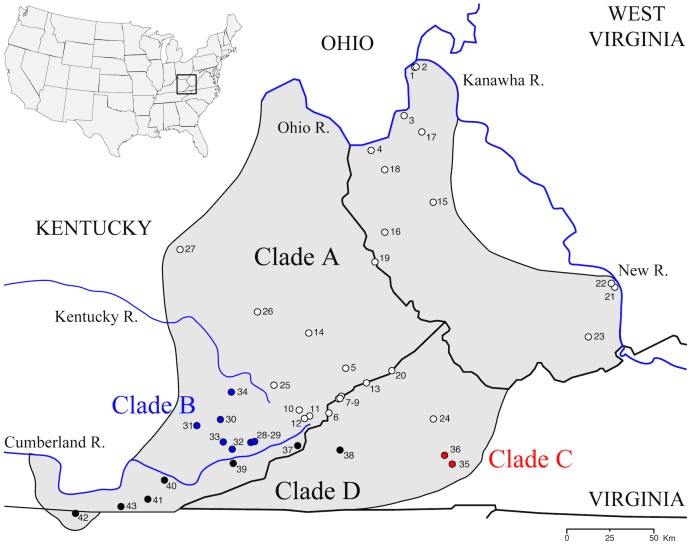
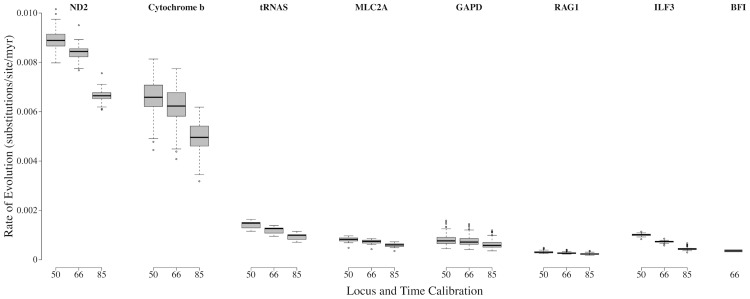
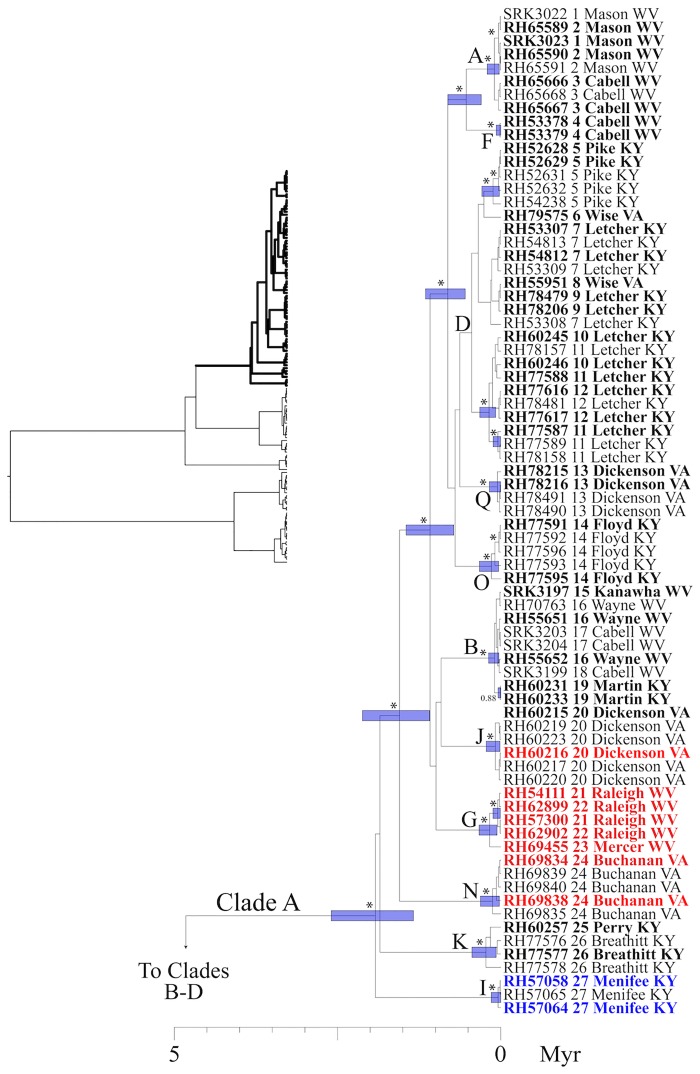
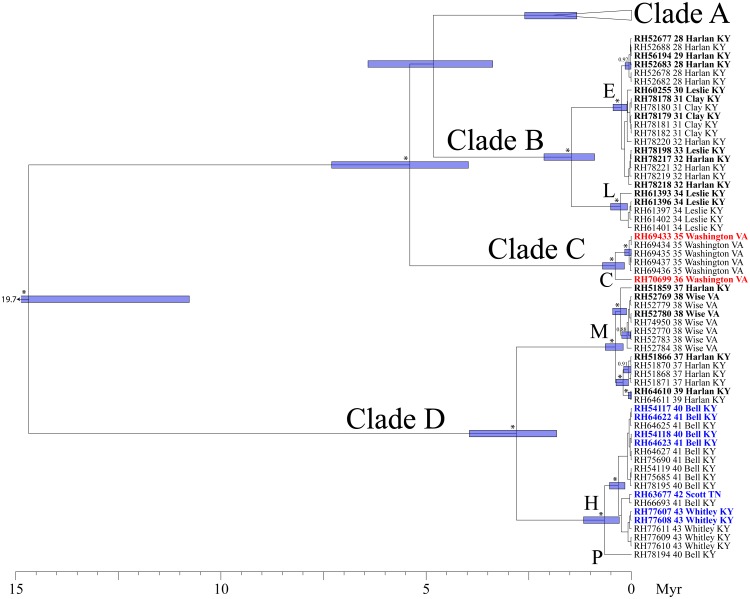
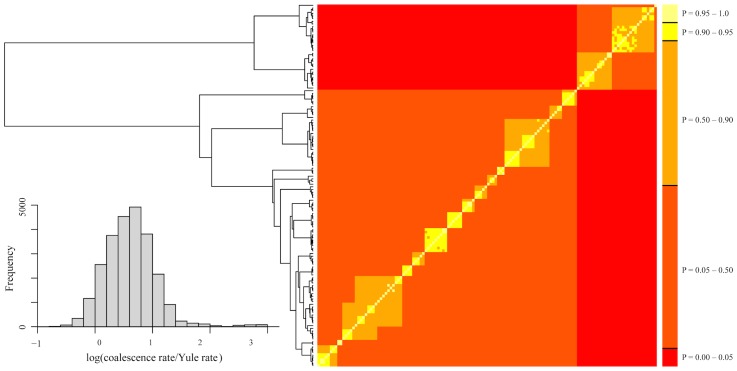
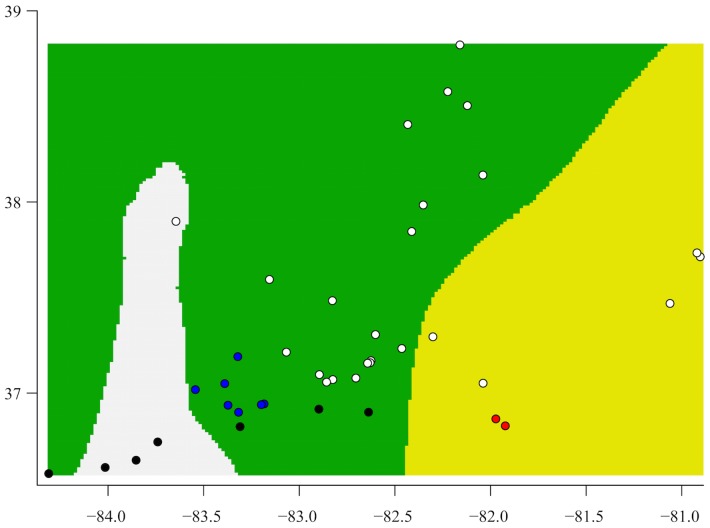
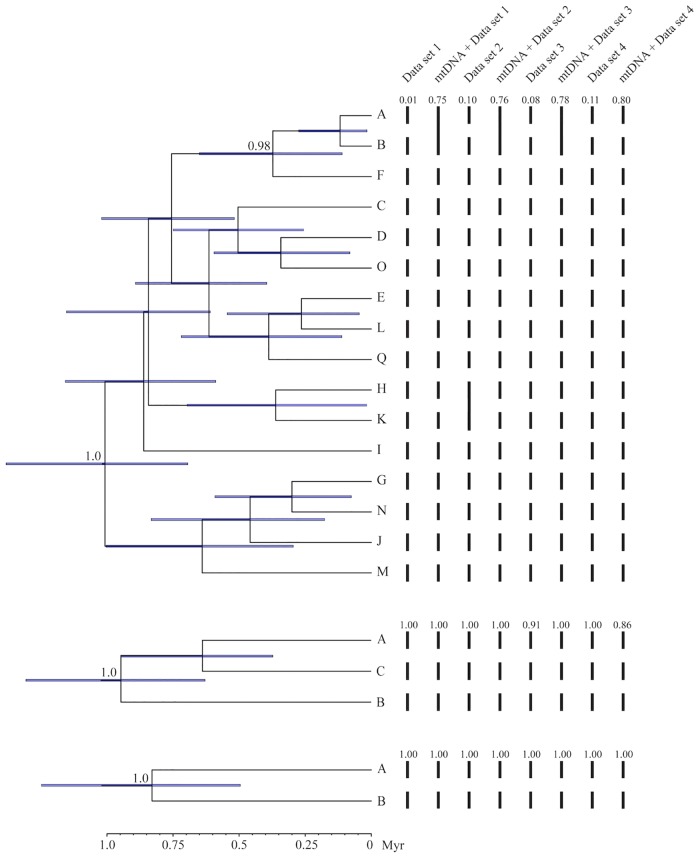
Species are a fundamental unit of biodiversity, yet can be challenging to delimit objectively. This is particularly true of species complexes characterized by high levels of population genetic structure, hybridization between genetic groups, isolation by distance, and limited phenotypic variation. Previous work on the Cumberland Plateau Salamander, Plethodon kentucki, suggested that it might constitute a species complex despite occupying a relatively small geographic range. To examine this hypothesis, we sampled 135 individuals from 43 populations, and used four mitochondrial loci and five nuclear loci (5693 base pairs) to quantify phylogeographic structure and probe for cryptic species diversity. Rates of evolution for each locus were inferred using the multidistribute package, and time calibrated gene trees and species trees were inferred using BEAST 2 and *BEAST 2, respectively. Because the parameter space relevant for species delimitation is large and complex, and all methods make simplifying assumptions that may lead them to fail, we conducted an array of analyses. Our assumption was that strongly supported species would be congruent across methods. Putative species were first delimited using a Bayesian implementation of the GMYC model (bGMYC), Geneland, and Brownie. We then validated these species using the genealogical sorting index and BPP. We found substantial phylogeographic diversity using mtDNA, including four divergent clades and an inferred common ancestor at 14.9 myr (95% HPD: 10.8-19.7 myr). By contrast, this diversity was not corroborated by nuclear sequence data, which exhibited low levels of variation and weak phylogeographic structure. Species trees estimated a far younger root than did the mtDNA data, closer to 1.0 myr old. Mutually exclusive putative species were identified by the different approaches. Possible causes of data set discordance, and the problem of species delimitation in complexes with high levels of population structure and introgressive hybridization, are discussed.
物种是生物多样性的基本单位,但要客观界定却颇具挑战。对于以高水平种群遗传结构、遗传群体间杂交、距离隔离和有限表型变异为特征的物种复合体而言,情况尤其如此。先前对坎伯兰高原蝾螈(Plethodon kentucki)的研究表明,尽管其地理分布范围相对较小,但它可能构成一个物种复合体。为检验这一假设,我们从43个种群中采集了135个个体样本,并使用四个线粒体基因座和五个核基因座(共5693个碱基对)来量化系统地理学结构并探寻隐秘物种多样性。使用multidistribute软件包推断每个基因座的进化速率,并分别使用BEAST 2和*BEAST 2推断时间校准的基因树和物种树。由于与物种界定相关的参数空间庞大且复杂,并且所有方法都做了可能导致其失效的简化假设,因此我们进行了一系列分析。我们的假设是,得到有力支持的物种在不同方法间应具有一致性。首先使用GMYC模型的贝叶斯实现方法(bGMYC)、Geneland和Brownie来界定假定物种。然后我们使用谱系分选指数和BPP对这些物种进行验证。我们通过线粒体DNA发现了大量的系统地理学多样性,包括四个不同的分支以及一个推断出的1490万年前(95%最高后验密度区间:1080 - 1970万年前)的共同祖先。相比之下,核序列数据并未证实这种多样性,其显示出低水平的变异和微弱的系统地理学结构。物种树估计的根部年龄比线粒体DNA数据要年轻得多,接近100万年前。不同方法识别出了相互排斥的假定物种。文中讨论了数据集不一致的可能原因,以及在具有高水平种群结构和渐渗杂交的复合体中物种界定的问题。