France Emma F, Wells Mary, Lang Heidi, Williams Brian
Nursing, Midwifery and Allied Health Professions Research Unit, School of Health Sciences, University of Stirling, Stirling, FK9 4NF, UK.
Syst Rev. 2016 Mar 15;5:44. doi: 10.1186/s13643-016-0218-4.
Meta-ethnography is a unique, systematic, qualitative synthesis approach widely used to provide robust evidence on patient and clinician beliefs and experiences and understandings of complex social phenomena. It can make important theoretical and conceptual contributions to health care policy and practice.
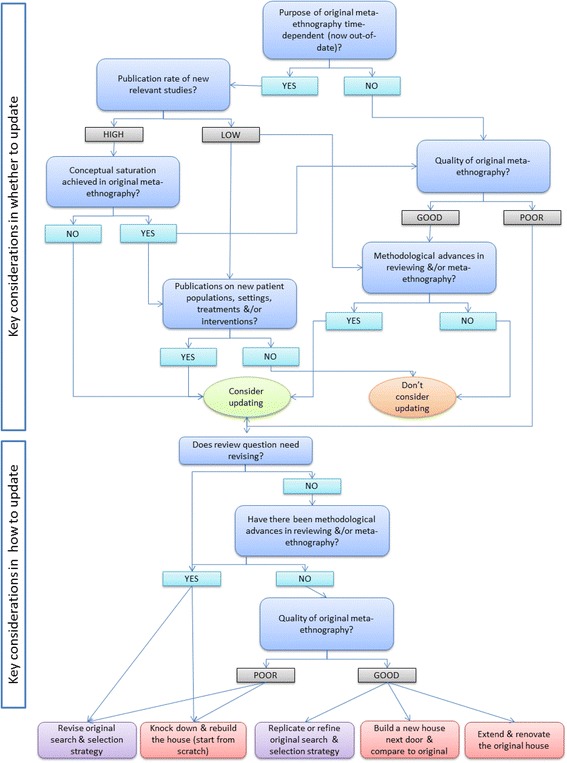
Since beliefs, experiences, health care contexts and social phenomena change over time, the continued relevance of the findings from meta-ethnographies cannot be assumed. However, there is little guidance on whether, when and how meta-ethnographies should be updated; Cochrane guidance on updating reviews of intervention effectiveness is unlikely to be fully appropriate. This is the first in-depth discussion on updating a meta-ethnography; it explores why, when and how to update a meta-ethnography. Three main methods of updating the analysis and synthesis are examined. Advantages and disadvantages of each method are outlined, relating to the context, purpose, process and output of the update and the nature of the new data available. Recommendations are made for the appropriate use of each method, and a worked example of updating a meta-ethnography is provided.
This article makes a unique contribution to this evolving area of meta-ethnography methodology.
元民族志是一种独特的、系统的定性综合方法,广泛用于为患者和临床医生对复杂社会现象的信念、经历及理解提供有力证据。它能为医疗保健政策和实践做出重要的理论和概念贡献。
由于信念、经历、医疗保健背景和社会现象会随时间变化,不能假定元民族志研究结果仍具有持续相关性。然而,关于是否、何时以及如何更新元民族志,几乎没有相关指导;Cochrane关于更新干预效果综述的指导不太可能完全适用。这是首次对更新元民族志进行的深入讨论;探讨了为何、何时以及如何更新元民族志。研究了三种更新分析与综合的主要方法。概述了每种方法的优缺点,涉及更新的背景、目的、过程和结果以及可用新数据的性质。针对每种方法的恰当使用提出了建议,并提供了一个更新元民族志的实例。
本文对元民族志方法论这一不断发展的领域做出了独特贡献。