Yong Loo Lin School of Medicine, National University of Singapore, NUHS Tower Block, 1E Kent Ridge Road, Level 11, Singapore, 119228, Singapore.
Division of Supportive and Palliative Care, National Cancer Centre Singapore, 30 Hospital Boulevard, Singapore, 168583, Singapore.
BMC Med Educ. 2024 Oct 10;24(1):1119. doi: 10.1186/s12909-024-06117-3.
Medical education is tasked with shaping how medical students and physicians think, feel and act as professionals, or their Professional Identity Formation (PIF). This process has traditionally rested upon imparting knowledge; integrating sociocultural, professional and organizational expectations and codes of conduct; inculcating program and practice beliefs, values and principles (belief systems); and imbuing shared identities - quintessential elements that, together, comprise the socialization process. Key to supporting this socialization process is reflective practice. However, regnant approaches to mobilizing reflective cycles are faced with resource, personnel and time constraints, hindering efforts to nurture PIF. Group non-written reflections (GNWR) - broadly defined as facilitator-led discussions of shared reflective experiences within groups of learners - may prove to be an effective compromise. To address diverse approaches and a lack of effective understanding, we propose a systematic scoping review (SSR) to map the current use of GNWR in medical training and its role in shaping PIF.
Guided by the Systematic Evidence-Based Approach (SEBA)'s constructivist ontological and relativist epistemological position, this SSR in SEBA searched for articles on GNWR published in PubMed, Embase, Psychinfo, CINAHL, ERIC, ASSIA, SCOPUS, Google Scholar, Open Grey, GreyLit and ProQuest databases. The data found was concurrently analyzed using thematic and direct content analysis. Complementary themes and categories identified were combined, creating the domains that framed the discussion.
Of the 8560 abstracts and 336 full-text articles reviewed, 98 articles were included. The four domains identified were: (1) Indications of use and their value; (2) Structure and how they can be used; (3) Models of reflective practice in GNWR; and (4) Features of communities of practice and the socialisation process.
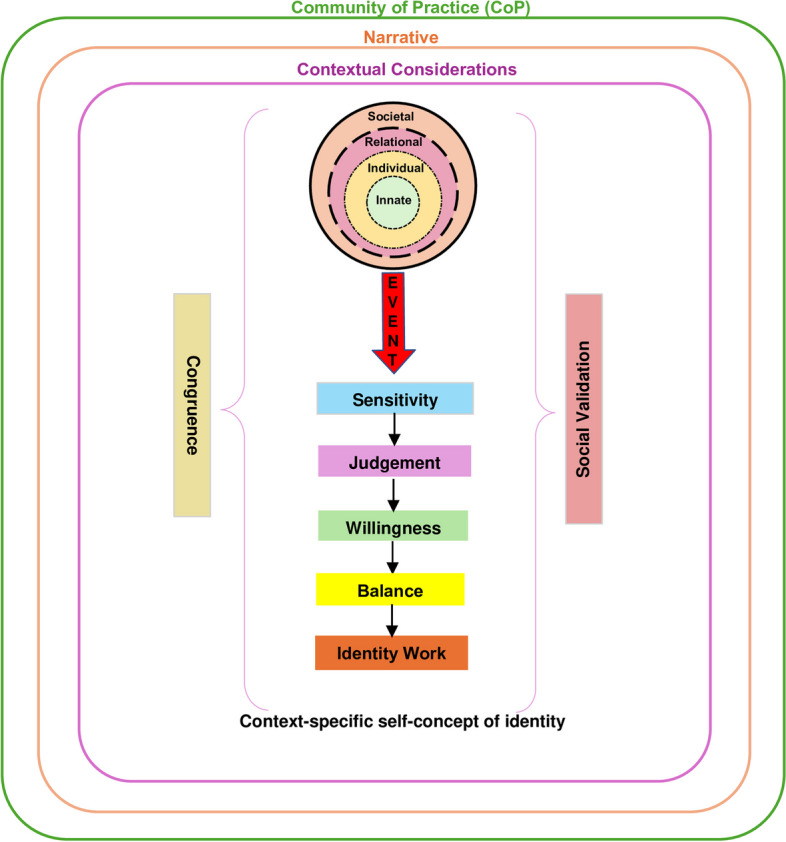
This SSR in SEBA concludes that GNWR does impact PIF when effectively structured and supported. The Krishna-Pisupati Model for PIF platforms a model that explains GNWR's effects of PIF and advances fourteen recommendations to maximize GNWR use.
医学教育的任务是塑造医学生和医生作为专业人员的思维、感受和行为方式,即他们的专业身份形成(Professional Identity Formation,PIF)。这一过程传统上依赖于传授知识;整合社会文化、专业和组织期望以及行为准则;灌输计划和实践信念、价值观和原则(信仰体系);并赋予共同身份——这些要素共同构成了社会化过程。支持这一社会化过程的关键是反思实践。然而,当前调动反思周期的方法面临着资源、人员和时间的限制,阻碍了培养 PIF 的努力。群体非书面反思(Group Non-written Reflections,GNWR)——广义上是指在学习者群体中由促进者主导的共享反思经验的讨论——可能被证明是一种有效的折衷方案。为了解决多样化的方法和缺乏有效理解的问题,我们提出了一项系统的范围审查(Systematic Scoping Review,SSR),以绘制 GNWR 在医学培训中的当前使用情况及其在塑造 PIF 中的作用。
本 SSR 在系统证据基础方法(Systematic Evidence-Based Approach,SEBA)的指导下,基于其建构主义本体论和相对主义认识论立场,在 PubMed、Embase、Psychinfo、CINAHL、ERIC、ASSIA、SCOPUS、Google Scholar、Open Grey、GreyLit 和 ProQuest 数据库中搜索了关于 GNWR 的文章。同时使用主题和直接内容分析对发现的数据进行分析。互补的主题和类别被合并,形成了讨论的框架。
在审查的 8560 篇摘要和 336 篇全文文章中,有 98 篇文章被纳入。确定了四个领域:(1)使用的指示及其价值;(2)结构以及如何使用;(3)GNWR 中的反思实践模型;和(4)实践社区的特征和社会化过程。
这项 SEBA 中的 SSR 得出结论,当 GNWR 得到有效构建和支持时,确实会影响 PIF。Krishna-Pisupati PIF 模型为 GNWR 对 PIF 的影响提供了一个平台,并提出了 14 项建议,以最大限度地利用 GNWR。