Wirth Brigitte, Humphreys B Kim, Peterson Cynthia
Chiropractic Medicine Department, Faculty of Medicine, University of Zurich and University Hospital Balgrist, Forchstr. 340, CH-8008 Zurich, Switzerland.
Chiropractic Medicine Department, Faculty of Medicine, University of Zurich and University Hospital Balgrist, Forchstr. 340, CH-8008 Zurich, Switzerland ; Radiology Department, University Hospital Balgrist, Forchstr. 340, 8008 Zurich, Switzerland.
Chiropr Man Therap. 2016 Mar 16;24:9. doi: 10.1186/s12998-016-0090-2. eCollection 2016.
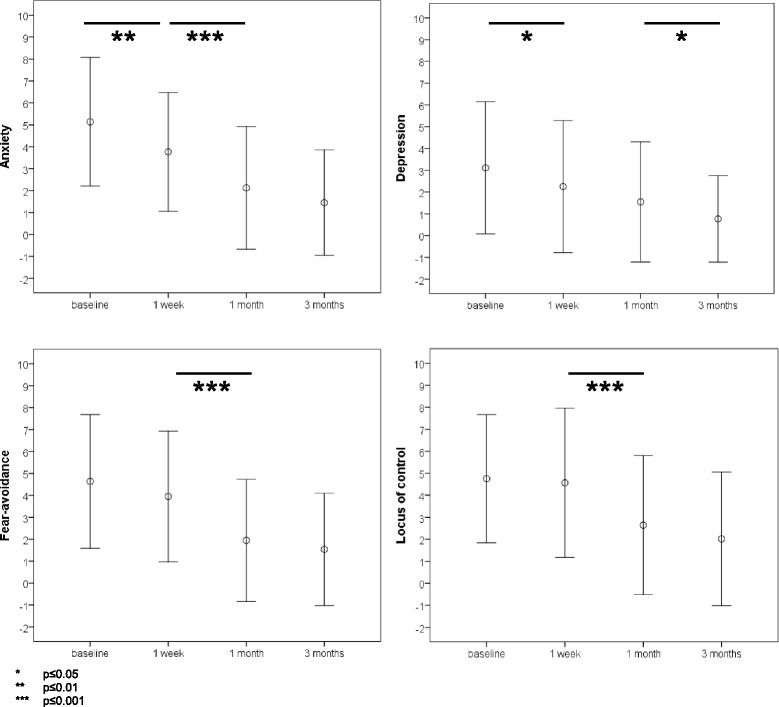
The influence of psychological factors on acute neck pain is sparsely studied. In a secondary analysis of prospectively collected data, this study investigated how several psychological factors develop in the first three months of acute neck pain and how these factors influence self-perceived recovery.
Patients were recruited in various chiropractic practices throughout Switzerland between 2010 and 2014. The follow-up telephone interviews were conducted for all patients by research assistants in the coordinating university hospital following a standardized procedure. The population of this study consisted of 103 patients (68 female; mean age = 38.3 ± 13.8 years) with a first episode of acute (<4 weeks) neck pain. Prior to the first treatment, the patients filled in the Bournemouth Questionnaire (BQ). One week and 1 and 3 months later, they completed the BQ again along with the Patient Global Impression of Change (PGIC). The temporal development (repeated measure ANOVA) of the BQ questions 4 (anxiety), 5 (depression), 6 (fear-avoidance) and 7 (pain locus of control) as well as the influence of these scores on the PGIC were investigated (binary logistic regression analyses, receiver operating curves (ROC)).
All psychological parameters showed significant reduction within the first month. The parameter 'anxiety' was associated with outcome at 1 and 3 months (p = 0.013, R(2) = 0.40 and p = 0.039, R(2) = 0.63, respectively). Baseline depression (p = 0.037, R(2) = 0.21), but not baseline anxiety, was a predictor for poor outcome. A high reduction in anxiety within the first month was a significant predictor for favorable outcome after 1 month (p < 0.001; R(2) = 0.57).
Psychological factors emerged from this study as relevant in the early phase of acute neck pain. Particularly persistent anxiety and depression at baseline might be risk factors for a transition to chronic pain that should be addressed in the early management of neck pain patients.
心理因素对急性颈部疼痛的影响研究较少。在对前瞻性收集的数据进行的二次分析中,本研究调查了几种心理因素在急性颈部疼痛的前三个月中如何发展,以及这些因素如何影响自我感知的恢复情况。
2010年至2014年间,在瑞士各地的多家脊椎按摩诊所招募患者。由协调大学医院的研究助理按照标准化程序对所有患者进行随访电话访谈。本研究的人群包括103例首次发作急性(<4周)颈部疼痛的患者(68例女性;平均年龄=38.3±13.8岁)。在首次治疗前,患者填写伯恩茅斯问卷(BQ)。1周以及1个月和3个月后,他们再次填写BQ以及患者整体变化印象(PGIC)。研究了BQ问题4(焦虑)、5(抑郁)、6(恐惧回避)和7(疼痛控制源)的时间发展(重复测量方差分析)以及这些分数对PGIC的影响(二元逻辑回归分析、受试者工作特征曲线(ROC))。
所有心理参数在第一个月内均显著降低。参数“焦虑”与1个月和3个月时的结果相关(分别为p = 0.013,R(2)=0.40和p = 0.039,R(2)=0.63)。基线抑郁(p = 0.037,R(2)=0.21)而非基线焦虑是预后不良的预测因素。第一个月内焦虑的大幅降低是1个月后预后良好的显著预测因素(p < 0.001;R(2)=0.57)。
本研究表明心理因素在急性颈部疼痛的早期阶段具有相关性。特别是基线时持续存在的焦虑和抑郁可能是转变为慢性疼痛的危险因素,在颈部疼痛患者的早期管理中应予以关注。