Ichinomiya Mutsuo, Dos Santos Adriana Lopes, Gourvil Priscillia, Yoshikawa Shinya, Kamiya Mitsunobu, Ohki Kaori, Audic Stéphane, de Vargas Colomban, Noël Mary-Hélène, Vaulot Daniel, Kuwata Akira
Prefectural University of Kumamoto, Kumamoto, Japan.
Sorbonne Universités, UPMC University Paris 06, CNRS, UMR 7144 Station Biologique de Roscoff, Roscoff, France.
ISME J. 2016 Oct;10(10):2419-34. doi: 10.1038/ismej.2016.38. Epub 2016 Mar 22.
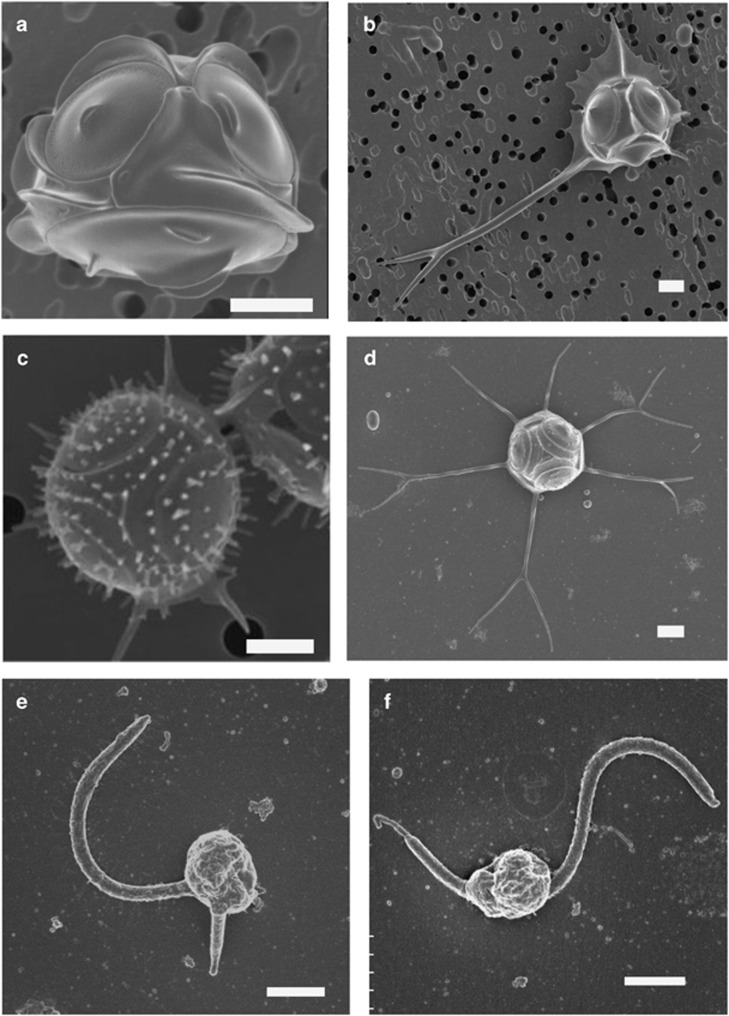
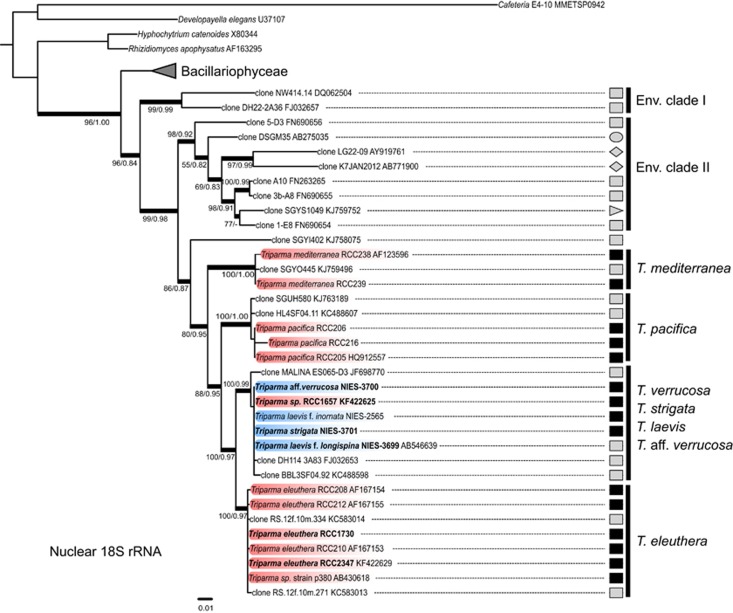
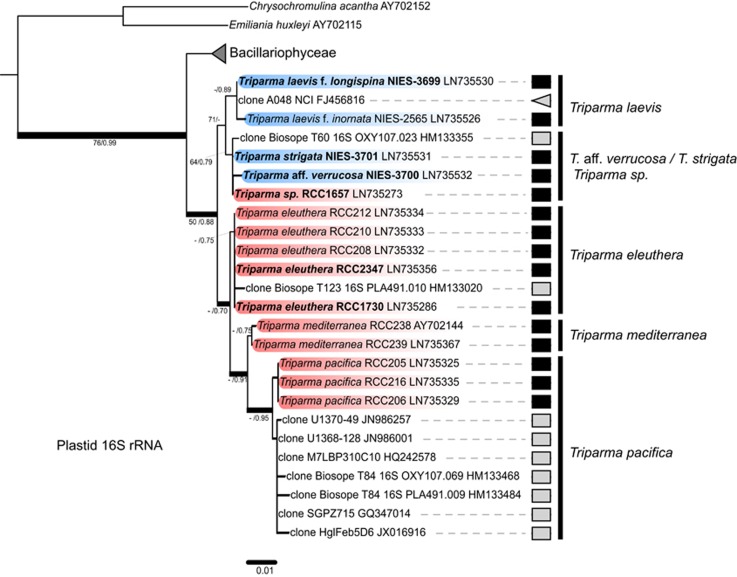
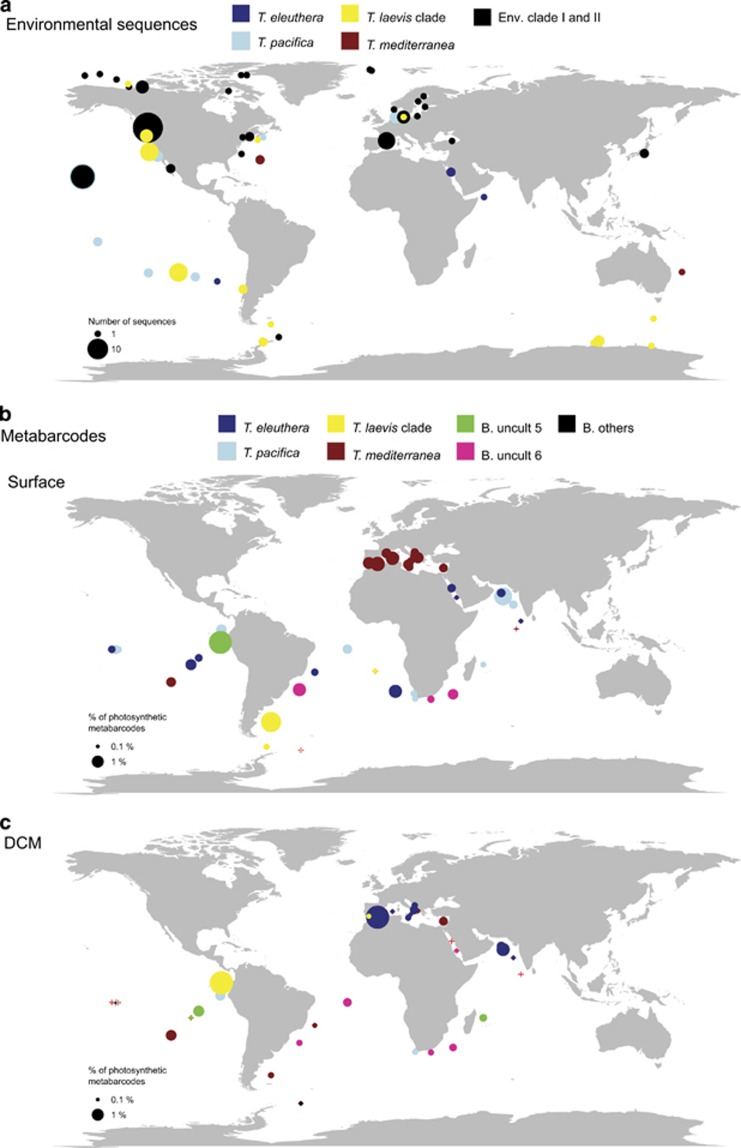
Bolidomonas is a genus of picoplanktonic flagellated algae that is closely related to diatoms. Triparma laevis, a species belonging to the Parmales, which are small cells with a siliceous covering, has been shown to form a monophyletic group with Bolidomonas. We isolated several novel strains of Bolidophyceae that have permitted further exploration of the diversity of this group using nuclear, plastidial and mitochondrial genes. The resulting phylogenetic data led us to formally emend the taxonomy of this group to include the Parmales within the Bolidophyceae, to combine Bolidomonas within Triparma and to define a novel species, Triparma eleuthera sp. nov. The global distribution of Bolidophyceae was then assessed using environmental sequences available in public databases, as well as a large 18S rRNA V9 metabarcode data set from the Tara Oceans expedition. Bolidophyceans appear ubiquitous throughout the sampled oceans but always constitute a minor component of the phytoplankton community, corresponding to at most ~4% of the metabarcodes from photosynthetic groups (excluding dinoflagellates). They are ~10 times more abundant in the small size fraction (0.8-5 μm) than in larger size fractions. T. eleuthera sp. nov. constitutes the most abundant and most widespread operational taxonomic unit (OTU) followed by T. pacifica, T. mediterranea and the T. laevis clade. The T. mediterranea OTU is characteristic of Mediterranean Sea surface waters and the T. laevis clade OTU is most prevalent in colder waters, in particular off Antarctica.
波氏藻属是一类与硅藻密切相关的微微型鞭毛藻。Triparma laevis是属于Parma藻目的一个物种,该目细胞较小,具有硅质覆盖物,已被证明与波氏藻属形成一个单系类群。我们分离出了几种新型的波氏藻科菌株,这使得我们能够利用核基因、质体基因和线粒体基因进一步探索该类群的多样性。由此产生的系统发育数据使我们正式修订了该类群的分类,将Parma藻目纳入波氏藻科,将波氏藻属并入Triparma属,并定义了一个新物种,即新种Triparma eleuthera。然后,我们利用公共数据库中可用的环境序列以及来自塔拉海洋探险的一个大型18S rRNA V9元条形码数据集,评估了波氏藻科的全球分布。在整个采样海域中,波氏藻科似乎无处不在,但始终是浮游植物群落的一个次要组成部分,最多占光合类群(不包括甲藻)元条形码的4%左右。它们在小粒径部分(0.8-5微米)的丰度比在大粒径部分高约10倍。新种Triparma eleuthera是最丰富、分布最广的操作分类单元(OTU),其次是太平洋Triparma、地中海Triparma和Triparma laevis分支。地中海Triparma OTU是地中海表层水的特征,而Triparma laevis分支OTU在较冷的水域最为普遍,特别是在南极海域。