Willner Marian, Viermetz Manuel, Marschner Mathias, Scherer Kai, Braun Christian, Fingerle Alexander, Noël Peter, Rummeny Ernst, Pfeiffer Franz, Herzen Julia
Department of Physics and Institute of Medical Engineering, Technische Universität München, Garching, Germany.
Department of Diagnostic and Interventional Radiology, Technische Universität München, Munich, Germany.
PLoS One. 2016 Mar 22;11(3):e0151889. doi: 10.1371/journal.pone.0151889. eCollection 2016.
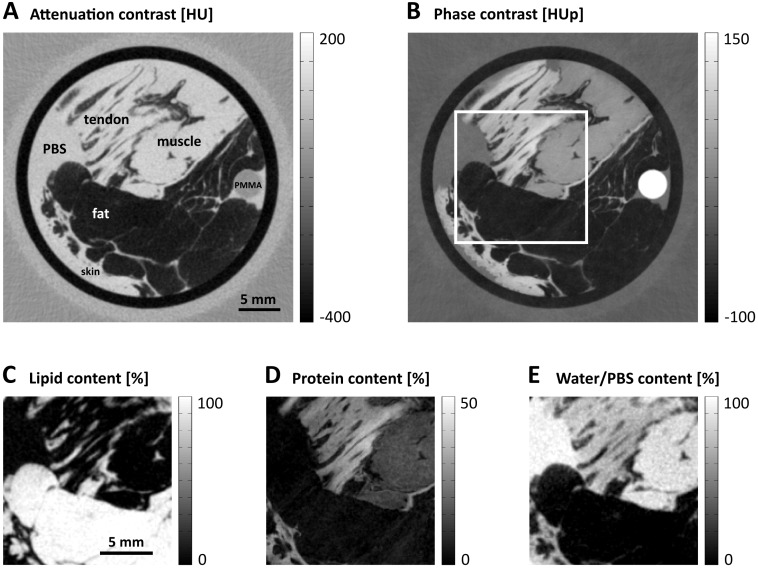
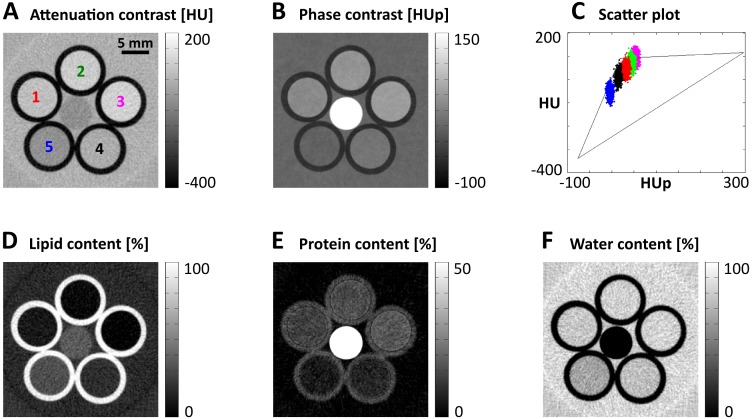
X-ray phase-contrast computed tomography is an emerging imaging technology with powerful capabilities for three-dimensional (3D) visualization of weakly absorbing objects such as biological soft tissues. This technique is an extension of existing X-ray applications because conventional attenuation-contrast images are simultaneously acquired. The complementary information provided by both the contrast modalities suggests that enhanced material characterization is possible when performing combined data analysis. In this study, we describe how protein, lipid, and water concentrations in each 3D voxel can be quantified by vector decomposition. Experimental results of dairy products, porcine fat and rind, and different human soft tissue types are presented. The results demonstrate the potential of phase-contrast imaging as a new analysis tool. The 3D representations of protein, lipid, and water contents open up new opportunities in the fields of biology, medicine, and food science.
X射线相衬计算机断层扫描是一种新兴的成像技术,在对生物软组织等弱吸收物体进行三维(3D)可视化方面具有强大的能力。由于同时获取了传统的衰减对比图像,该技术是现有X射线应用的扩展。两种对比模式提供的互补信息表明,在进行联合数据分析时,可以增强材料表征。在本研究中,我们描述了如何通过矢量分解对每个3D体素中的蛋白质、脂质和水浓度进行量化。给出了乳制品、猪脂肪和猪皮以及不同人类软组织类型的实验结果。结果证明了相衬成像作为一种新分析工具的潜力。蛋白质、脂质和水含量的3D表示在生物学、医学和食品科学领域开辟了新的机遇。