Yoo Sae-Rom, Seo Chang-Seob, Lee Na-Ri, Shin Hyeun-Kyoo, Jeong Soo-Jin
K-herb Research Center, Daejeon, Republic of Korea.
KM Convergence Research Division, Korea Institute of Oriental Medicine, Daejeon, Republic of Korea; Korean Medicine Life Science, University of Science and Technology, Daejeon, Republic of Korea.
Pharmacogn Mag. 2015 Oct;11(Suppl 4):S585-91. doi: 10.4103/0973-1296.172966.
Xanthii fructus (Compositae) is a traditional herbal medicine used for treating headache, toothache, pruritus, empyema, and rhinitis. In this study of the quality control of X. fructus, we performed simultaneous analysis of nine marker compounds: Protocatechuic acid (1), chlorogenic acid (2), caffeic acid (3), 4,5-dicaffeoylquinic acid (4), ferulic acid (5), 3,5-dicaffeoylquinic acid (6), 1,3-dicaffeoylquinic acid (7), 1,4-dicaffeoylquinic acid (8), and 4,5-dicaffeoylquinic acid (9).
Nine components were separated using reversed-phase SunFire™ C18 analytical column and analyzed using high-performance liquid chromatography. We examined the biological effects of the nine marker compounds by determining their anti-inflammatory activities in the murine macrophage cell line RAW 264.7.
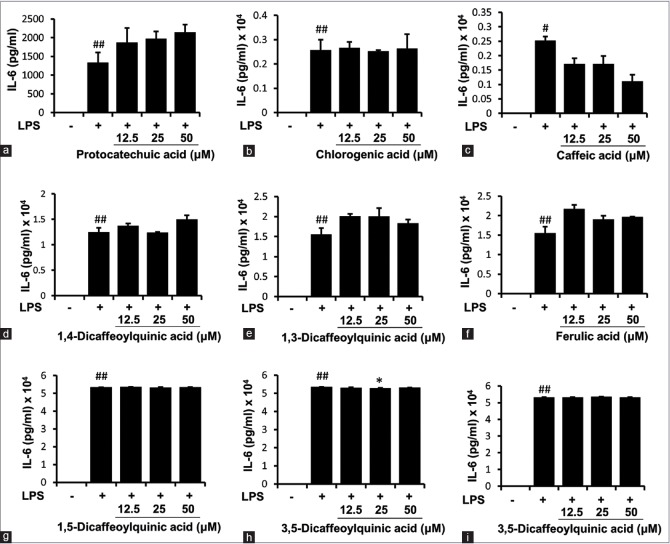
Among the nine marker compounds, eight significantly inhibited lipopolysaccharide (LPS)-stimulated tumor necrosis factor-alpha (TNF-α) production. 1, 3, 5 had significant inhibitory effects on LPS-induced prostaglandin E2 (PGE2) production in RAW 264.7 cells. None of the tested marker compounds had a significant effect on interleukin-6 production in LPS-treated RAW 264.7 cells. Our data demonstrated that each marker compound from X. fructus exerts anti-inflammatory activity by targeting different inflammation-related pathways such as the TNF-α or PGE2 pathway.
Further experiments using in vitro and in vivo models are needed to identify the mechanisms responsible for the anti-inflammatory properties of each marker compound.
Simultaneous analysis of nine phenylpropanoids in the Xanthii fructus was established using HPLC-PDA system.1,4-dicaffeoylquinic acid significantly inhibited LPS-stimulated TNF-a production.Protocatechuic acid, caffeic acid and ferulic acid had significant inhibitory effects on LPS-induced PGE2 production in RAW 264.7 cells.
苍耳子(菊科)是一种传统草药,用于治疗头痛、牙痛、瘙痒、脓胸和鼻炎。在这项关于苍耳子质量控制的研究中,我们对9种标记化合物进行了同步分析:原儿茶酸(1)、绿原酸(2)、咖啡酸(3)、4,5-二咖啡酰奎宁酸(4)、阿魏酸(5)、3,5-二咖啡酰奎宁酸(6)、1,3-二咖啡酰奎宁酸(7)、1,4-二咖啡酰奎宁酸(8)和4,5-二咖啡酰奎宁酸(9)。
使用反相SunFire™ C18分析柱分离9种成分,并采用高效液相色谱法进行分析。我们通过测定9种标记化合物在小鼠巨噬细胞系RAW 264.7中的抗炎活性,来研究它们的生物学效应。
在9种标记化合物中,8种显著抑制脂多糖(LPS)刺激的肿瘤坏死因子-α(TNF-α)生成。1、3、5对RAW 264.7细胞中LPS诱导的前列腺素E2(PGE2)生成有显著抑制作用。在所测试的标记化合物中,没有一种对LPS处理的RAW 264.7细胞中白细胞介素-6的生成有显著影响。我们的数据表明,苍耳子中的每种标记化合物通过靶向不同的炎症相关途径(如TNF-α或PGE2途径)发挥抗炎活性。
需要使用体外和体内模型进行进一步实验,以确定每种标记化合物抗炎特性的作用机制。
采用HPLC-PDA系统建立了苍耳子中9种苯丙素类化合物的同步分析方法。1,4-二咖啡酰奎宁酸显著抑制LPS刺激的TNF-α生成。原儿茶酸、咖啡酸和阿魏酸对RAW 264.7细胞中LPS诱导的PGE2生成有显著抑制作用。