Pollard Kenneth Michael
Department of Molecular and Experimental Medicine, The Scripps Research Institute , La Jolla, CA , USA.
Front Immunol. 2016 Mar 11;7:97. doi: 10.3389/fimmu.2016.00097. eCollection 2016.
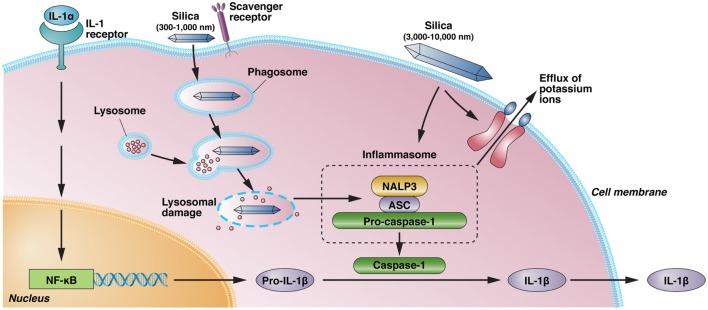
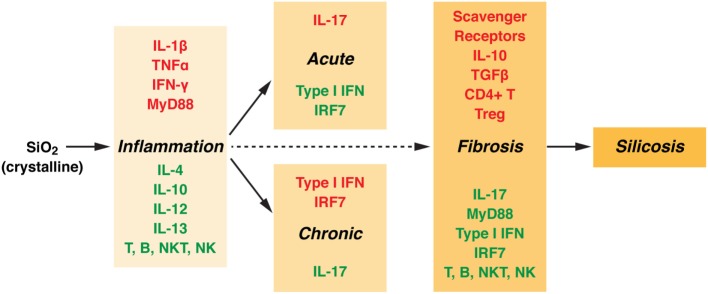
Inhalation of dust containing crystalline silica is associated with a number of acute and chronic diseases including systemic autoimmune diseases. Evidence for the link with autoimmune disease comes from epidemiological studies linking occupational exposure to crystalline silica dust with the systemic autoimmune diseases systemic lupus erythematosus, systemic sclerosis, and rheumatoid arthritis. Although little is known regarding the mechanism by which silica exposure leads to systemic autoimmune disease, there is a voluminous literature on silica exposure and silicosis that may help identify immune processes that precede development of autoimmunity. The pathophysiology of silicosis consists of deposition of silica particles in the alveoli of the lung. Ingestion of these particles by macrophages initiates an inflammatory response, which stimulates fibroblasts to proliferate and produce collagen. Silica particles are encased by collagen leading to fibrosis and the nodular lesions characteristic of the disease. The steps in the development of silicosis, including acute and chronic inflammation and fibrosis, have different molecular and cellular requirements, suggesting that silica-induced inflammation and fibrosis may be mechanistically separate. Significantly, it is unclear whether silica-induced inflammation and fibrosis contribute similarly to the development of autoimmunity. Nonetheless, the findings from human and animal model studies are consistent with an autoimmune pathogenesis that begins with activation of the innate immune system leading to proinflammatory cytokine production, pulmonary inflammation leading to activation of adaptive immunity, breaking of tolerance, and autoantibodies and tissue damage. The variable frequency of these immunological features following silica exposure suggests substantial genetic involvement and gene/environment interaction in silica-induced autoimmunity. However, numerous questions remain unanswered.
吸入含有结晶二氧化硅的粉尘与多种急慢性疾病有关,包括系统性自身免疫性疾病。与自身免疫性疾病存在关联的证据来自流行病学研究,这些研究将职业性接触结晶二氧化硅粉尘与系统性红斑狼疮、系统性硬化症和类风湿性关节炎等系统性自身免疫性疾病联系起来。尽管对于二氧化硅暴露导致系统性自身免疫性疾病的机制知之甚少,但关于二氧化硅暴露和矽肺的文献众多,这可能有助于识别自身免疫发展之前的免疫过程。矽肺的病理生理学包括二氧化硅颗粒在肺泡中的沉积。巨噬细胞摄取这些颗粒会引发炎症反应,刺激成纤维细胞增殖并产生胶原蛋白。二氧化硅颗粒被胶原蛋白包裹,导致纤维化以及该疾病特有的结节性病变。矽肺发展过程中的各个步骤,包括急性和慢性炎症以及纤维化,具有不同的分子和细胞需求,这表明二氧化硅诱导的炎症和纤维化在机制上可能是分开的。重要的是,目前尚不清楚二氧化硅诱导的炎症和纤维化对自身免疫发展的贡献是否相似。尽管如此,人类和动物模型研究的结果与自身免疫发病机制一致,该机制始于先天免疫系统的激活,导致促炎细胞因子产生、肺部炎症导致适应性免疫激活、耐受性破坏以及自身抗体和组织损伤。二氧化硅暴露后这些免疫特征的频率各不相同,这表明在二氧化硅诱导的自身免疫中存在大量基因参与以及基因/环境相互作用。然而,众多问题仍未得到解答。