Machnicka Magdalena A, Dunin-Horkawicz Stanislaw, de Crécy-Lagard Valérie, Bujnicki Janusz M
Laboratory of Bioinformatics and Protein Engineering, International Institute of Molecular and Cell Biology, ul. Ks. Trojdena 4, 02-109 Warsaw, Poland.
Department of Microbiology and Cell Science, University Florida, Gainesville, FL, USA.
Methods. 2016 Sep 1;107:34-41. doi: 10.1016/j.ymeth.2016.03.013. Epub 2016 Mar 23.
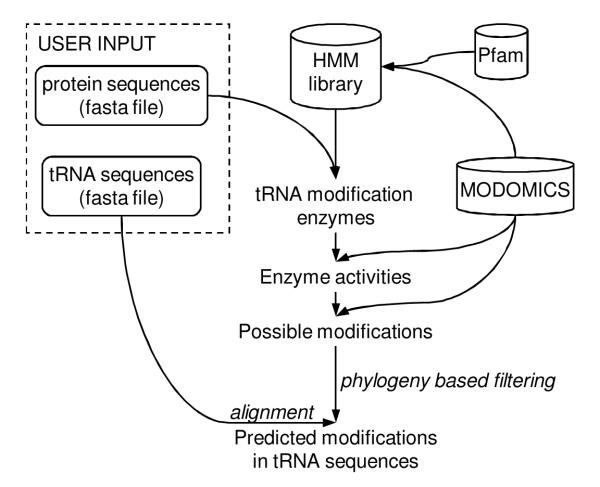
tRNA molecules contain numerous chemically altered nucleosides, which are formed by enzymatic modification of the primary transcripts during the complex tRNA maturation process. Some of the modifications are introduced by single reactions, while other require complex series of reactions carried out by several different enzymes. The location and distribution of various types of modifications vary greatly between different tRNA molecules, organisms and organelles. We have developed a computational method tRNAmodpred, for predicting modifications in tRNA sequences. Briefly, our method takes as an input one or more unmodified tRNA sequences and a set of protein sequences corresponding to a proteome of a cell. Subsequently it identifies homologs of known tRNA modification enzymes in the proteome, predicts tRNA modification activities and maps them onto known pathways of RNA modification from the MODOMICS database. Thereby, theoretically possible modification pathways are identified, and products of these modification reactions are proposed for query tRNAs. This method allows for predicting modification patterns for newly sequenced genomes as well as for checking tentative modification status of tRNAs from one species treated with enzymes from another source, e.g. to predict the possible modifications of eukaryotic tRNAs expressed in bacteria. tRNAmodpred is freely available as a web server at http://genesilico.pl/trnamodpred/.
转运RNA(tRNA)分子含有大量经过化学修饰的核苷,这些核苷是在复杂的tRNA成熟过程中通过对初级转录本进行酶促修饰而形成的。一些修饰是通过单一反应引入的,而其他修饰则需要由几种不同的酶进行一系列复杂的反应。不同类型修饰的位置和分布在不同的tRNA分子、生物体和细胞器之间有很大差异。我们开发了一种计算方法tRNAmodpred,用于预测tRNA序列中的修饰。简而言之,我们的方法将一个或多个未修饰的tRNA序列以及一组对应于细胞蛋白质组的蛋白质序列作为输入。随后,它在蛋白质组中识别已知tRNA修饰酶的同源物,预测tRNA修饰活性,并将它们映射到来自MODOMICS数据库的已知RNA修饰途径上。由此,确定理论上可能的修饰途径,并为查询的tRNA提出这些修饰反应的产物。该方法可用于预测新测序基因组的修饰模式,以及检查用来自另一个来源的酶处理的一个物种的tRNA的暂定修饰状态,例如预测在细菌中表达的真核tRNA的可能修饰。tRNAmodpred可作为网络服务器在http://genesilico.pl/trnamodpred/上免费获取。