Hossain Hemayet, Rahman Shaikh Emdadur, Akbar Proity Nayeeb, Khan Tanzir Ahmed, Rahman Md Mahfuzur, Jahan Ismet Ara
Chemical Research Division, BCSIR Laboratories, Bangladesh Council of Scientific and Industrial Research, Dr. Qudrat-E-Khuda Road, Dhaka, 1205, Bangladesh.
Pharmacy Discipline, Life Science School, Khulna University, Khulna, 9208, Bangladesh.
BMC Res Notes. 2016 Mar 28;9:191. doi: 10.1186/s13104-016-2000-z.
Syzygium jambos has been used as a traditional medicine for the treatment of inflammatory diseases in Bangladesh. The study investigates the high performance liquid chromatography (HPLC) profiling of phenolic compounds, and evaluates the antioxidant and anti-inflammatory activities of ethanol extract of S. jambos available in Bangladesh.
The extract was subjected to HPLC for the identification and quantification of the major bioactive polyphenols present in S. jambos. Antioxidant activity was determined using 2, 2'-azino bis-3-ethylbenzothiazoline-6-sulfonic acid (ABTS) radical scavenging, reducing power assay, total antioxidant capacity, total phenolic and flavonoid content. Furthermore, the anti-inflammatory effect of the extract in rats for two different test models: carrageenan and histamine-induced paw edema was inspected.
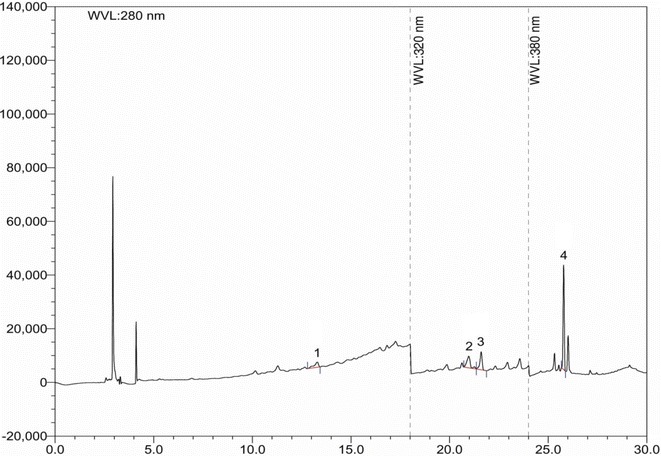
High levels of catechin hydrate and rutin hydrate (99.00 and 79.20 mg/100 g extract, respectively) and moderate amounts of ellagic acid and quercetin (59.40 and 69.30 mg/100 g extract, respectively) were quantified in HPLC. Catechin hydrate from this plant extract was determined for the first time through HPLC. For ABTS scavenging assay, the median inhibition concentration (IC50) value of S. jambos was 57.80 µg/ml, which was significant to that of ascorbic acid (12.01 µg/ml). The maximum absorbance for reducing power assay was found to be 0.4934. The total antioxidant capacity, phenolic and flavonoid contents were calculated to be 628.50 mg/g of ascorbic acid, 230.82 mg/g of gallic acid and 11.84 mg/g of quercetin equivalent, respectively. At a dose of 400 mg/kg, a significant acute anti-inflammatory activity (P < 0.01) was observed in rats for both the test models with a reduction in the paw volume of 58.04 and 53.95 %, in comparison to those of indomethacin (62.94 and 65.79 %), respectively.
The results suggest that the phenolic and flavonoid compounds are responsible for acute anti-inflammatory and antioxidant activities of S. jambos.
在孟加拉国,蒲桃被用作治疗炎症性疾病的传统药物。本研究调查了酚类化合物的高效液相色谱(HPLC)图谱,并评估了孟加拉国产蒲桃乙醇提取物的抗氧化和抗炎活性。
对提取物进行HPLC分析,以鉴定和定量蒲桃中主要的生物活性多酚。采用2,2'-联氮-双-3-乙基苯并噻唑啉-6-磺酸(ABTS)自由基清除法、还原力测定法、总抗氧化能力、总酚和黄酮含量测定法来测定抗氧化活性。此外,还考察了该提取物在两种不同试验模型(角叉菜胶和组胺诱导的爪肿胀)大鼠中的抗炎作用。
HPLC定量分析显示,蒲桃中含有高水平的儿茶素水合物和芦丁水合物(分别为99.00和79.20 mg/100 g提取物),以及中等含量的鞣花酸和槲皮素(分别为59.40和69.30 mg/100 g提取物)。通过HPLC首次测定了该植物提取物中的儿茶素水合物。在ABTS清除试验中,蒲桃的半数抑制浓度(IC50)值为57.80 μg/ml,与抗坏血酸(12.01 μg/ml)相比有显著差异。还原力测定的最大吸光度为0.