Liu Yun-Long, Zhang Hao-Min, Pan Hong-Ming, Bao Yu-Hang, Xue Jing, Wang Tian-Chang, Dong Xiao-Cheng, Li Xiao-Ling, Bao Hong-Guang
Department of Chest Surgery, The Second Affiliated Hospital of Qiqihar Medical University, Qiqihar, Heilongjiang, People's Republic of China.
Basic Medical Science College, Qiqihar Medical University, Qiqihar, Heilongjiang, People's Republic of China.
Onco Targets Ther. 2016 Mar 7;9:1241-9. doi: 10.2147/OTT.S94228. eCollection 2016.
We conducted a systematic review and meta-analysis aiming to assess the relationship between apolipoprotein E (APOE) gene ε2/ε3/ε4 polymorphism and breast cancer risk.
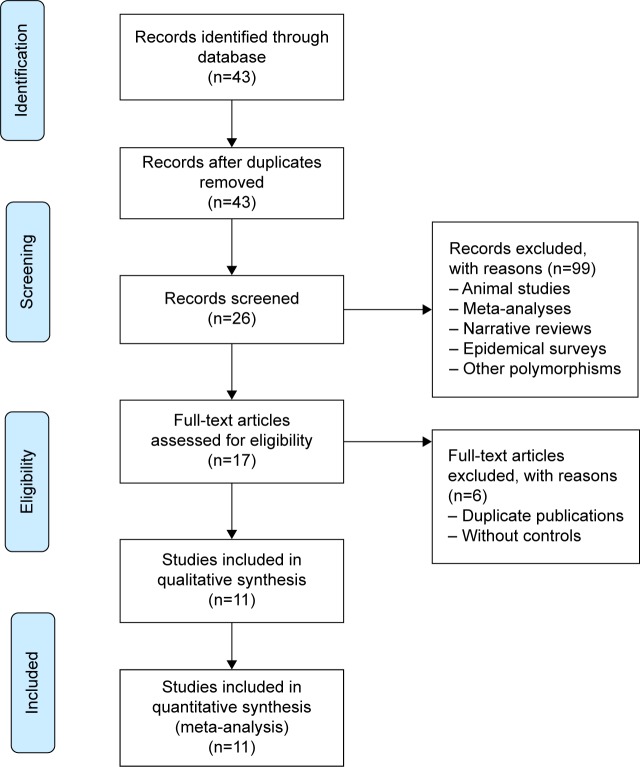
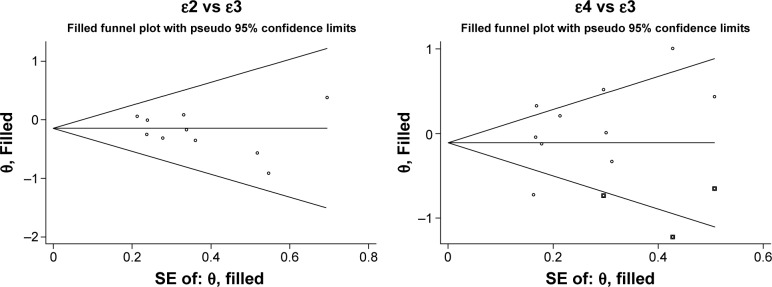
Yun-Long Liu and Hao-Min Zhang independently completed literature retrieval and data collection, and statistical analyses were performed by Stata. Individual odds ratio (OR) and 95% confidence interval (CI) were pooled in a random-effects model using the DerSimonian-Laird method. Heterogeneity was evaluated by I (2) statistic at a significance level of 50%. Publication bias was assessed by Egger's test.
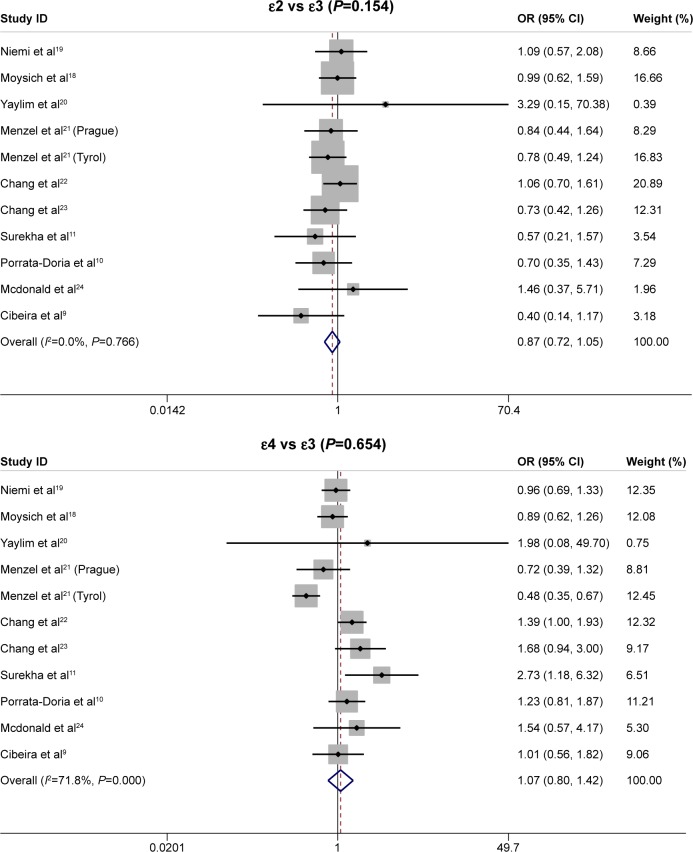
Eleven articles including 2,074 breast cancer patients and 2,372 controls were summarized. Using the most common allele ε3 as a reference, the ε2 (OR =0.87, 95% CI =0.72-1.05, P=0.154, I (2)=0.0%) and ε4 (OR =1.07, 95% CI =0.80-1.42, P=0.654, I (2)=71.8%) alleles were not found to be significantly associated with breast cancer risk in the overall analyses. Subgroup analyses revealed that the comparison of allele ε4 with ε3 was significant in Asians (OR =1.58, 95% CI =1.17-6.32, P=0.003, I (2)=12.1%) and in studies that used the restriction fragment length polymorphism (RFLP) genotyping method (OR =1.27; 95% CI =1.01-1.61, P=0.045, I (2)=34.3%), and was marginally significant in hospital-based studies (OR =1.33; 95% CI =0.98-1.79, P=0.065, I (2)=30.2%), without heterogeneity. Moreover, the presence of the ε2 allele was significantly associated with breast cancer in small studies (total sample size <500) (OR =0.73, 95% CI =0.54-1.00, P=0.052, I (2)=0.0%) without heterogeneity. The Egger's test indicated low probabilities of publication bias.
We observed a significant association between APOE gene ε4 allele and breast cancer risk in Asian populations. Moreover, the findings of our subgroup analyses suggest that source of controls, genotyping platform, and sample size might be the potential causes of heterogeneity.
我们进行了一项系统评价和荟萃分析,旨在评估载脂蛋白E(APOE)基因ε2/ε3/ε4多态性与乳腺癌风险之间的关系。
刘云龙和张浩民独立完成文献检索和数据收集,并使用Stata进行统计分析。采用DerSimonian-Laird方法,在随机效应模型中合并个体比值比(OR)和95%置信区间(CI)。采用I²统计量在50%的显著性水平下评估异质性。采用Egger检验评估发表偏倚。
总结了11篇文章,包括2074例乳腺癌患者和2372例对照。以最常见的等位基因ε3作为参照,在总体分析中,未发现ε2(OR =0.87,95%CI =0.72-1.05,P=0.154,I²=0.0%)和ε4(OR =1.07,95%CI =0.80-1.42,P=0.654,I²=71.8%)等位基因与乳腺癌风险存在显著关联。亚组分析显示,在亚洲人群中(OR =1.58,95%CI =1.17-6.32,P=0.003,I²=12.1%)以及在使用限制性片段长度多态性(RFLP)基因分型方法的研究中(OR =1.27;95%CI =1.01-1.61,P=0.045,I²=34.3%),ε4与ε3等位基因的比较具有显著性,在基于医院的研究中具有边缘显著性(OR =1.33;95%CI =0.98-1.79,P=0.065,I²=30.2%),且无异质性。此外,在小型研究(总样本量<500)中,ε2等位基因的存在与乳腺癌显著相关(OR =0.73,95%CI =0.54-1.00,P=0.052,I²=0.0%),且无异质性。Egger检验表明发表偏倚的可能性较低。
我们观察到在亚洲人群中,APOE基因ε4等位基因与乳腺癌风险之间存在显著关联。此外,我们亚组分析的结果表明,对照来源、基因分型平台和样本量可能是异质性的潜在原因。