Bao Z-X, Yang X-W, Shi J, Liu L-X
Department of Gastroenterology and Hepatology, The First Clinical Hospital of Shanxi Medical University, Mailbox 427, 85 Jiefang South Road, Taiyuan, Shanxi Province, China. 030001,
Med Oral Patol Oral Cir Bucal. 2016 May 1;21(3):e335-40. doi: 10.4317/medoral.21079.
The aim of this study was to assess the serum zinc levels in patients with common oral mucosal diseases by comparing these to healthy controls.
A total of 368 patients, which consisted of 156 recurrent aphthous stomatitis (RAS) patients, 57 oral lichen planus (OLP) patients, 55 burning mouth syndrome (BMS) patients, 54 atrophic glossitis (AG) patients, 46 xerostomia patients, and 115 sex-and age-matched healthy control subjects were enrolled in this study. Serum zinc levels were measured in all participants. Statistical analysis was performed using a one-way ANOVA, t-test, and Chi-square test.
The mean serum zinc level in the healthy control group was significantly higher than the levels of all other groups (p < 0.001). No individual in the healthy control group had a serum zinc level less than the minimum normal value. However, up to 24.7% (13/54) of patients with AG presented with zinc deficiency, while 21.2% (33/156) of patients with RAS, 16.4% (9/55) of patients with BMS, 15.2% (7/46) of patients with xerostomia, and 14.0% (8/57) of patients with OLP were zinc deficient. Altogether, the zinc deficiency rate was 19.02% (70/368) in the oral mucosal diseases (OMD) group (all patients with OMD). The difference between the OMD and healthy control group was significant (p <0.001). Gender differences in serum zinc levels were also present, although not statistically significant.
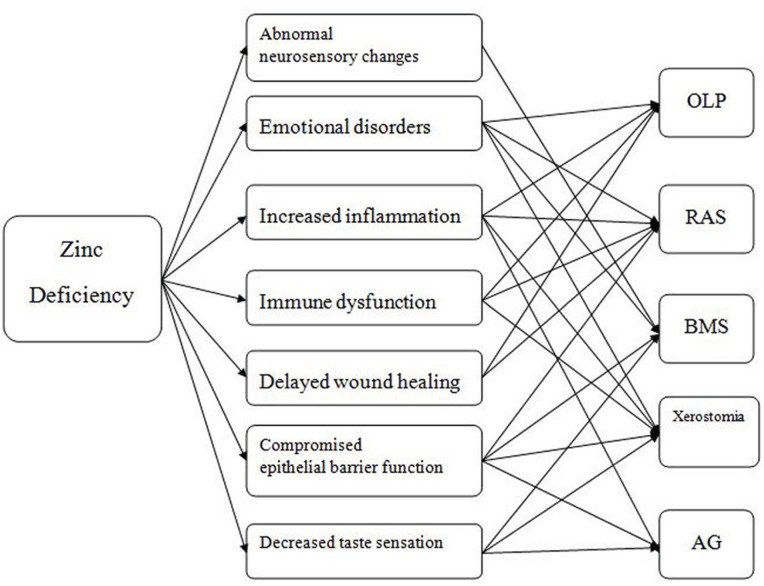
Zinc deficiency may be involved in the pathogenesis of common oral mucosal diseases. Zinc supplementation may be a useful treatment for oral mucosal diseases, but this requires further investigation; the optimal serum level of zinc, for the prevention and treatment of oral mucosal diseases, remains to be determined.
本研究旨在通过将常见口腔黏膜疾病患者的血清锌水平与健康对照者进行比较,来评估这些患者的血清锌水平。
本研究共纳入368例患者,其中包括156例复发性阿弗他口炎(RAS)患者、57例口腔扁平苔藓(OLP)患者、55例灼口综合征(BMS)患者、54例萎缩性舌炎(AG)患者、46例口干症患者以及115例年龄和性别匹配的健康对照者。测定了所有参与者的血清锌水平。采用单因素方差分析、t检验和卡方检验进行统计分析。
健康对照组的平均血清锌水平显著高于所有其他组(p<0.001)。健康对照组中没有个体的血清锌水平低于最低正常值。然而,高达24.7%(13/54)的AG患者存在锌缺乏,而RAS患者中有21.2%(33/156)、BMS患者中有16.4%(9/55)、口干症患者中有15.2%(7/46)以及OLP患者中有14.0%(8/57)存在锌缺乏。总体而言,口腔黏膜疾病(OMD)组(所有OMD患者)的锌缺乏率为19.02%(70/368)。OMD组与健康对照组之间的差异具有统计学意义(p<0.001)。血清锌水平也存在性别差异,尽管无统计学意义。
锌缺乏可能参与常见口腔黏膜疾病的发病机制。补充锌可能是治疗口腔黏膜疾病的一种有效方法,但这需要进一步研究;预防和治疗口腔黏膜疾病的最佳血清锌水平仍有待确定。