Vanden Eynden Frédéric, Racapé Judith, Vincent Jame, Vachiéry Jean-Luc, Bové Thierry, Van Nooten Guido
Department of Cardiac Surgery, Université Libre de Bruxelles, Hôpital Académique Erasme, 808 Route de Lennick, B-1070, Brussels, Belgium.
Research Center of Biostatistics, Epidemiology and Clinical Research, School of Public Health, Université Libre de Bruxelles, Brussels, Belgium.
Respir Res. 2016 Mar 31;17:33. doi: 10.1186/s12931-016-0350-7.
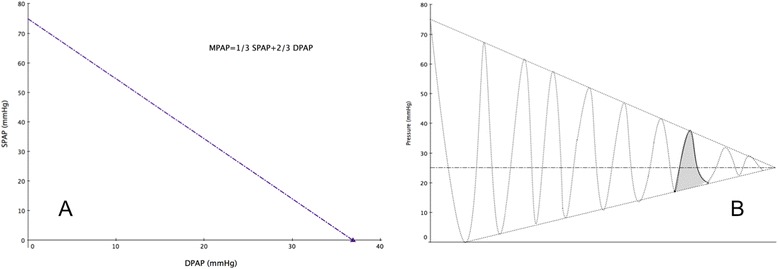
In the pulmonary circulation, there is a linear relationship between systolic pulmonary arterial pressure (SPAP) and mean pulmonary arterial pressure (MPAP). The aim of this study was to determine the passive or active nature of this mechanism by exploring the relationship in patients with and without autonomic rhythm control of the heart and pulmonary circulation.
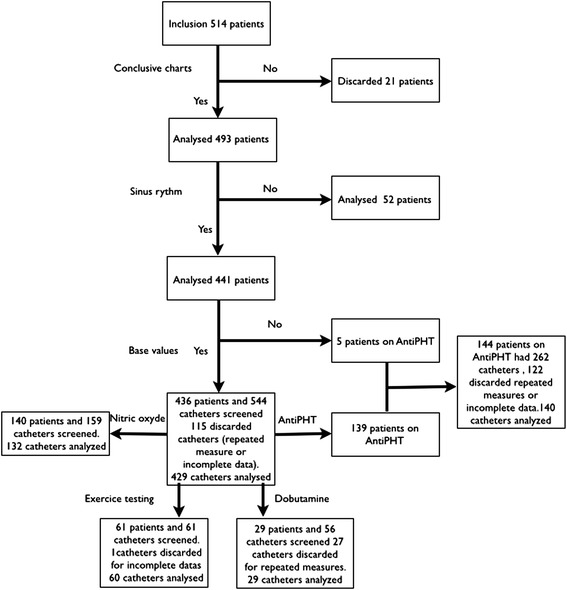
Pulmonary arterial pressure recordings from non-transplanted patients and patients with heart transplants or double lung transplants were retrospectively reviewed. The relationships between systolic, diastolic, and mean pulmonary arterial pressures were explored.
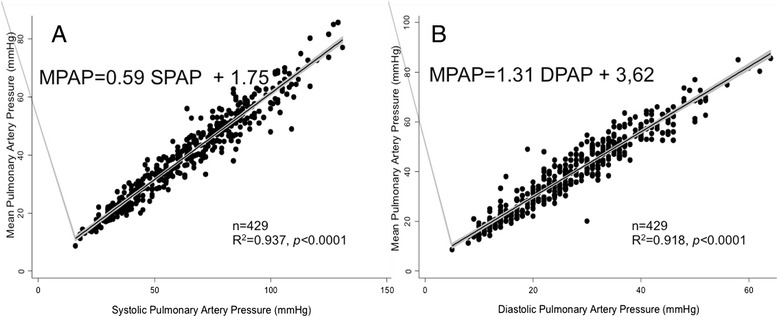
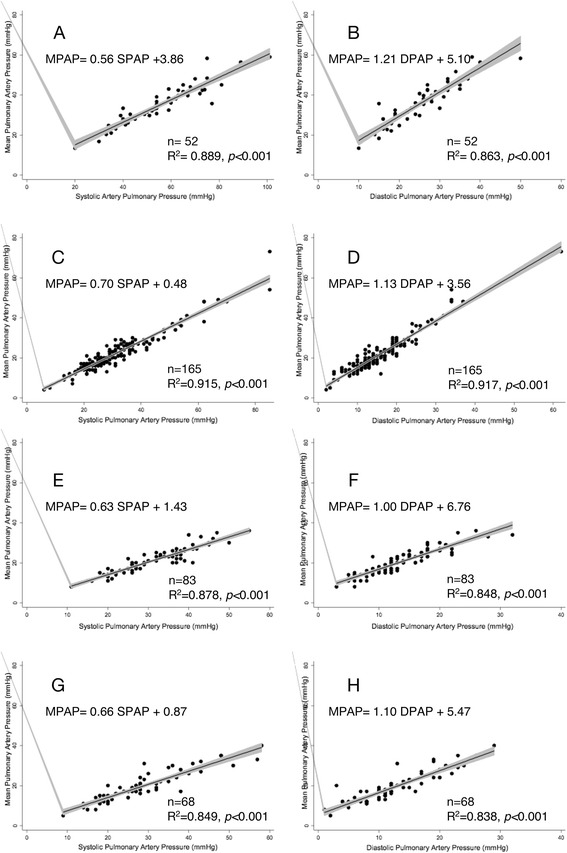
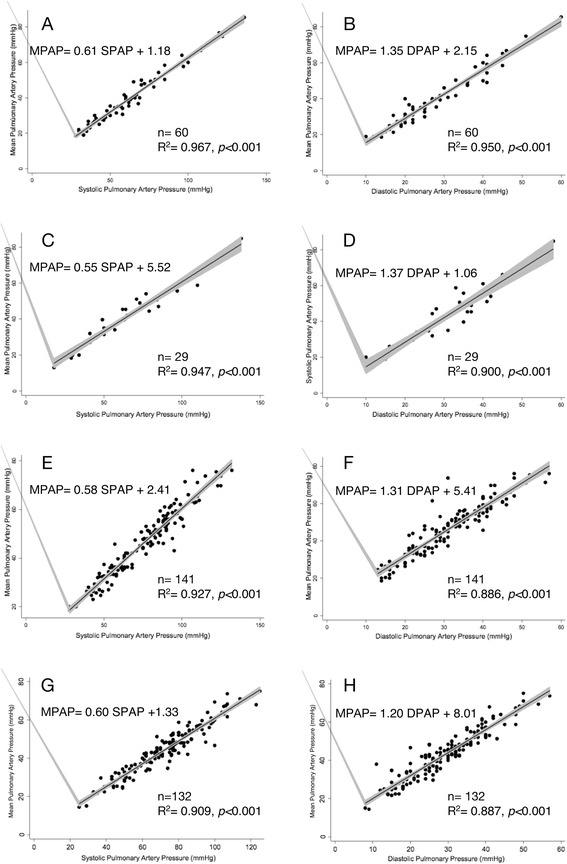
A linear relationship was observed between the SPAP and MPAP, whether patients were paced (MPAP = 0.56 SPAP + 3.86 mmHg, r (2) = 0.889), treated with inotropes (MPAP = 0.55 SPAP + 5.52 mmHg, r (2) = 0.947) or pulmonary vasodilators (MPAP = 0.58 SPAP + 2.41 mmHg, r (2) = 0.927), were exercising (MPAP = 0.61 SPAP + 1.18 mmHg, r (2) = 0.967), had a heart transplant (MPAP = 0.66 SPAP +0.87 mmHg, r (2) = 0.849), a double lung transplant (MPAP = 0.7 SPAP +0.48 mmHg, r (2) = 0.915), or no intervention (MPAP = 0.59 SPAP +1.75 mmHg, r (2) = 0.937).
We demonstrate that the linear relationship between SPAP and MPAP remains in several situations. Therefore, we conclude that the underlying mechanism is a passive consequence of the elastic properties of the cardiopulmonary unit.
在肺循环中,收缩期肺动脉压(SPAP)与平均肺动脉压(MPAP)之间存在线性关系。本研究的目的是通过探究心脏和肺循环有或无自主节律控制的患者之间的这种关系,来确定该机制的被动或主动性质。
回顾性分析非移植患者以及心脏移植或双肺移植患者的肺动脉压记录。探讨收缩压、舒张压和平均肺动脉压之间的关系。
无论患者是接受起搏治疗(MPAP = 0.56 SPAP + 3.86 mmHg,r² = 0.889)、使用正性肌力药物治疗(MPAP = 0.55 SPAP + 5.52 mmHg,r² = 0.947)、使用肺血管扩张剂治疗(MPAP = 0.58 SPAP + 2.41 mmHg,r² = 0.927)、正在运动(MPAP = 0.61 SPAP + 1.18 mmHg,r² = 0.967)、接受心脏移植(MPAP = 0.66 SPAP + 0.87 mmHg,r² = 0.849)、接受双肺移植(MPAP = 0.7 SPAP + 0.48 mmHg,r² = 0.915)还是未接受干预(MPAP = 0.59 SPAP + 1.75 mmHg,r² = 0.937),SPAP与MPAP之间均观察到线性关系。
我们证明,SPAP与MPAP之间的线性关系在多种情况下均存在。因此,我们得出结论,其潜在机制是心肺单元弹性特性的被动结果。