Onoue Ayumi, Omori Hisamitsu, Katoh Takahiko, Kubota Kenichi, Nonami Yoshio, Ogata Yasuhiro, Inoue Hiromasa
Department of Biomedical Laboratory Sciences, Kumamoto University, Kumamoto, Japan.
Department of Public Health, Faculty of Life Sciences, Kumamoto University, Kumamoto, Japan.
Int J Chron Obstruct Pulmon Dis. 2016 Mar 16;11:567-75. doi: 10.2147/COPD.S99786. eCollection 2016.
The aim of this study was to reveal the association between airflow limitation (AL) severity and reduction with work productivity as well as use of sick leave among Japanese workers.
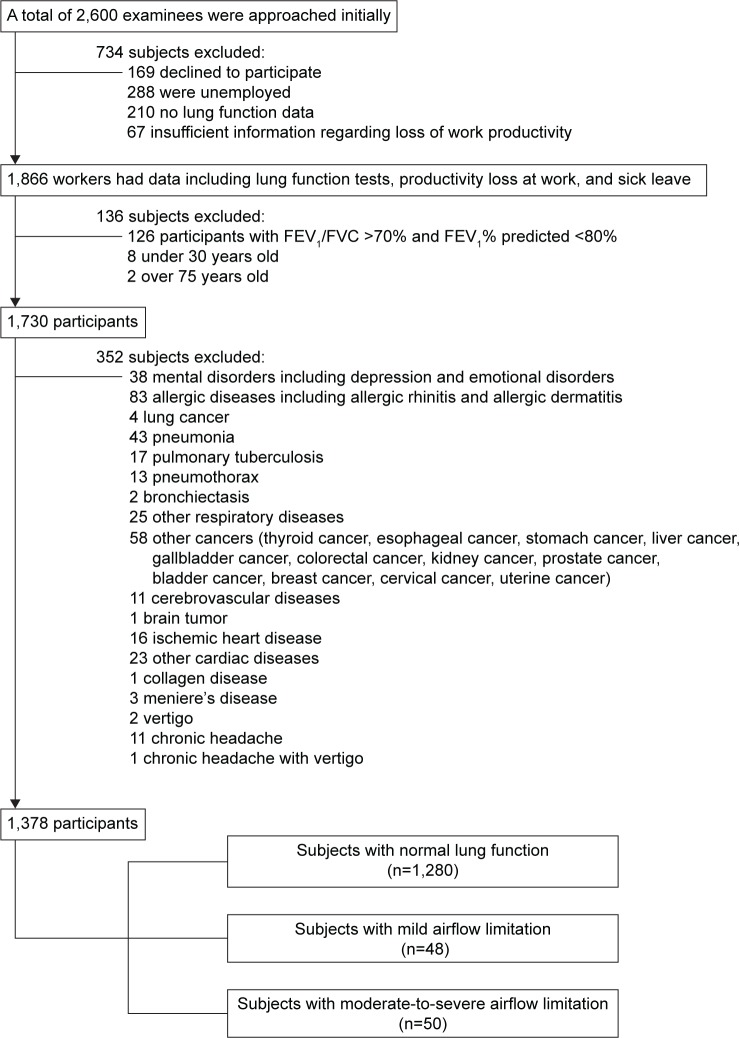
This cross-sectional study included 1,378 workers who underwent a lung function test during a health checkup at the Japanese Red Cross Kumamoto Health Care Center. AL was defined as forced expiratory volume in 1 second/forced vital capacity of <0.7. Workers completed a questionnaire on productivity loss at work and sick leave. The quality and quantity of productivity loss at work were measured on a ten-point scale indicating how much work was actually performed on the previous workday. Participants were asked how many days in the past 12 months they were unable to work because of health problems. Logistic regression analysis was used to assess the associations between AL severity and the quality and quantity of productivity loss at work as well as use of sick leave.
Compared with workers without AL, workers with moderate-to-severe AL showed a significant productivity loss (quality: odds ratio [OR] =2.04, 95% confidence interval [CI]: 1.12-3.71, P=0.02 and quantity: OR =2.19, 95% CI: 1.20-4.00, P=0.011) and use of sick leave (OR =2.69, 95% CI: 1.33-5.44, P=0.006) after adjusting for sex, age, body mass index, smoking status, hypertension, hyperglycemia, dyslipidemia, sleep duration, work hours per day, and workplace smoking environment.
AL severity was significantly associated with work productivity loss and use of sick leave. Our findings suggested that early intervention in the subjects with AL at the workforce might be beneficial for promoting work ability.
本研究旨在揭示日本工人气流受限(AL)严重程度与降低工作生产率以及病假使用之间的关联。
这项横断面研究纳入了1378名在日本红十字会熊本医疗中心健康检查期间接受肺功能测试的工人。AL被定义为1秒用力呼气量/用力肺活量<0.7。工人们完成了一份关于工作中生产率损失和病假的问卷。工作中生产率损失的质量和数量用十分制衡量,表明前一个工作日实际完成的工作量。参与者被问及在过去12个月中有多少天因健康问题无法工作。采用逻辑回归分析评估AL严重程度与工作中生产率损失的质量和数量以及病假使用之间的关联。
与无AL的工人相比,中重度AL的工人在调整性别、年龄、体重指数、吸烟状况、高血压、高血糖、血脂异常、睡眠时间、每天工作小时数和工作场所吸烟环境后,显示出显著的生产率损失(质量:优势比[OR]=2.04,95%置信区间[CI]:1.12 - 3.71,P = 0.02;数量:OR = 2.19,95%CI:1.20 - 4.00,P = 0.011)和病假使用(OR = 2.69,95%CI:1.33 - 5.44,P = 0.006)。
AL严重程度与工作生产率损失和病假使用显著相关。我们的研究结果表明,对劳动力中患有AL的受试者进行早期干预可能有利于提高工作能力。