Chang Yung-Sen, Chiang Bor-Luen
Department of Pediatrics, Taipei City Hospital Renai Branch, Taipei 106, Taiwan.
Graduate Institute of Clinical Medicine, College of Medicine, National Taiwan University, Taipei 100, Taiwan.
Int J Mol Sci. 2016 Mar 29;17(4):462. doi: 10.3390/ijms17040462.
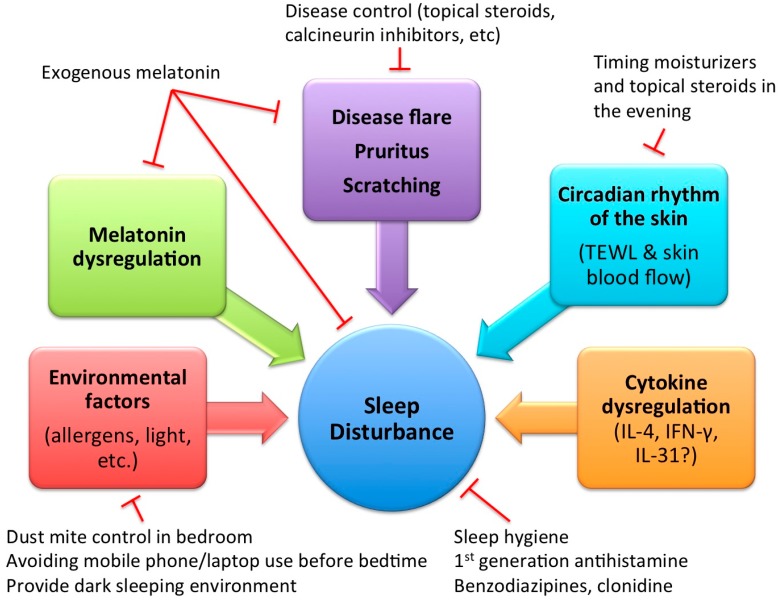
Sleep disturbance is common in children with atopic dermatitis (AD). It is a major factor leading to impaired quality of life in these patients and could have negative effects on neurocognitive function and behavior. However, the pathophysiology of sleep disturbance in children with AD is poorly understood, and there is no consensus on how to manage sleep problems in these patients. Pruritus and scratching could lead to sleep disruption but is unlikely the sole etiology. The circadian rhythm of cytokines, the immune system, and skin physiology such as transcutaneous water loss and skin blood flow might also play a role. Recent studies have suggested that melatonin could also be involved due to its multiple effects on sleep, immunomodulation, and anti-oxidant ability. Environmental factors should also be considered. In this review, we summarize the current understanding of the pathophysiology of sleep disturbance in children with AD, and discuss possible therapeutic implications.
睡眠障碍在特应性皮炎(AD)患儿中很常见。它是导致这些患者生活质量受损的主要因素,并且可能对神经认知功能和行为产生负面影响。然而,AD患儿睡眠障碍的病理生理学尚不清楚,对于如何管理这些患者的睡眠问题也没有共识。瘙痒和搔抓可能导致睡眠中断,但不太可能是唯一的病因。细胞因子、免疫系统以及皮肤生理(如经皮水分流失和皮肤血流量)的昼夜节律也可能起作用。最近的研究表明,褪黑素也可能参与其中,因为它对睡眠、免疫调节和抗氧化能力有多种作用。环境因素也应予以考虑。在本综述中,我们总结了目前对AD患儿睡眠障碍病理生理学的认识,并讨论了可能的治疗意义。