Mamtani Manju, Kulkarni Hemant, Wong Gerard, Weir Jacquelyn M, Barlow Christopher K, Dyer Thomas D, Almasy Laura, Mahaney Michael C, Comuzzie Anthony G, Glahn David C, Magliano Dianna J, Zimmet Paul, Shaw Jonathan, Williams-Blangero Sarah, Duggirala Ravindranath, Blangero John, Meikle Peter J, Curran Joanne E
South Texas Diabetes and Obesity Institute, University of Texas Rio Grande Valley School of Medicine, Brownsville, TX, 78520, USA.
Baker IDI Heart and Diabetes Institute, Melbourne, VIC, Australia.
Lipids Health Dis. 2016 Apr 4;15:67. doi: 10.1186/s12944-016-0234-3.
Detection of type 2 diabetes (T2D) is routinely based on the presence of dysglycemia. Although disturbed lipid metabolism is a hallmark of T2D, the potential of plasma lipidomics as a biomarker of future T2D is unknown. Our objective was to develop and validate a plasma lipidomic risk score (LRS) as a biomarker of future type 2 diabetes and to evaluate its cost-effectiveness for T2D screening.
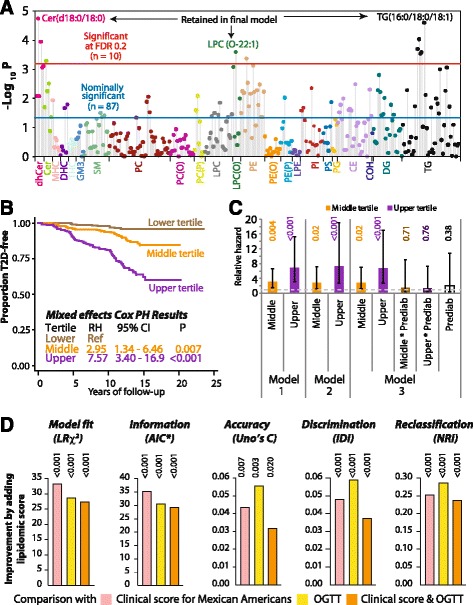
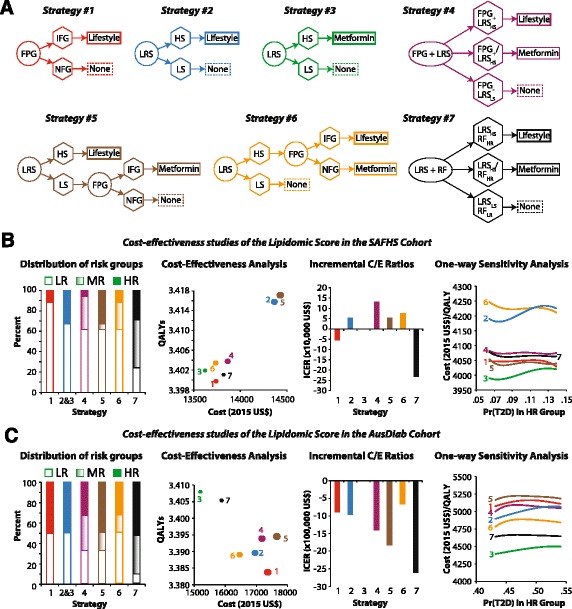
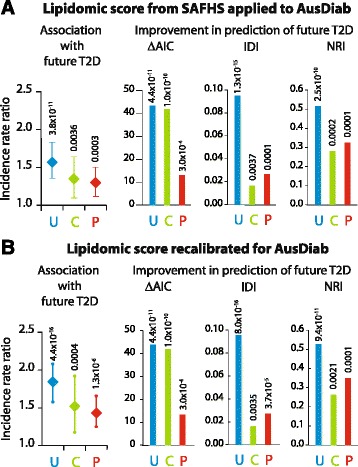
Plasma LRS, based on significantly associated lipid species from an array of 319 lipid species, was developed in a cohort of initially T2D-free individuals from the San Antonio Family Heart Study (SAFHS). The LRS derived from SAFHS as well as its recalibrated version were validated in an independent cohort from Australia--the AusDiab cohort. The participants were T2D-free at baseline and followed for 9197 person-years in the SAFHS cohort (n = 771) and 5930 person-years in the AusDiab cohort (n = 644). Statistically and clinically improved T2D prediction was evaluated with established statistical parameters in both cohorts. Modeling studies were conducted to determine whether the use of LRS would be cost-effective for T2D screening. The main outcome measures included accuracy and incremental value of the LRS over routinely used clinical predictors of T2D risk; validation of these results in an independent cohort and cost-effectiveness of including LRS in screening/intervention programs for T2D.
The LRS was based on plasma concentration of dihydroceramide 18:0, lysoalkylphosphatidylcholine 22:1 and triacyglycerol 16:0/18:0/18:1. The score predicted future T2D independently of prediabetes with an accuracy of 76%. Even in the subset of initially euglycemic individuals, the LRS improved T2D prediction. In the AusDiab cohort, the LRS continued to predict T2D significantly and independently. When combined with risk-stratification methods currently used in clinical practice, the LRS significantly improved the model fit (p < 0.001), information content (p < 0.001), discrimination (p < 0.001) and reclassification (p < 0.001) in both cohorts. Modeling studies demonstrated that LRS-based risk-stratification combined with metformin supplementation for high-risk individuals was the most cost-effective strategy for T2D prevention.
Considering the novelty, incremental value and cost-effectiveness of LRS it should be used for risk-stratification of future T2D.
2型糖尿病(T2D)的检测通常基于血糖异常。尽管脂质代谢紊乱是T2D的一个标志,但血浆脂质组学作为未来T2D生物标志物的潜力尚不清楚。我们的目标是开发并验证一种血浆脂质组学风险评分(LRS)作为未来2型糖尿病的生物标志物,并评估其用于T2D筛查的成本效益。
基于319种脂质种类中显著相关的脂质种类开发血浆LRS,该评分来自圣安东尼奥家族心脏研究(SAFHS)中最初无T2D的个体队列。源自SAFHS的LRS及其重新校准版本在来自澳大利亚的独立队列——澳大利亚糖尿病(AusDiab)队列中进行了验证。参与者在基线时无T2D,在SAFHS队列中随访了9197人年(n = 771),在AusDiab队列中随访了5930人年(n = 644)。在两个队列中使用既定的统计参数评估了统计学和临床上T2D预测的改善情况。进行了建模研究以确定使用LRS进行T2D筛查是否具有成本效益。主要结局指标包括LRS相对于常规使用的T2D风险临床预测指标的准确性和增加值;在独立队列中验证这些结果以及将LRS纳入T2D筛查/干预项目的成本效益。
LRS基于二氢神经酰胺18:0、溶血烷基磷脂酰胆碱22:1和三酰甘油16:0/18:0/18:1的血浆浓度。该评分独立于糖尿病前期预测未来T2D,准确性为76%。即使在最初血糖正常的个体亚组中,LRS也改善了T2D预测。在AusDiab队列中,LRS继续显著且独立地预测T2D。当与目前临床实践中使用的风险分层方法相结合时,LRS在两个队列中均显著改善了模型拟合(p < 0.001)、信息含量(p < 0.001)、辨别力(p < 0.001)和重新分类(p < 0.001)。建模研究表明,基于LRS的风险分层与对高危个体补充二甲双胍相结合是预防T2D最具成本效益的策略。
考虑到LRS的新颖性、增加值和成本效益,应将其用于未来T