Kulkarni Hemant, Mamtani Manju, Peralta Juan, Almeida Marcio, Dyer Thomas D, Goring Harald H, Johnson Matthew P, Duggirala Ravindranath, Mahaney Michael C, Olvera Rene L, Almasy Laura, Glahn David C, Williams-Blangero Sarah, Curran Joanne E, Blangero John
South Texas Diabetes and Obesity Institute, University of Texas Rio Grande Valley School of Medicine, Brownsville, TX, United States of America.
Department of Psychiatry, University of Texas Health Science Center at San Antonio, San Antonio, TX, United States of America.
PLoS One. 2016 Mar 23;11(3):e0151177. doi: 10.1371/journal.pone.0151177. eCollection 2016.
While the role of type 2 diabetes (T2D) in inducing endothelial dysfunction is fairly well-established the etiological role of endothelial dysfunction in the onset of T2D is still a matter of debate. In the light of conflicting evidence in this regard, we conducted a prospective study to determine the association of circulating levels of soluble intercellular adhesion molecule 1 (sICAM-1) and soluble vessel cell adhesion molecule 1 (sVCAM-1) with incident T2D.
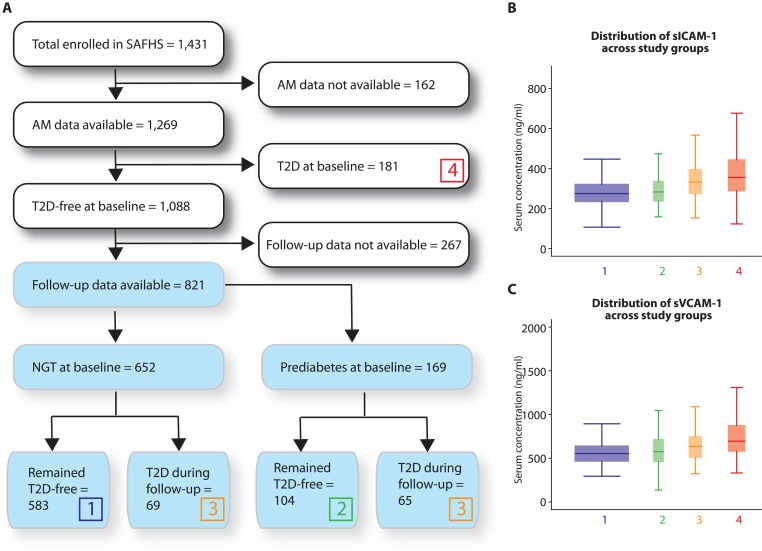
Data from this study came from 1,269 Mexican Americans of whom 821 initially T2D-free individuals were longitudinally followed up in the San Antonio Family Heart Study. These individuals were followed for 9752.95 person-years for development of T2D. Prospective association of sICAM-1 and sVCAM-1 with incident T2D was studied using Kaplan-Meier survival plots and mixed effects Cox proportional hazards modeling to account for relatedness among study participants. Incremental value of adhesion molecule biomarkers was studied using integrated discrimination improvement (IDI) and net reclassification improvement (NRI) indexes.
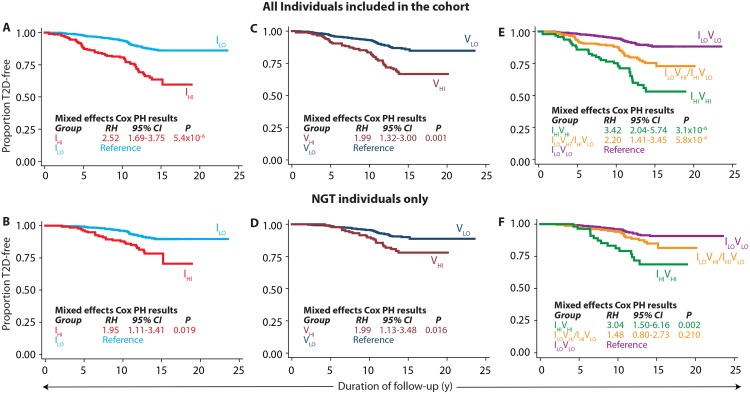
Decreasing median values for serum concentrations of sICAM-1 and sVCAM-1 were observed in the following groups in this order: individuals with T2D at baseline, individuals who developed T2D during follow-up, individuals with prediabetes at baseline and normal glucose tolerant (NGT) individuals who remained T2D-free during follow-up. Top quartiles for sICAM-1 and sVCAM-1 were strongly and significantly associated with homeostatic model of assessment--insulin resistance (HOMA-IR). Mixed effects Cox proportional hazards modeling revealed that after correcting for important clinical confounders, high sICAM-1 and sVCAM-1 concentrations were associated with 2.52 and 1.99 times faster progression to T2D as compared to low concentrations, respectively. Individuals with high concentrations for both sICAM-1 and sVCAM-1 progressed to T2D 3.42 times faster than those with low values for both sICAM-1 and sVCAM-1. The results were similar in women in reproductive age group and the remainder of the cohort. Inclusion of sICAM-1 and sVCAM-1 in predictive models significantly improved reclassification and discrimination. The majority of these results were seen even when the analyses were restricted to NGT individuals.
Serum concentrations of sICAM-1 and sVCAM-1 independently and additively predict future T2D and represent important candidate biomarkers of T2D.
虽然2型糖尿病(T2D)在诱导内皮功能障碍中的作用已得到相当充分的确立,但内皮功能障碍在T2D发病中的病因学作用仍存在争议。鉴于这方面证据相互矛盾,我们进行了一项前瞻性研究,以确定循环中可溶性细胞间黏附分子1(sICAM - 1)和可溶性血管细胞黏附分子1(sVCAM - 1)水平与新发T2D之间的关联。
本研究数据来自1269名墨西哥裔美国人,其中821名最初无T2D的个体在圣安东尼奥家庭心脏研究中接受了纵向随访。这些个体随访了9752.95人年以观察T2D的发生情况。使用Kaplan - Meier生存曲线和混合效应Cox比例风险模型研究sICAM - 1和sVCAM - 1与新发T2D的前瞻性关联,以考虑研究参与者之间的相关性。使用综合判别改善(IDI)和净重新分类改善(NRI)指数研究黏附分子生物标志物的增量价值。
观察到血清sICAM - 1和sVCAM - 1浓度的中位数在以下组中依次降低:基线时患有T2D的个体、随访期间发生T2D的个体、基线时患有糖尿病前期的个体以及随访期间仍无T2D的糖耐量正常(NGT)个体。sICAM - 1和sVCAM - 1的最高四分位数与稳态模型评估 - 胰岛素抵抗(HOMA - IR)密切且显著相关。混合效应Cox比例风险模型显示,在校正重要的临床混杂因素后,与低浓度相比,高sICAM - 1和sVCAM - 1浓度与进展至T2D的速度分别快2.52倍和1.99倍。sICAM - 1和sVCAM - 1浓度均高的个体进展至T2D的速度比两者浓度均低的个体快3.42倍。在育龄妇女组和队列的其余部分中结果相似。将sICAM - 1和sVCAM - 1纳入预测模型显著改善了重新分类和判别。即使将分析限于NGT个体,大多数这些结果仍然可见。
血清sICAM - 1和sVCAM - 1浓度独立且相加地预测未来T2D,并代表T2D的重要候选生物标志物。