Larsen Andrew C, Dunn Matthew R, Hatch Andrew, Sau Sujay P, Youngbull Cody, Chaput John C
The Biodesign Institute, Arizona State University, Tempe, Arizona 85287-5301, USA.
School of Life Sciences, Arizona State University, Tempe, Arizona 85287-5301, USA.
Nat Commun. 2016 Apr 5;7:11235. doi: 10.1038/ncomms11235.
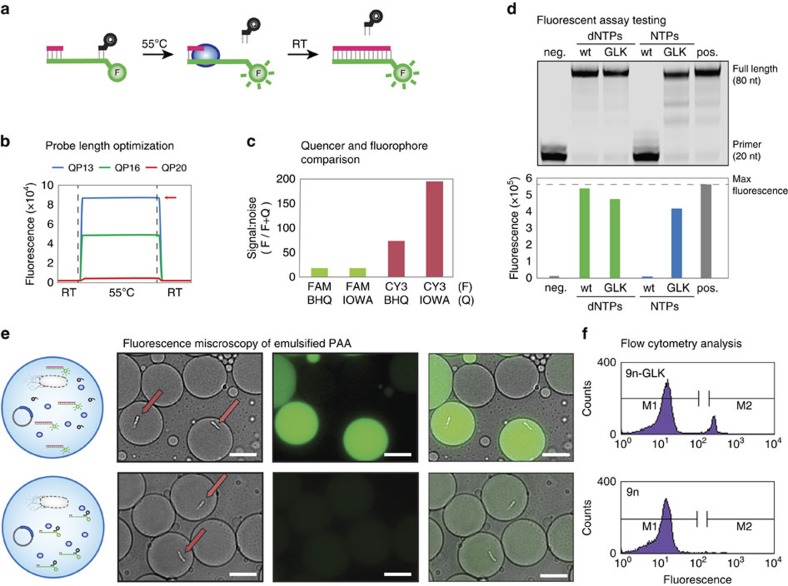
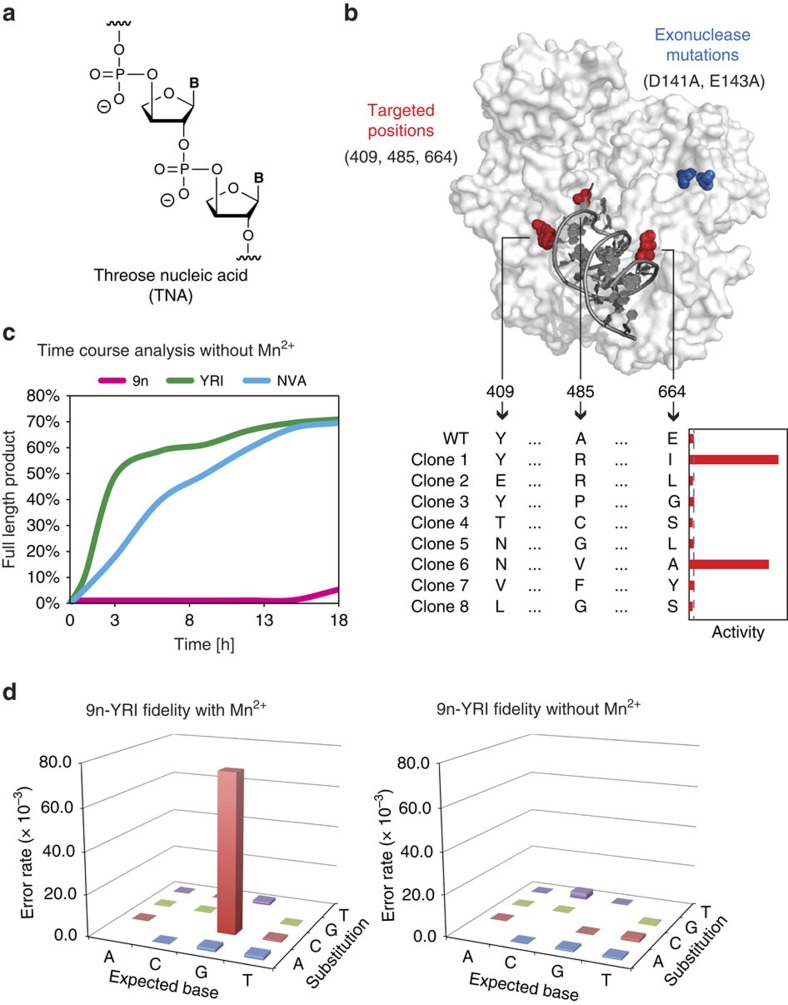
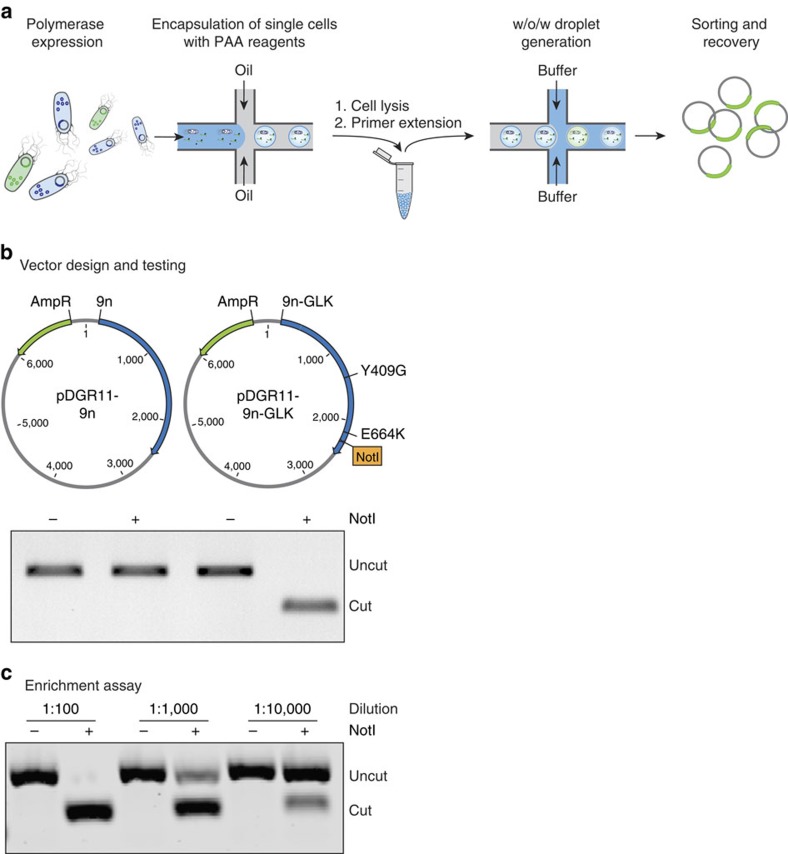
Polymerases that synthesize artificial genetic polymers hold great promise for advancing future applications in synthetic biology. However, engineering natural polymerases to replicate unnatural genetic polymers is a challenging problem. Here we present droplet-based optical polymerase sorting (DrOPS) as a general strategy for expanding polymerase function that employs an optical sensor to monitor polymerase activity inside the microenvironment of a uniform synthetic compartment generated by microfluidics. We validated this approach by performing a complete cycle of encapsulation, sorting and recovery on a doped library and observed an enrichment of ∼1,200-fold for a model engineered polymerase. We then applied our method to evolve a manganese-independent α-L-threofuranosyl nucleic acid (TNA) polymerase that functions with >99% template-copying fidelity. Based on our findings, we suggest that DrOPS is a versatile tool that could be used to evolve any polymerase function, where optical detection can be achieved by Watson-Crick base pairing.
合成人工遗传聚合物的聚合酶在推动合成生物学未来应用方面具有巨大潜力。然而,改造天然聚合酶以复制非天然遗传聚合物是一个具有挑战性的问题。在此,我们提出基于液滴的光学聚合酶分选(DrOPS),作为一种扩展聚合酶功能的通用策略,该策略利用光学传感器监测聚合酶在微流控产生的均匀合成隔室内微环境中的活性。我们通过对掺杂文库进行完整的封装、分选和回收循环来验证这种方法,并观察到一种模型工程聚合酶富集了约1200倍。然后,我们应用我们的方法进化出一种与锰无关的α-L-苏糖呋喃糖核酸(TNA)聚合酶,其模板复制保真度>99%。基于我们的发现,我们认为DrOPS是一种通用工具,可用于进化任何可通过沃森-克里克碱基配对实现光学检测的聚合酶功能。