Richards J S, Arias Vásquez A, von Rhein D, van der Meer D, Franke B, Hoekstra P J, Heslenfeld D J, Oosterlaan J, Faraone S V, Buitelaar J K, Hartman C A
Department of Cognitive Neuroscience, Donders Institute for Brain, Cognition and Behaviour, Radboud University Medical Center, Nijmegen, The Netherlands.
Karakter Child and Adolescent Psychiatry University Centre, Nijmegen, The Netherlands.
Transl Psychiatry. 2016 Apr 5;6(4):e771. doi: 10.1038/tp.2016.37.
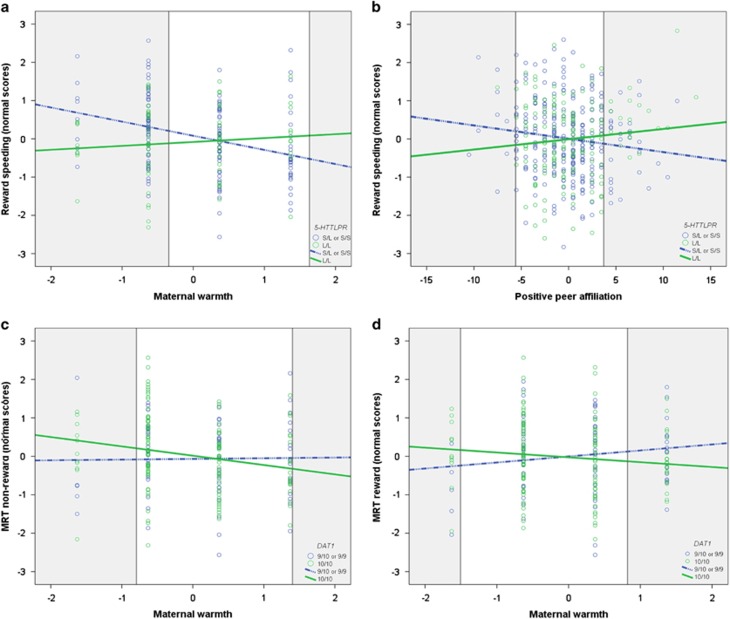
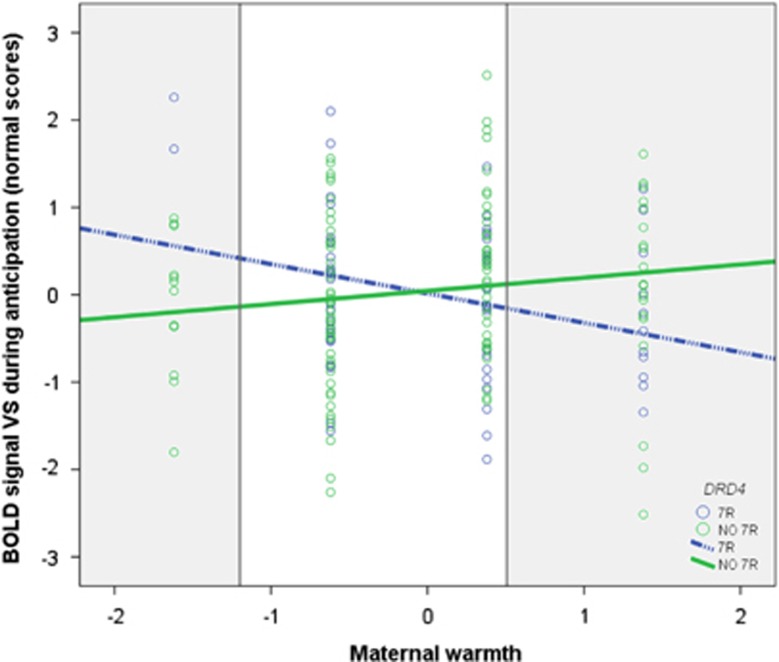
Little is known about the causes of individual differences in reward sensitivity. We investigated gene-environment interactions (GxE) on behavioral and neural measures of reward sensitivity, in light of the differential susceptibility theory. This theory states that individuals carrying plasticity gene variants will be more disadvantaged in negative, but more advantaged in positive environments. Reward responses were assessed during a monetary incentive delay task in 178 participants with and 265 without attention-deficit/hyperactivity disorder (ADHD), from N=261 families. We examined interactions between variants in candidate plasticity genes (DAT1, 5-HTT and DRD4) and social environments (maternal expressed emotion and peer affiliation). HTTLPR short allele carriers showed the least reward speeding when exposed to high positive peer affiliation, but the most when faced with low positive peer affiliation or low maternal warmth. DAT1 10-repeat homozygotes displayed similar GxE patterns toward maternal warmth on general task performance. At the neural level, DRD4 7-repeat carriers showed the least striatal activation during reward anticipation when exposed to high maternal warmth, but the most when exposed to low warmth. Findings were independent of ADHD severity. Our results partially confirm the differential susceptibility theory and indicate the importance of positive social environments in reward sensitivity and general task performance for persons with specific genotypes.
关于奖励敏感性个体差异的成因,我们所知甚少。根据差异易感性理论,我们研究了奖励敏感性在行为和神经测量方面的基因-环境相互作用(GxE)。该理论指出,携带可塑性基因变体的个体在负面环境中会处于更不利的地位,但在正面环境中会更具优势。在一项金钱激励延迟任务中,对来自261个家庭的178名患有注意力缺陷多动障碍(ADHD)的参与者和265名未患该病的参与者的奖励反应进行了评估。我们研究了候选可塑性基因(DAT1、5-HTT和DRD4)中的变体与社会环境(母亲的情感表达和同伴关系)之间的相互作用。HTTLPR短等位基因携带者在面对高度积极的同伴关系时奖励加速最少,但在面对低度积极的同伴关系或低度母亲温暖时奖励加速最多。DAT1 10重复纯合子在一般任务表现上对母亲温暖表现出类似的GxE模式。在神经层面,DRD4 7重复携带者在面对高度母亲温暖时奖励预期期间纹状体激活最少,但在面对低度温暖时激活最多。研究结果与ADHD严重程度无关。我们的结果部分证实了差异易感性理论,并表明积极的社会环境对于具有特定基因型的个体在奖励敏感性和一般任务表现方面的重要性。