Groome Michelle J, Zell Elizabeth R, Solomon Fatima, Nzenze Susan, Parashar Umesh D, Izu Alane, Madhi Shabir A
Medical Research Council, Respiratory and Meningeal Pathogens Research Unit Department of Science and Technology/National Research Foundation, Vaccine Preventable Diseases School of Public Health, Faculty of Health Sciences, University of the Witwatersrand, Johannesburg, South Africa.
Stat-Epi Associates Inc, West Palm Beach, Florida.
Clin Infect Dis. 2016 May 1;62 Suppl 2(Suppl 2):S188-95. doi: 10.1093/cid/civ1204.
The public health impact of rotavirus vaccination in African settings with a high human immunodeficiency virus (HIV) infection prevalence is yet to be established. We evaluated trends in all-cause diarrheal hospitalizations in Soweto, Johannesburg, before and after the introduction of rotavirus vaccine into South Africa's national immunization program in August 2009.
Hospitalizations in children <5 years of age with a diagnosis of diarrhea, defined byInternational Classification of Diseases, Tenth Revisioncodes A00-A05, A06.0-A06.3, A06.9, A07.0-A07.2, A07.9, and A08-A09, were identified at the Chris Hani Baragwanath Academic Hospital from 1 January 2006 to 31 December 2014. The median annual prevaccine (2006-2008) hospitalization incidence was compared to that of the vaccine era (2010-2014), and stratified by age group and HIV infection status.
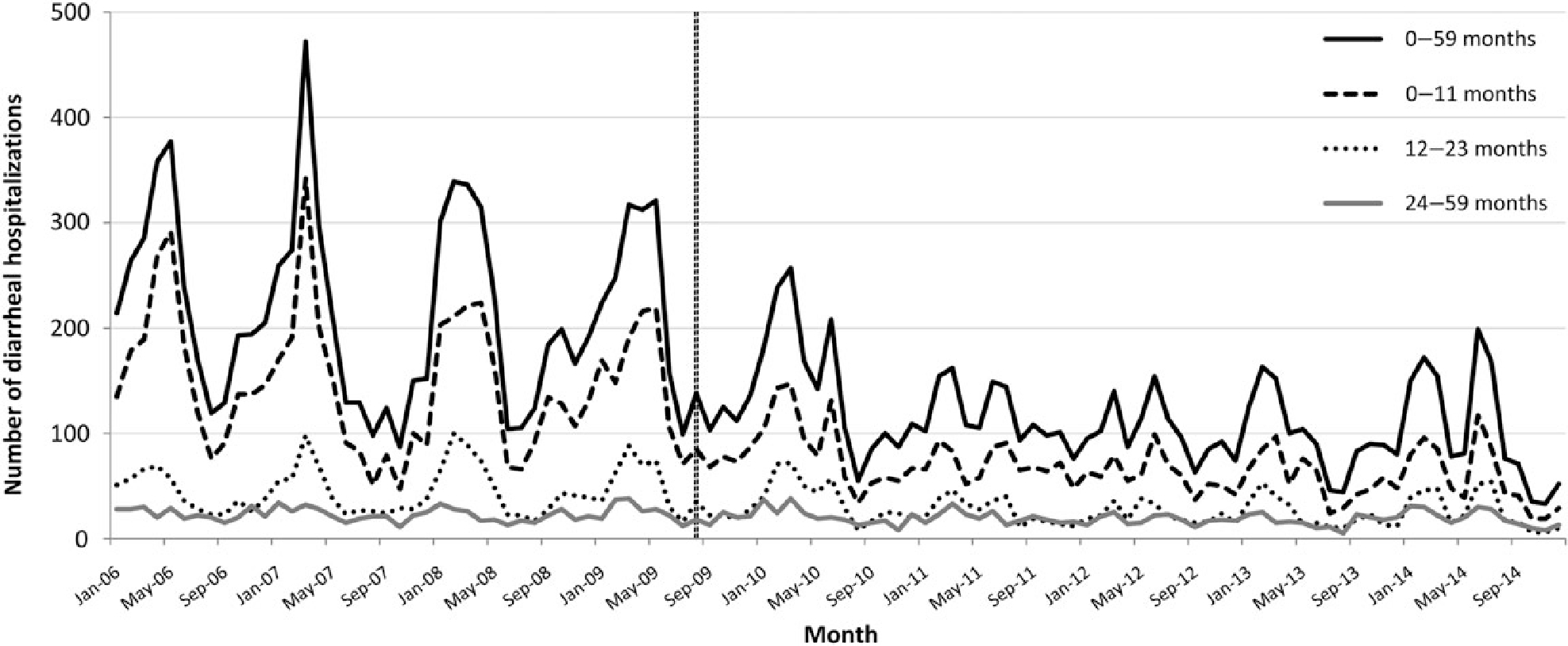
Incidence reductions (per 1000 population) were greatest in children aged <12 months: 54.4 in the prevaccine era vs 30.0, 23.6, 20.0, 18.8, and 18.9 in the postvaccine years 2010-2014, respectively (a 44.9%-65.4% reduction). Lower incidence reductions (39.8%-49.4%) were observed among children aged 12-24 months from the second year post-vaccine introduction onward. Reductions were observed in both HIV-infected and HIV-uninfected children. There was a change in the seasonal pattern of diarrheal hospitalizations post-vaccine introduction, with flattening of the autumn-winter peaks seen in the prevaccine years.
An accelerated and sustained decline in all-cause diarrheal hospitalizations, temporally associated with rotavirus vaccine introduction, was observed in children <2 years of age. However, the impact of other interventions such as improved sanitation and changes in HIV management cannot be discounted.
在人类免疫缺陷病毒(HIV)感染率较高的非洲地区,轮状病毒疫苗对公共卫生的影响尚未明确。我们评估了2009年8月南非国家免疫规划引入轮状病毒疫苗前后,约翰内斯堡索韦托地区全因腹泻住院的趋势。
在克里斯·哈尼·巴拉干纳特学术医院确定2006年1月1日至2014年12月31日期间,年龄小于5岁、诊断为腹泻(根据《国际疾病分类》第十版编码A00 - A05、A06.0 - A06.3、A06.9、A07.0 - A07.2、A07.9以及A08 - A09)的住院儿童。将疫苗接种前(2006 - 2008年)的年住院发病率中位数与疫苗接种时代(2010 - 2014年)进行比较,并按年龄组和HIV感染状况分层。
年龄小于12个月的儿童发病率下降幅度(每1000人口)最大:疫苗接种前时代为54.4,而在2010 - 2014年疫苗接种后的年份分别为30.0、23.6、20.0、18.8和18.9(下降44.9% - 65.4%)。从疫苗引入后的第二年起,12 - 24个月龄儿童的发病率下降幅度较低(39.8% - 49.4%)。HIV感染儿童和未感染儿童的发病率均有所下降。疫苗引入后腹泻住院的季节性模式发生了变化,疫苗接种前年份秋冬季节的高峰趋于平缓。
在2岁以下儿童中观察到全因腹泻住院率加速且持续下降,这在时间上与轮状病毒疫苗的引入相关。然而,其他干预措施(如改善卫生条件和HIV管理的变化)的影响也不容忽视。